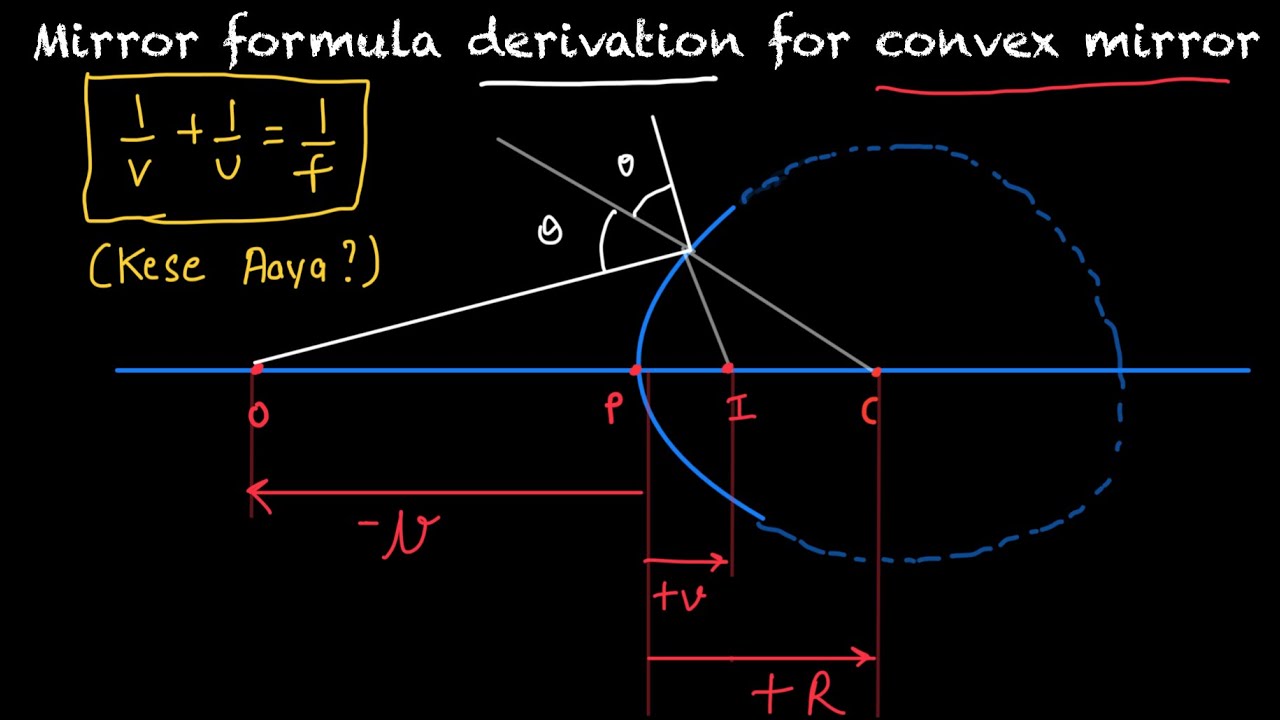
Mirror formula derivation for convex mirror 1/v + 1/u = 1/f . Class 12th physics ray optics jee neet
Автор: Physics by Himanshu Bhaiya
Загружено: 2026-01-10
Просмотров: 0
Class 12 Physics | Ray Optics – Convex Mirror Formula Derivation
In this video, we derive the mirror formula for a convex mirror step-by-step using ray diagrams, geometry, and sign convention. The most important relation in spherical mirror optics is:
\boxed{\frac{1}{v} + \frac{1}{u} = \frac{1}{f}}
This formula is used to find the image distance (v) when an object is placed at a distance u from a convex mirror having focal length f. This derivation is extremely important for Class 12 board exams, JEE Main, JEE Advanced, and NEET.
Most students memorize this formula without understanding where it comes from. In this lecture, we build the formula from scratch using correct ray geometry, normal at point of incidence, and similar triangles so that you truly understand convex mirror optics.
⸻
🔍 What You Will Learn in This Video
This lecture covers everything from basics to exam-level understanding:
• What is a convex mirror
• How convex mirrors form images
• What are pole (P), focus (F), and centre of curvature (C)
• Why F and C lie behind the mirror in convex mirrors
• What is object distance (u)
• What is image distance (v)
• What is focal length (f)
• How sign convention works for convex mirrors
• Ray diagram used in derivation
• How geometry leads to the mirror formula
• Why convex mirror always forms a virtual, erect, and diminished image
⸻
📐 Why This Formula is Important
The mirror formula:
\frac{1}{v} + \frac{1}{u} = \frac{1}{f}
is used in almost every convex mirror question. You will see it in:
• Board exam numericals
• JEE PYQs
• NEET questions
• School tests
Understanding the derivation helps you:
• Use the formula correctly
• Apply sign convention properly
• Avoid silly mistakes
• Visualize ray diagrams better
⸻
🧠 Concept Behind the Derivation
For a convex mirror:
• Object is always in front of the mirror
• Image is always formed behind the mirror
• F and C are always behind the mirror
• Reflected rays diverge
• Image is formed by the extension of reflected rays
In this derivation:
• A ray parallel to the principal axis reflects as if it came from the focus
• A ray directed towards the centre of curvature reflects back along its path
• These rays form similar triangles
• Using geometry, the mirror formula emerges naturally
No memorization. Only physics.
⸻
📚 Chapter Mapping
Class: 12
Subject: Physics
Chapter: Ray Optics and Optical Instruments
Topic: Convex Mirror Formula Derivation
⸻
🎯 Who Should Watch This Video
This video is perfect for:
• Class 12 students
• JEE aspirants
• NEET aspirants
• Students weak in ray optics
• Anyone who wants crystal-clear understanding
⸻
✏️ Key Formulas Used
Mirror formula:
\frac{1}{v} + \frac{1}{u} = \frac{1}{f}
Relation between focal length and radius:
f = \frac{R}{2}
Magnification:
m = \frac{v}{u}
⸻
🧩 Why Convex Mirrors are Important
Convex mirrors are used in:
• Rear-view mirrors
• Security mirrors
• Surveillance systems
They always give:
• Wide field of view
• Virtual images
• Upright images
• Diminished size
Understanding their formula is essential for physics applications.
⸻
🔥 Suggested Next Videos
1. Concave Mirror Formula Derivation
2. Ray Diagrams for Convex Mirror
3. Sign Convention in Ray Optics
4. JEE PYQs on Spherical Mirrors
⸻
💬 Final Message
Ray optics is not about memorizing formulas — it is about understanding light.
This derivation will make you confident in convex mirror questions for boards, JEE, and NEET.
Доступные форматы для скачивания:
Скачать видео mp4
-
Информация по загрузке: