PowerPrompt KYC Reinvented The Battle for Real Identity
Автор: QuantoSei
Загружено: 2026-01-21
Просмотров: 6
Secure your platform today.
Try the Live Demo: https://kyc.quantosei.com/
Contact for Integration: info@quantosei.com
Android App Demo: https://quantosei.com/wp-content/uploads/2...
In the early days of the internet, a password was enough. Today, with the rise of Generative AI, Deepfakes, and sophisticated spoofing attacks, traditional security measures are obsolete.
For Financial Institutions, FinTechs, and Government services, the challenge is no longer just "knowing your customer" (KYC); it is proving that the customer is actually present, alive, and human during the interaction.
This represents the new frontier of EduTech and Cybersecurity: Biometric Liveness Detection paired with AI-driven OCR.
We explore the mechanics behind this technology, how "Touchless" fingerprints are changing the hardware game, and why modern eKYC (Electronic Know Your Customer) is the backbone of the digital economy.
The Problem: Presentation Attacks and Deepfakes
To understand the solution, we must understand the threat. Cybercriminals use Presentation Attacks (PAD) to bypass security. This includes:
Static Spoofing: Holding a photo or a video of a victim in front of a camera.
Deepfakes: Using AI to render a synthetic face that moves and speaks like the victim.
3D Masks: High-fidelity masks designed to trick depth sensors.
A standard selfie upload is no longer secure. Systems need to verify "Liveness"—the biological traits that confirm a user is a living human being, not a digital rendering.
How the Technology Works
1. Active & Passive Liveness Detection
Modern identity systems, such as the architecture found in the Quantosei KYC Platform, utilize a hybrid approach to liveness.
Real-Time Face Tracking: The system creates a 3D face map, tracking micro-movements. It ensures the face is not a flat image.
Blink & Motion Analysis: By prompting users to perform natural actions (like "Blink twice" or "Turn head"), the system validates neurological responses. This is known as Challenge-Response authentication.
AI Deep Learning: Neural networks analyze the video feed pixel-by-pixel to detect artifacts common in deepfakes (such as inconsistent lighting or skin texture anomalies).
2. OCR: The Bridge Between Physical and Digital
Optical Character Recognition (OCR) converts images of text into machine-readable data. In a KYC context, this technology automatically scans passports, driver's licenses, or national IDs.
The Benefit: It eliminates manual entry errors.
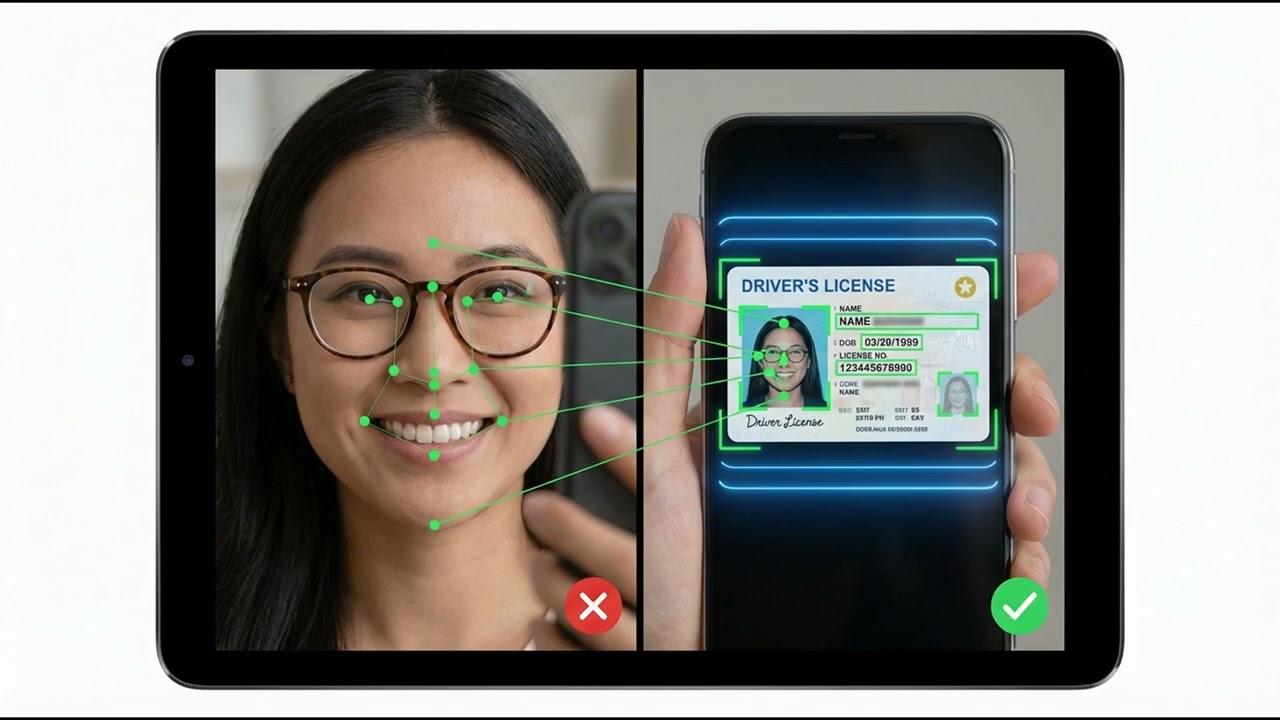
The Security Match: The system extracts the photo from the ID card and uses facial recognition algorithms to compare it against the "Live" face of the user. If the biometric data points don't match, access is denied.
3. The Revolution: Touchless Fingerprint ID (4FingerID™)
Historically, biometric fingerprinting required expensive hardware scanners—a major barrier for mobile banking and remote onboarding.
The latest breakthrough in KYC systems is Touchless Fingerprint Technology. Using the standard high-resolution camera on a smartphone, AI can now capture, process, and verify fingerprints without physical contact.
How it works:
The user holds their hand horizontally in front of the camera.
The AI identifies the four fingers (Index, Middle, Ring, Little).
It enhances the contrast to read the ridges and valleys of the fingerprint.
It converts this visual data into a biometric template for matching.
This democratizes high-security verification, allowing anyone with a smartphone to access bank-grade security features.
The Workflow: What a Secure Onboarding Looks Like
For the end-user, the technology must be invisible and frictionless. A state-of-the-art flow typically takes less than 60 seconds:
Liveness Check: The user centers their face; the AI confirms they are real via blink detection.
ID Capture: The user scans the front and back of their ID card. The system validates the document's authenticity via OCR.
Biometric Matching: The system matches the live face to the ID photo.
Touchless Fingerprint (Optional High-Security Step): The user shows their hand to the camera for multi-factor authentication.
Why Compliance is King (GDPR, AML, CCPA)
Implementing these technologies isn't just about stopping hackers; it's about global compliance.
Automated KYC systems ensure that businesses meet Anti-Money Laundering (AML) regulations by screening users against global watchlists instantly. Furthermore, privacy-focused platforms ensure that this sensitive biometric data is encrypted, adhering to GDPR (General Data Protection Regulation) standards to protect user privacy.
For organizations looking to deploy this level of security, the technology is no longer theoretical—it is available now.
Experience the Future of Identity
If you are interested in seeing how AI-Powered Liveness Detection and Touchless Fingerprinting work in a live environment, Quantosei offers a comprehensive demonstration of this next-gen capability.
Доступные форматы для скачивания:
Скачать видео mp4
-
Информация по загрузке: