How to Readline with Python's Subprocess Module Without Closing Stdin
Автор: vlogize
Загружено: 2025-09-30
Просмотров: 1
Learn how to effectively use the `subprocess` module in Python to read lines from the output without closing stdin, ensuring smooth data handling.
---
This video is based on the question https://stackoverflow.com/q/63771730/ asked by the user 'Kaia' ( https://stackoverflow.com/u/1275942/ ) and on the answer https://stackoverflow.com/a/63771857/ provided by the user 'alani' ( https://stackoverflow.com/u/13596037/ ) at 'Stack Overflow' website. Thanks to these great users and Stackexchange community for their contributions.
Visit these links for original content and any more details, such as alternate solutions, latest updates/developments on topic, comments, revision history etc. For example, the original title of the Question was: Python subprocess Popen readline before closing stdin
Also, Content (except music) licensed under CC BY-SA https://meta.stackexchange.com/help/l...
The original Question post is licensed under the 'CC BY-SA 4.0' ( https://creativecommons.org/licenses/... ) license, and the original Answer post is licensed under the 'CC BY-SA 4.0' ( https://creativecommons.org/licenses/... ) license.
If anything seems off to you, please feel free to write me at vlogize [AT] gmail [DOT] com.
---
How to Readline with Python's Subprocess Module Without Closing Stdin
In Python programming, there are numerous scenarios where you might need to interact with external processes. One common need is reading output from a subprocess while still sending input to it. However, this can sometimes lead to challenges, especially regarding stream buffering and how data flows between your program and the subprocess.
The Challenge
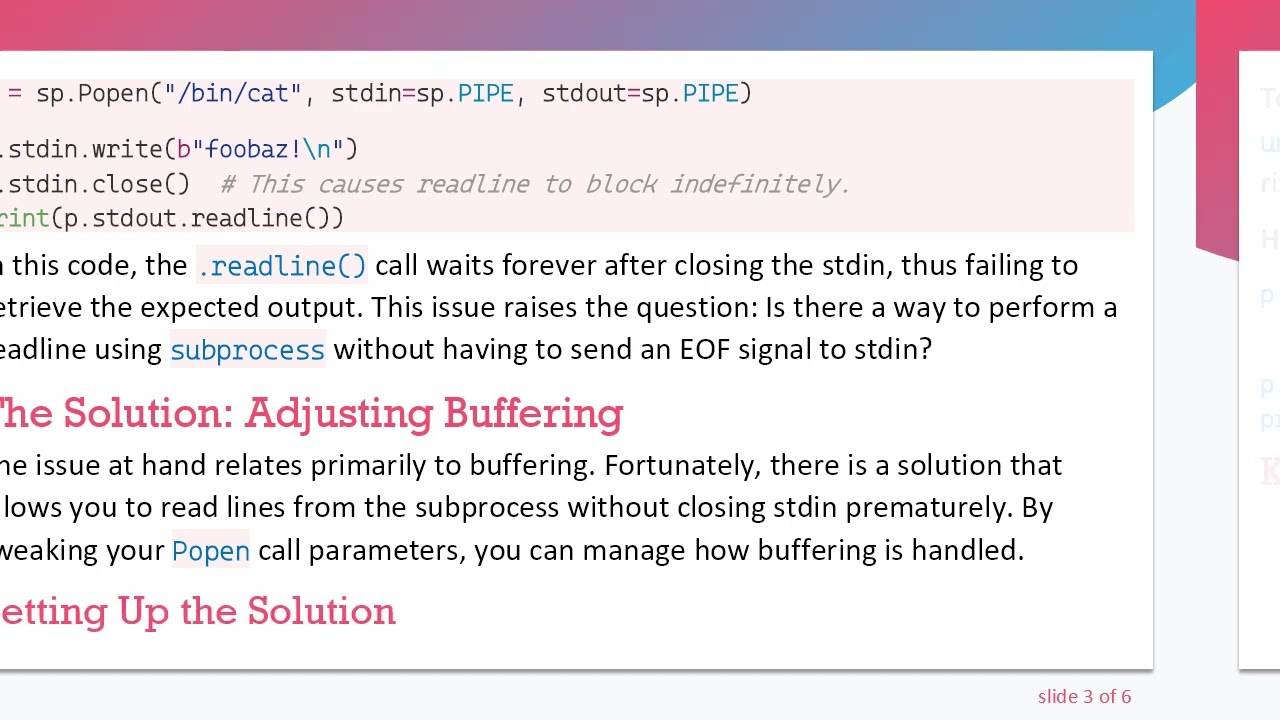
When using the subprocess module, many developers encounter a common issue: trying to read from the output of a subprocess while closing the input stream leads to unexpected blocking behavior. The specific concern here is that, if you close the stdin stream before trying to read from stdout, your program may hang indefinitely. This is evident in the following code setup:
[[See Video to Reveal this Text or Code Snippet]]
In this code, the .readline() call waits forever after closing the stdin, thus failing to retrieve the expected output. This issue raises the question: Is there a way to perform a readline using subprocess without having to send an EOF signal to stdin?
The Solution: Adjusting Buffering
The issue at hand relates primarily to buffering. Fortunately, there is a solution that allows you to read lines from the subprocess without closing stdin prematurely. By tweaking your Popen call parameters, you can manage how buffering is handled.
Setting Up the Solution
To resolve the problem, you can use bufsize=1 combined with universal_newlines=True. This ensures that the output is processed correctly without risking inadvertent blocking.
Here's how to modify your original code:
[[See Video to Reveal this Text or Code Snippet]]
Key Parameters Explained
bufsize=1: This sets the buffer size to line-buffered mode. This means that the buffering strategy will flush output on newlines, making output responses more immediate and responsive.
universal_newlines=True: This allows the output and input to be treated as text streams rather than binary, enabling the handling of string data instead of bytes. Note that in some recent Python versions, you might find text=True as an equivalent setting.
Version Note
It's important to note that the above solution has been tested with Python 3.5.2. If you're using a more recent version, you might experience slight variations in behavior, so always refer to the relevant Python documentation for your version.
Conclusion
With these adjustments to your subprocess setup, you can now effectively manage input and output streams without unnecessary blocking. This method not only clarifies how to interact with the subprocess module but also offers insight into managing external processes within your Python applications efficiently.
Exploring additional libraries might help in specific scenarios, but for basic subprocess interactions, the strategies discussed will serve you well. Whether you're building scripts to automate tasks or developing complex applications, mastering these nuances is essential for seamless data handling in Python.
Доступные форматы для скачивания:
Скачать видео mp4
-
Информация по загрузке:

![Курс Python с Абсолютного нуля! [12 часов из 80] Python курс - качественный старт для начинающих!](https://image.4k-video.ru/id-video/lYMLLI-MJek)