How to Avoid Writing Duplicate Lines to a File in Java
Автор: vlogize
Загружено: 2025-10-06
Просмотров: 5
Learn how to efficiently prevent writing duplicate lines to a file in Java, enhancing data integrity and file management.
---
This video is based on the question https://stackoverflow.com/q/63980941/ asked by the user 'Eric Bush' ( https://stackoverflow.com/u/11750803/ ) and on the answer https://stackoverflow.com/a/63981027/ provided by the user 'rzwitserloot' ( https://stackoverflow.com/u/768644/ ) at 'Stack Overflow' website. Thanks to these great users and Stackexchange community for their contributions.
Visit these links for original content and any more details, such as alternate solutions, latest updates/developments on topic, comments, revision history etc. For example, the original title of the Question was: Is there a way to avoid writing duplicate lines to a file in Java?
Also, Content (except music) licensed under CC BY-SA https://meta.stackexchange.com/help/l...
The original Question post is licensed under the 'CC BY-SA 4.0' ( https://creativecommons.org/licenses/... ) license, and the original Answer post is licensed under the 'CC BY-SA 4.0' ( https://creativecommons.org/licenses/... ) license.
If anything seems off to you, please feel free to write me at vlogize [AT] gmail [DOT] com.
---
How to Avoid Writing Duplicate Lines to a File in Java
When working with file writing in Java, especially in scenarios where methods are called frequently, you may encounter the frustrating problem of generating duplicate lines in your text file. This can happen when data changes infrequently, causing repetitive writes to occur. Fortunately, there are effective strategies to prevent duplicate lines from being written in the first place.
Understanding the Problem
Imagine you have a code base where a method responsible for writing data to a file is triggered repeatedly, even if the data does not change each time. This can lead to an overflow of redundant information in your file, making it less readable and manageable.
Example Scenario
Consider the following method in your Java application:
[[See Video to Reveal this Text or Code Snippet]]
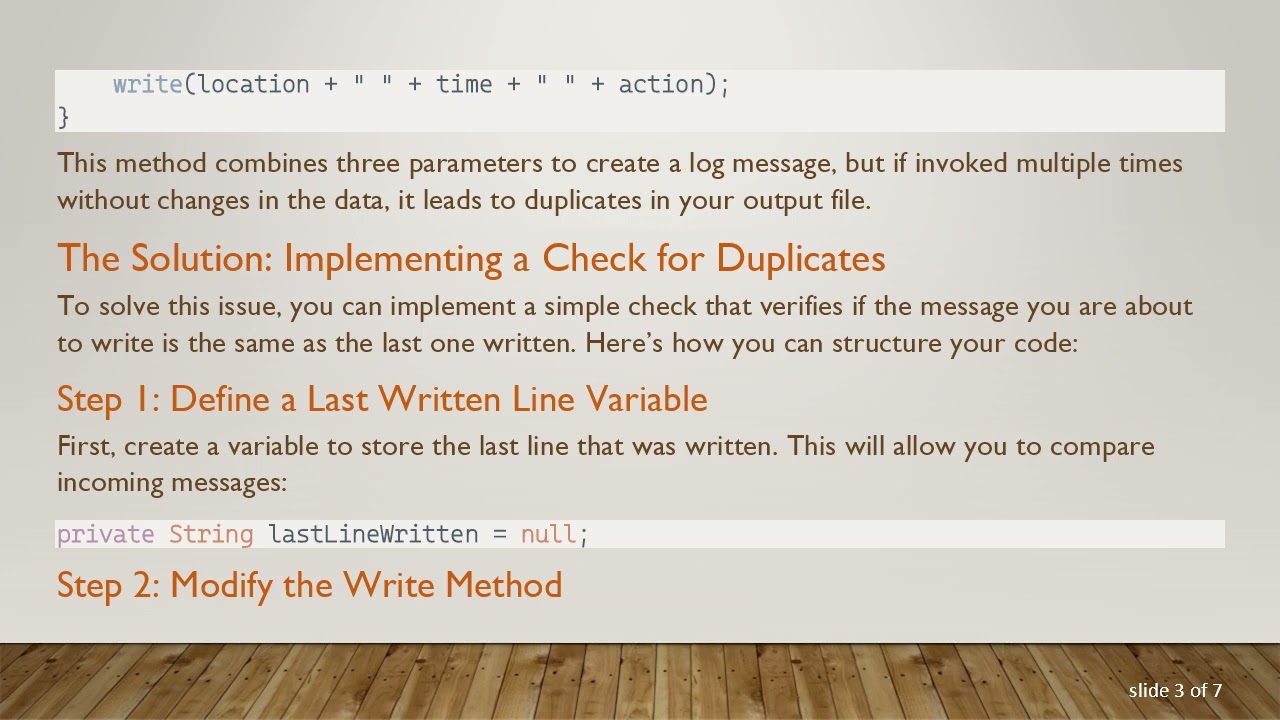
This method combines three parameters to create a log message, but if invoked multiple times without changes in the data, it leads to duplicates in your output file.
The Solution: Implementing a Check for Duplicates
To solve this issue, you can implement a simple check that verifies if the message you are about to write is the same as the last one written. Here’s how you can structure your code:
Step 1: Define a Last Written Line Variable
First, create a variable to store the last line that was written. This will allow you to compare incoming messages:
[[See Video to Reveal this Text or Code Snippet]]
Step 2: Modify the Write Method
Next, integrate a condition within your method that writes lines to the file. Inside this method, check if the current line is the same as the last one. If so, skip the writing process:
[[See Video to Reveal this Text or Code Snippet]]
Step 3: Update Your Receive Message Method
Finally, update the method that triggers the writing operation to call the newly improved writing method only when necessary:
[[See Video to Reveal this Text or Code Snippet]]
Important Considerations
Thread Safety: If your application involves multithreading (multiple threads calling the write method), ensure you handle synchronization appropriately. This can help prevent situations where multiple threads might cause the same line to be written multiple times, leading to corrupted file contents. You might need to mark your write method as synchronized:
[[See Video to Reveal this Text or Code Snippet]]
null Checks: Always include null checks for your string inputs to avoid NullPointerExceptions.
Conclusion
By implementing a simple check for duplicates before writing to a file in Java, you can significantly improve the integrity of your data and enhance file management. This straightforward method not only makes your logs clearer but also reduces the need for post-process cleaning.
Now you’re equipped with the necessary techniques to keep your data management clean and effective. Happy coding!
Доступные форматы для скачивания:
Скачать видео mp4
-
Информация по загрузке:


![Python - Полный Курс по Python [15 ЧАСОВ]](https://image.4k-video.ru/id-video/cfJrtx-k96U)


![HTML - Полный Курс HTML Для Начинающих [3 ЧАСА]](https://image.4k-video.ru/id-video/W4MIiV4nZDY)
