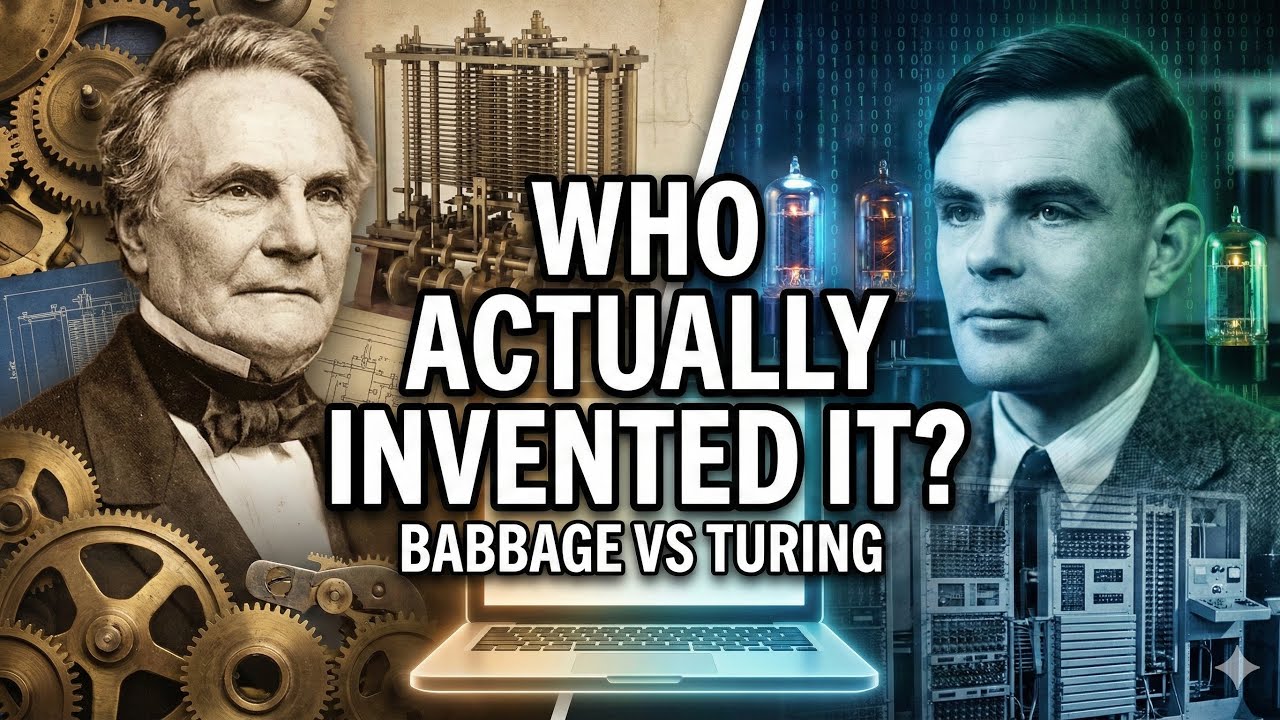
Who Actually Invented the Computer? Babbage vs Turing
Автор: Next Gen Choices
Загружено: 2026-01-18
Просмотров: 88
This video presents a detailed critique and analysis of a scholarly argument regarding the invention of the computer. The discussion focuses on a "dual parentage" theory, suggesting that the modern computer is a fusion of Charles Babbage’s physical architecture and Alan Turing’s universal logic. The speakers propose narrative improvements to the original text, such as better integrating early 1940s machines like the Z3 and ABC as evidence of these legacies rather than just chronological footnotes. It also suggests drawing stronger technical parallels between Babbage’s mechanical components and later electronic systems, and using the 1973 patent trial as a dramatic climax to highlight the theme of forgotten or suppressed historical breakthroughs.
Key Moments & Timestamps
00:00 Introduction to the analysis: Framing the invention of the computer through the legacies of Babbage and Turing versus the machines of the 1940s.
00:44 Discussion of the central claim: The modern computer as a fusion of Babbage's architecture and Turing's logic.
01:37 First suggestion for improvement: Reorienting the middle section to use 1940s machines (like the Z3 and ABC) as proof points for the dual legacy rather than a simple checklist of "firsts."
02:02 Analyzing the Z3: Using Konrad Zuse's work to validate the universality of Turing's binary logic model.
03:00 Analyzing the ABC (Atanasoff–Berry Computer): Positioning it as the electronic fulfillment of Babbage's specific, application-driven philosophy.
04:15 Second suggestion: Strengthening the synthesis by explicitly mapping Babbage’s mechanical architecture (the Store and the Mill) onto early electronic machines.
05:08 Comparison of Memory: contrasting Babbage’s mechanical "Store" (approx. 16kb) with electronic solutions like the ABC’s capacitors or Mercury delay lines.
06:46 Comparison of Processing: Paralleling Babbage’s "Mill" and its rotating barrels to the relay logic and vacuum tube circuitry of the 1940s.
07:58 Third suggestion: Using the 1973 Honeywell v. Sperry Rand patent trial as a narrative climax to resolve the theme of forgotten histories and secrecy.
09:36 Turing’s Struggle: Discussing how the secrecy around Colossus hampered Turing’s ability to sell his ACE computer design.
10:53 Summary of the three recommended improvements: Clarifying the genealogy, creating structural synthesis, and leveraging the legal trial as a climax. 🔔 🔥 Subscribe to NextGen Choices — because the future doesn’t reward the strongest or the smartest… it rewards those who choose to keep going.
If this story moved you, share it with someone who needs strength today — and ask yourself: what choice will you make next?
#historyofcomputing #charlesbabbage #alanturing #computerhistory #konradzuse #atanasoffberrycomputer #eniac #colossus #techhistory #computerscience #technology #innovation #retrocomputing #digitalrevolution #engineering #mathhistory #turingmachine #analyticalengine #z3computer #1940stech
Доступные форматы для скачивания:
Скачать видео mp4
-
Информация по загрузке: