Mastering Hierarchical Sorting of Tables in R
Автор: vlogize
Загружено: 2025-09-30
Просмотров: 0
Discover how to perform `hierarchical sorting` of a table in R using ordered factors. Learn step-by-step methods for achieving your data analysis goals.
---
This video is based on the question https://stackoverflow.com/q/63780493/ asked by the user 'tacrolimus' ( https://stackoverflow.com/u/12291701/ ) and on the answer https://stackoverflow.com/a/63780831/ provided by the user 'Allan Cameron' ( https://stackoverflow.com/u/12500315/ ) at 'Stack Overflow' website. Thanks to these great users and Stackexchange community for their contributions.
Visit these links for original content and any more details, such as alternate solutions, latest updates/developments on topic, comments, revision history etc. For example, the original title of the Question was: Hierarchical sorting of a table in R
Also, Content (except music) licensed under CC BY-SA https://meta.stackexchange.com/help/l...
The original Question post is licensed under the 'CC BY-SA 4.0' ( https://creativecommons.org/licenses/... ) license, and the original Answer post is licensed under the 'CC BY-SA 4.0' ( https://creativecommons.org/licenses/... ) license.
If anything seems off to you, please feel free to write me at vlogize [AT] gmail [DOT] com.
---
Mastering Hierarchical Sorting of Tables in R: A Simple Guide
When working with data tables in R, you might encounter situations where you need to sort or subset data based on specific criteria. One common challenge is hierarchical sorting, especially when dealing with categorical data like genetic information. For instance, you might need to extract the most significant consequence of genetic variants from a dataset where multiple consequences exist per ID. In this post, we'll walk through an example to demonstrate how to effectively perform hierarchical sorting using base R.
The Problem Explained
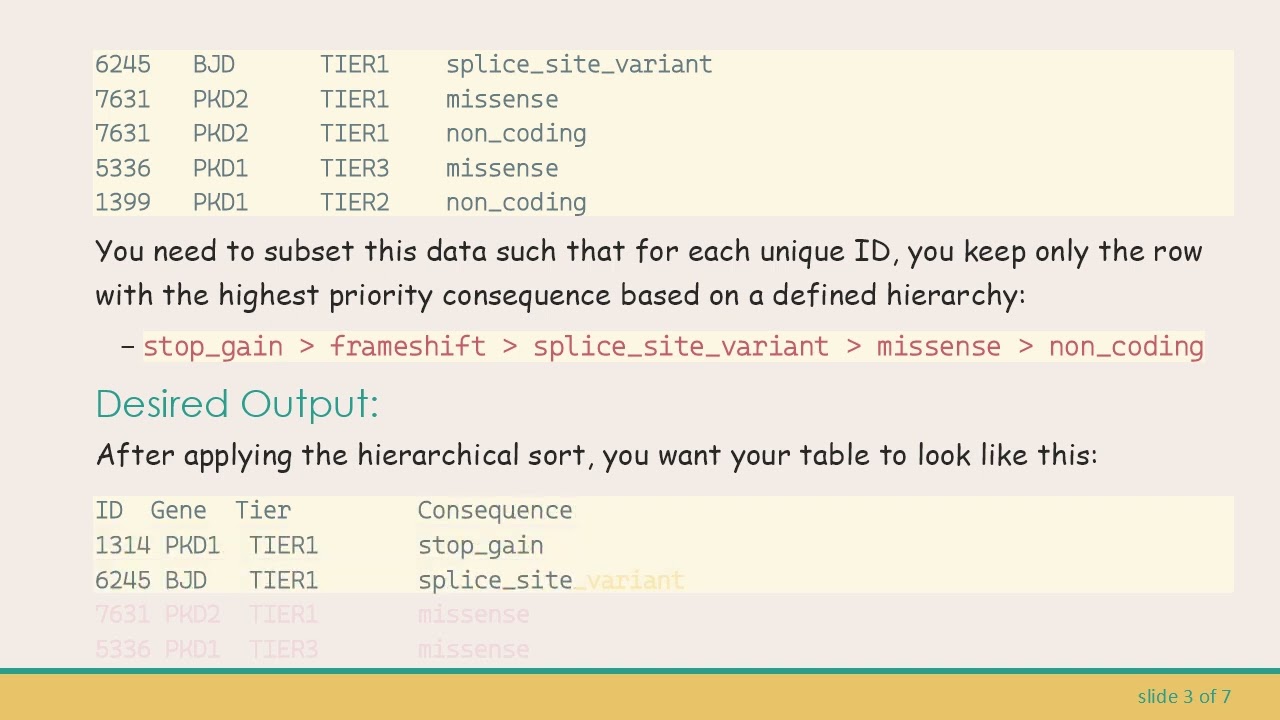
Consider a dataset that contains genetic variant information, structured as follows:
[[See Video to Reveal this Text or Code Snippet]]
You need to subset this data such that for each unique ID, you keep only the row with the highest priority consequence based on a defined hierarchy:
stop_gain > frameshift > splice_site_variant > missense > non_coding
Desired Output:
After applying the hierarchical sort, you want your table to look like this:
[[See Video to Reveal this Text or Code Snippet]]
The Solution
To achieve this in R while keeping it simple and using base R functions, follow these steps:
1. Convert Consequence to an Ordered Factor
The first step is to convert the Consequence column into an ordered factor. This way, R understands the hierarchy you establish.
[[See Video to Reveal this Text or Code Snippet]]
2. Grouping and Extracting Maximum Consequences
Next, you can create a grouping operation that splits the data by ID. The goal here is to apply a function that will select the row with the highest Consequence for each group. Using split-apply-bind methodology, you can do this efficiently:
[[See Video to Reveal this Text or Code Snippet]]
Explanation:
split(df, df$ID): This splits the dataframe into a list of dataframes, one for each unique ID.
lapply(): Applies a function to each split dataframe.
which.max(x$Consequence): Finds the index of the maximum consequence based on the ordered factor.
do.call(rbind, ...): Combines the resulting dataframes back into a single dataframe.
Final Output
After executing the above commands, you should see an output focused solely on the highest-ranked consequences for each ID. The process is efficient and leverages the power of base R without requiring additional packages, making it suitable for high-performance computing environments.
Conclusion
Through this simple guide, you have learned how to perform hierarchical sorting of tables in R using ordered factors and basic data manipulation functions. This method is not only effective but also easy to implement in situations where data integrity and analysis efficiency are paramount.
Now, with this understanding, you can confidently handle hierarchical sorting tasks in your data analysis projects. Happy coding!
Доступные форматы для скачивания:
Скачать видео mp4
-
Информация по загрузке: