Magnetic Field and Magnetic Force
Автор: Mostly Physics
Загружено: 2023-09-17
Просмотров: 1874
Here we cover magnetic field and magnetic force.
0:11 - Permanent Bar Magnetics
1:31 - Magnetic Field of a Bar Magnet
2:10 - No Magnetic Monopoles
2:57 - Splitting a Bar Magnet
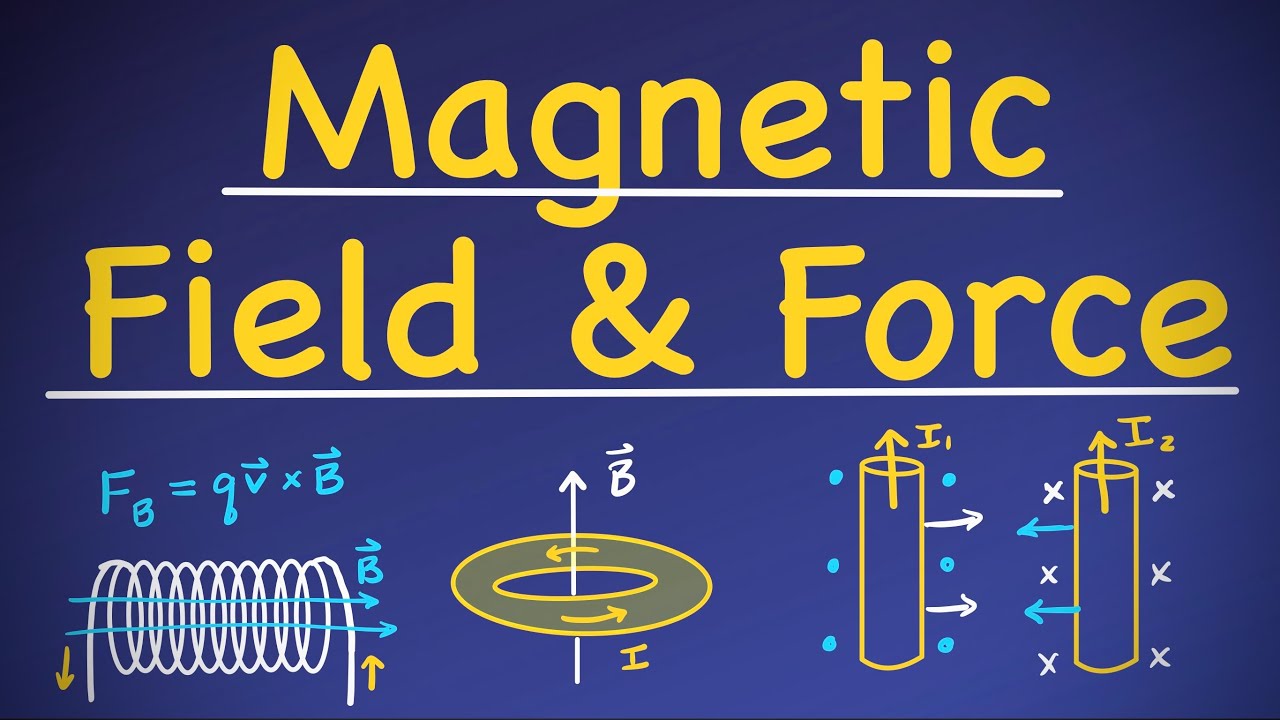
3:11 - Magnetic Field of Current Carrying Wire
4:11 - Indicating Direction in 3D
5:48 - Sources of Magnetic Fields
7:03 - Biot-Savart Law - Magnetic Field of a Moving Charge
7:52 - RHR for Field of a Moving Charge
8:55 - Fields of Important Current Configurations
10:00 - Current Loop as a Magnetic Dipole
10:30 - Magnetic Moment and Field of a Dipole
11:02 - Gauss's Law and Ampere's Law
11:49 - Magnetic Force on a Moving Charge
13:11 - Cyclotron Motion
14:25 - Velocity Selector
16:46 - Force on Current Carrying Wire
18:13 - Force Between Parallel Current Carrying Wires
19:56 - Torque on a Current Loop
21:33 - Electric Motors
We begin by observing magnetism in the permanent bar magnets and the behavior of two magnets brought near each other in different orientations. We say magnets have two poles, a north pole and a south pole. Similar to electric charge, opposite magnetic poles attract each other, and like poles repel each other.
These attractive and repulsive forces are also acting at a distance, so we say a magnet produces a magnetic field that interacts with other magnets. These magnetic field lines come out of North poles and into South poles forming loops. We do not draw these field lines as beginning and ending on either pole. This is for good reason.
Unlike in electricity, we do not get single isolated north poles or isolated south poles. In other words, there are no magnetic monopoles. This is why we draw magnetic field lines in loops. If we do try to isolate poles by splitting a bar magnet, we just end up getting two smaller versions of the larger magnet with each having a north and south pole.
We also see magnetic behavior in a current carrying wire. A wire will deflect compass needles, showing a magnetic field forming a circle around a current carrying wire. It turns out these sources of magnetic fields are the same. Permanent magnets are formed by small current loops of electrons moving at the atomic level. These small current loops form magnetic fields that all add together to give a net magnetic field in some direction.
The field of a moving charge is found using the Biot-Savart law. Since we are usually interested with many charges moving through a conductor, we can integrate and use the Biot-Savart law to get the magnetic field of a current carrying wire. The direction of this field is given by the Right-Hand-Rule or RHR.
Rather than doing these integrals to get the magnetic field of wires in different configurations, we just look at the results. We focus on the field of an infinite straight wire, a coil of N loops, and a long coil called a solenoid. And if we focus on a current loop, the field looks just like the field of a bar magnet. So a current loop behaves like a magnetic dipole, which it should since it a bar magnet is made of many small current loops.
If we look at the field far from a current loop, we can use an approximation where we can write the field in terms of the area of the loop and current in the wire. Then we define the area times the current as the magnetic moment of the current loop.
Like Gauss's law can be found for an electric field, we can use what's called Ampere's law to a find a magnetic field.
A charge in a magnetic field feels no force. If it moves parallel to the field it still feels no force. But when the charge moves perpendicular to the field, there will be a force. This force will be maximum when the velocity is perpendicular to the field. This force is perpendicular to both the field and the velocity.
Because this force is perpendicular to the velocity, it will cause the charge to move around in a circle. This circular motion is called cyclotron motion.
If we look at a charge moving in both an electric field and magnetic field that are both perpendicular to the velocity of the charge. We can choose the directions such that the electric force and magnetic force are in opposite directions. Because the magnetic force depends on the speed of the charge, the relative size of these forces will depend on the speed.
A slow charge will feel a larger electric force while a faster charge may feel a larger magnetic force. At the right speed, the forces will cancel, and a charge will pass right through. We call this device a velocity selector.
We can also find the force on a current carrying wire is similar to the force on a charge. And since wires create magnetic fields, two current carrying wires will exert forces on one another. Wires with current in the same direction will attract, while wires with current in opposite directions will repel.
A current loop will feel a force and a torque when its face is not aligned with the magnetic field. This cause it to turn and allows us to make an electric motor, that uses electrical energy to do work.
Доступные форматы для скачивания:
Скачать видео mp4
-
Информация по загрузке:


![Forces and Newton's Laws of Motion [Overview]](https://imager.clipsaver.ru/_BC-PfpyExo/max.jpg)
![Векторы для физики [Полное введение]](https://imager.clipsaver.ru/EOGAIoDJrsM/max.jpg)