How to Properly Handle organization_id in PostgreSQL's json_to_set Function
Автор: vlogize
Загружено: 2025-10-09
Просмотров: 0
Learn how to handle empty strings when processing JSON with PostgreSQL's json_to_set function and avoid common errors.
---
This video is based on the question https://stackoverflow.com/q/64714733/ asked by the user 'Ankush Verma' ( https://stackoverflow.com/u/11751174/ ) and on the answer https://stackoverflow.com/a/64714788/ provided by the user 'Laurenz Albe' ( https://stackoverflow.com/u/6464308/ ) at 'Stack Overflow' website. Thanks to these great users and Stackexchange community for their contributions.
Visit these links for original content and any more details, such as alternate solutions, latest updates/developments on topic, comments, revision history etc. For example, the original title of the Question was: Adding a check in arguments json_to_set in postgres
Also, Content (except music) licensed under CC BY-SA https://meta.stackexchange.com/help/l...
The original Question post is licensed under the 'CC BY-SA 4.0' ( https://creativecommons.org/licenses/... ) license, and the original Answer post is licensed under the 'CC BY-SA 4.0' ( https://creativecommons.org/licenses/... ) license.
If anything seems off to you, please feel free to write me at vlogize [AT] gmail [DOT] com.
---
How to Properly Handle organization_id in PostgreSQL's json_to_set Function
When working with JSON data in PostgreSQL, developers often encounter challenges when processing or manipulating the data. One common issue arises when handling empty strings in JSON fields, specifically when the field is expected to be a numeric type. In this guide, we will address a specific problem related to using json_to_recordset and ensure that the organization_id is set to NULL instead of an empty string.
The Problem
Suppose you have a JSON structure that contains a list of users, and you need to extract their details into a temporary table in PostgreSQL. One of the fields, organization_id, should be a numeric type (bigint), but sometimes it can be represented as an empty string in the JSON input. If you try to insert an empty string into a bigint column, PostgreSQL will throw an error, as it expects valid numeric types.
In your case, the initial query looks like this:
[[See Video to Reveal this Text or Code Snippet]]
However, this approach leads to an error due to the attempt to cast an empty string to bigint, which results in:
[[See Video to Reveal this Text or Code Snippet]]
The Goal
Our goal is to modify the query so that when organization_id is an empty string, we replace it with NULL instead. This will allow the insert operation to succeed without errors.
The Solution
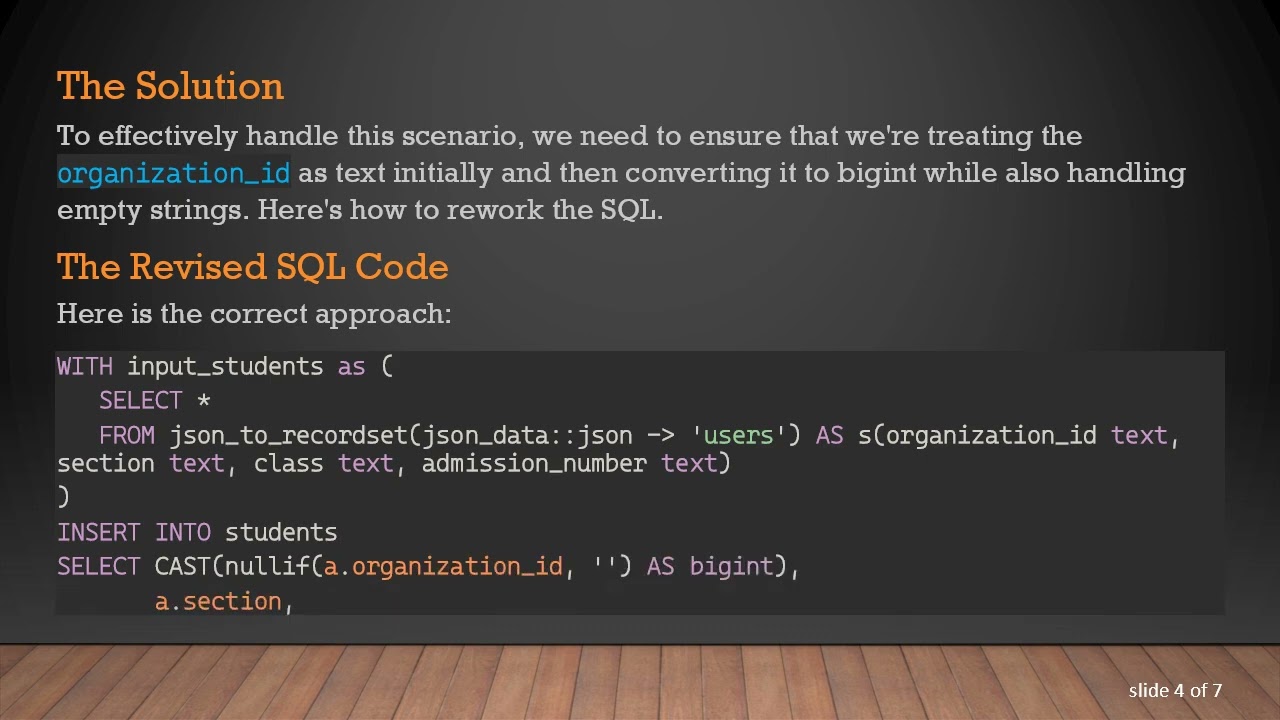
To effectively handle this scenario, we need to ensure that we're treating the organization_id as text initially and then converting it to bigint while also handling empty strings. Here's how to rework the SQL.
The Revised SQL Code
Here is the correct approach:
[[See Video to Reveal this Text or Code Snippet]]
Key Changes Explained
Change in the json_to_recordset Type Declaration:
Instead of declaring organization_id as bigint, declare it as text. This allows us to safely retrieve the value even if it is an empty string.
Use nullif Function:
The nullif function is used to convert the empty string into NULL. If a.organization_id is equal to '', it will return NULL, otherwise, it will return the value of organization_id.
Casting After nullif:
After using nullif, we then cast the result to bigint. This ensures that if organization_id is NULL, it will remain NULL, and if it is a valid string representation of a number, it will be converted to bigint.
With this revised code, you can now cleanly handle the organization_id field, avoiding the syntax errors and achieving your desired outcome.
Conclusion
When working with JSON data in PostgreSQL, it’s essential to manage data types carefully to prevent errors during insertion or manipulation. Always remember to handle potential empty strings before casting, especially when dealing with numeric fields. By following the solutions outlined above, you can ensure smoother operations when processing JSON records in your PostgreSQL databases.
Feel free to reach out if you have any questions or need further clarification on handling JSON data in PostgreSQL!
Доступные форматы для скачивания:
Скачать видео mp4
-
Информация по загрузке: