Create an Automated Countdown Timer from a Text File with Python
Автор: vlogize
Загружено: 2025-09-23
Просмотров: 0
Learn how to read times from a .txt file and countdown to each event using Python, perfect for integrations with Raspberry Pi and LED boards.
---
This video is based on the question https://stackoverflow.com/q/63560394/ asked by the user 'dandspach' ( https://stackoverflow.com/u/14154288/ ) and on the answer https://stackoverflow.com/a/63560784/ provided by the user 'dh762' ( https://stackoverflow.com/u/1344855/ ) at 'Stack Overflow' website. Thanks to these great users and Stackexchange community for their contributions.
Visit these links for original content and any more details, such as alternate solutions, latest updates/developments on topic, comments, revision history etc. For example, the original title of the Question was: Read time(s) from .txt file, then countdown to that time
Also, Content (except music) licensed under CC BY-SA https://meta.stackexchange.com/help/l...
The original Question post is licensed under the 'CC BY-SA 4.0' ( https://creativecommons.org/licenses/... ) license, and the original Answer post is licensed under the 'CC BY-SA 4.0' ( https://creativecommons.org/licenses/... ) license.
If anything seems off to you, please feel free to write me at vlogize [AT] gmail [DOT] com.
---
Create an Automated Countdown Timer from a Text File with Python
If you're working with time-sensitive events and want to automate reminders, creating a countdown timer in Python can be an excellent solution. This guide will guide you through the process of reading times from a .txt file and counting down to those times effectively. Whether you're developing a project with a Raspberry Pi or just want to keep track of upcoming events, this method can help streamline your approach.
Understanding the Problem
You have a text file, sorted_passes.txt, that contains a series of events with timestamps. Your goal is to set up a countdown timer that notifies you of each event as the time approaches. Here's an example of what the contents of your file might look like:
[[See Video to Reveal this Text or Code Snippet]]
You essentially have two options for the countdown functionality:
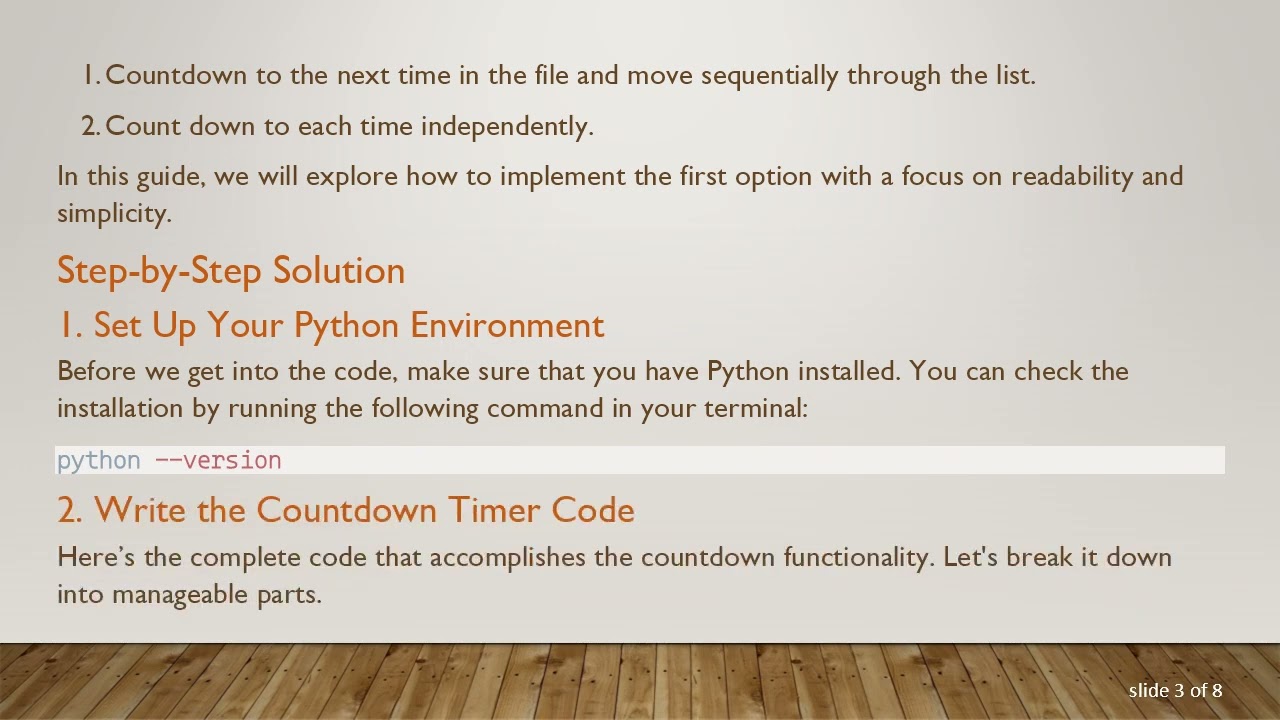
Countdown to the next time in the file and move sequentially through the list.
Count down to each time independently.
In this post, we will explore how to implement the first option with a focus on readability and simplicity.
Step-by-Step Solution
1. Set Up Your Python Environment
Before we get into the code, make sure that you have Python installed. You can check the installation by running the following command in your terminal:
[[See Video to Reveal this Text or Code Snippet]]
2. Write the Countdown Timer Code
Here’s the complete code that accomplishes the countdown functionality. Let's break it down into manageable parts.
[[See Video to Reveal this Text or Code Snippet]]
3. Code Explanation
Compare Function: This function checks whether the current time is before the event time and calculates the difference, printing the countdown.
Extract Timestamp Function: This function extracts the date and time from each line in the format specified, converting it into a datetime object.
Open File Function: Opens the sorted_passes.txt file and reads all lines into a list.
Main Loop: Iterates through each timestamp, calling the compare() function to count down and print the time difference. The loop continues until each timestamp is processed.
4. Run the Program
To run your countdown timer, save your code in a Python file, say countdown_timer.py, and execute it using:
[[See Video to Reveal this Text or Code Snippet]]
5. Example Output
Once the countdown begins, your output will look something like this:
[[See Video to Reveal this Text or Code Snippet]]
Final Thoughts
By following these steps, you've created a functioning countdown timer that can notify you of events listed in a text file. This can be especially useful for time-sensitive tasks related to Raspberry Pi projects or other automated systems. Make sure that the timestamps in your file are in chronological order for everything to work correctly.
Now, you can also expand upon this base solution by adding features, such as integrating a MAX7219 LED display to visually show the countdown.
Happy coding, and may your projects run smoothly!
Доступные форматы для скачивания:
Скачать видео mp4
-
Информация по загрузке:


![Python - Полный Курс по Python [15 ЧАСОВ]](https://image.4k-video.ru/id-video/cfJrtx-k96U)