Cardiac Anatomy, Human Anatomy, USMLE Step 1 - Full Vignette with Extended Explanations
Автор: EndlessMedical.Academy
Загружено: 2026-01-04
Просмотров: 14
A 22-year-old male collegiate runner presents with exertional chest pressure and near-syncope during intense sprinting, despite normal cardiac and pulmonary exams and negative standard cardiac workup. His only notable finding is an anomalous coronary artery on imaging. How should clinicians approach exertional symptoms in young, otherwise healthy athletes with abnormal coronary anatomy on cardiac imaging? What clinical factors should prompt further evaluation or concern in this population?
VIDEO INFO
Category: Cardiac Anatomy, Human Anatomy, USMLE Step 1
Difficulty: Hard - Advanced level - Challenges experienced practitioners
Question Type: Epidemiology
Case Type: Rare Presentation
Explore more ways to learn on this and other topics by going to https://endlessmedical.academy/auth?h...
QUESTION
A 22-year-old male college runner is evaluated for exertional chest pressure and two brief presyncope episodes during all-out sprint drills. He has no family history of sudden death, denies stimulant pills, and drinks one energy drink on practice days. He has not used illicit drugs since high school. He reports occasional heartburn and well-controlled childhood asthma. Social history includes a summer shipyard job with dust exposure and moderate alcohol use (about one drink daily)....
OPTIONS
A. In modern coronary CT angiography cohorts, right AAOCA with interarterial course is found in roughly 0.2-0.5% of studies, and in incidentally detected middle-aged adults the sudden-death risk appears very low; major adverse events relate more to coexisting atherosclerosis than to the anomaly itself.
B. Prevalence is approximately 1-2% on CT angiography, and even incidentally detected adults face a high sudden-death risk that generally warrants prophylactic surgical repair regardless of ischemia.
C. This anomaly is exceedingly rare in adults ( less than 0.05%), and adult detection implies a uniformly malignant course with high sudden-death risk independent of symptoms or testing.
D. AAOCA accounts for the majority of sudden deaths in young athletes, clearly exceeding hypertrophic cardiomyopathy, and most events happen at rest rather than exertion.
CORRECT ANSWER
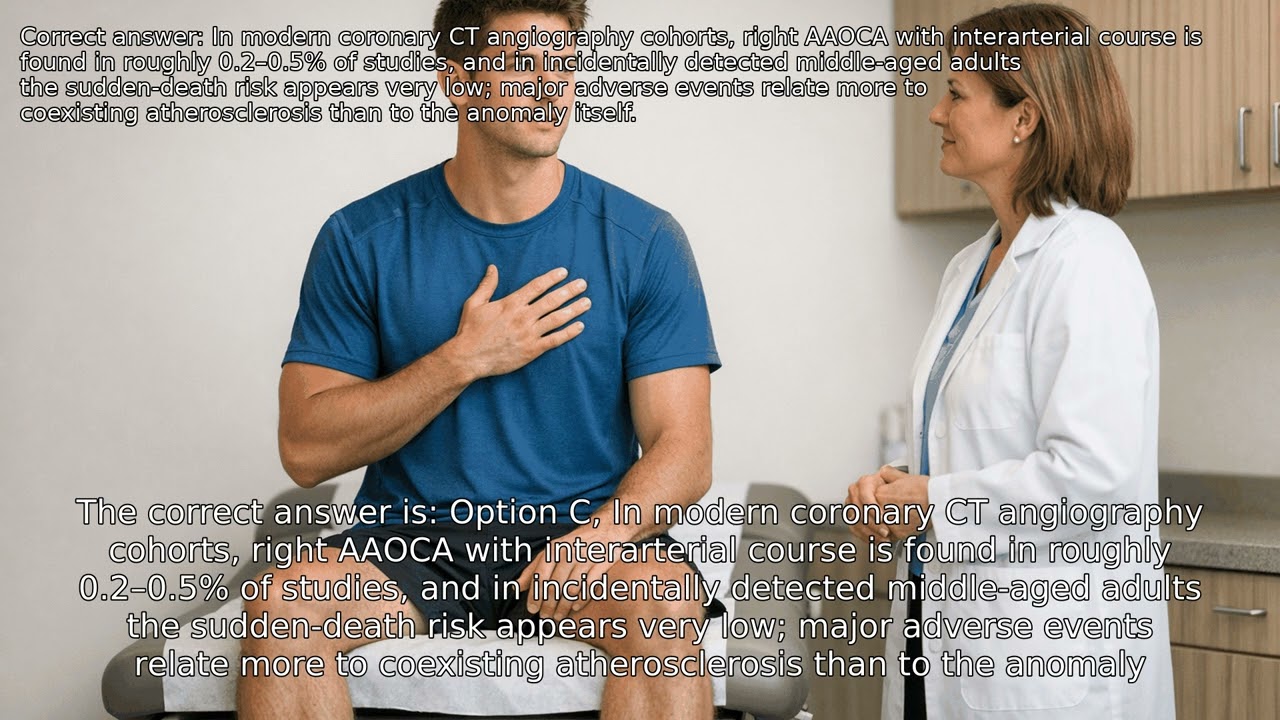
A. In modern coronary CT angiography cohorts, right AAOCA with interarterial course is found in roughly 0.2-0.5% of studies, and in incidentally detected middle-aged adults the sudden-death risk appears very low; major adverse events relate more to coexisting atherosclerosis than to the anomaly itself.
EXPLANATION
In modern coronary CT angiography datasets, right anomalous aortic origin of a coronary artery with interarterial course is found in roughly 0.2-0.5% of studies, and incidentally detected middle-aged adults appear to have a very low sudden-death risk. Contemporary outcomes are driven more by coexisting atherosclerosis than by the anomaly itself. This epidemiologic framing aligns with expert consensus on CCTA s role in anomaly assessment and with recent cohort data showing period prevalence near 0.35% and no observed sudden deaths during follow-up.
Statements claiming a 1-2% prevalence and uniformly high sudden-death risk warranting routine prophylactic surgery are not supported by current evidence. Conversely, calling it exceedingly rare ( less than 0.05%) and uniformly malignant is also inconsistent with CCTA registries....
---------------------------------------------------
Our cases and questions come from the https://EndlessMedical.Academy quiz engine - multi-model platform. Each question and explanation is forged by consensus between multiple top AI models (GPT, Claude, Grok, etc.), with automated web searches for the latest research and verified references. Calculations (e.g. eGFR, dosages) are checked via code execution to eliminate errors, and all references are reviewed by several AIs to minimize hallucinations.
Important note: This material is entirely AI-generated and has not been verified by human experts; despite stringent consensus checks, perfect accuracy cannot be guaranteed. Exercise caution - always corroborate the content with trusted references or qualified professionals, and never apply information from this book to patient care or clinical decisions without independent verification.
Clinicians already rely on AI and online tools - myself included - so treat this book as an additional focused aid, not a replacement for proper medical education. Visit https://endlessmedical.academy for more AI-supported resources and cases.
This material can not be treated as medical advice. May contain errors.
---------------------------------------------------
Доступные форматы для скачивания:
Скачать видео mp4
-
Информация по загрузке: