Neufahrwasser prison camp – an early Nazi hell in occupied Danzig.
Автор: History on YouTube
Загружено: 2023-12-04
Просмотров: 3542
This the location of a former National Socialist prison camp although it might not look like it today – now it is used as a building by the Polish coast guard. However this was the Neufahrwasser civilian prison camp and around 10,000 Poles passed through here in the first months of World War II . The camp was set up in 1939 in barracks buildings in Neufahrwasser , a district of what is now Nowy Port in the Polish city of Gdańsk.
The barracks in Neufahrwasser was the headquarters of all civilian prison camps for the annexed Danzig Free State and the Polish Corridor from 7 September 1939 to 31 March 1940, under the command of SS-Obersturmbannfuhrer Max Pauly . The Stutthof concentration camp later emerged from them.
These buildings were constructed in 1883 – 5 to be military barracks. Following the defeat of Germany, the regiment was that was using them was demobilized on 16 December 1918. The 128th Volunteer Infantry Regiment was created and located here in the spring of 1919. In June 1919, parts of the newly formed Infantry Regiment 34 of the Provisional Reichswehr used the barracks.
However, this land was to be lost to Germany. As a result of the Versailles Treaty, in 1920 Danzig became a free city and was demilitarized . From March 1922, ownership of the barracks was transferred to the Polish state . The buildings took on a new form, apartments and a primary school were set up here for Polish citizens who worked at extraterritorial institutions such as the Polish post office or in the port. Facilities also included a gymnasium, Boy Scout lodging , and a chapel.
With the invasion of Poland on 1 September 1939, mass arrests began in the Free City of Danzig. About 1,500 people were arrested on the first day of the war, about 1,000 were taken to the Viktoriaschule civil prison camp in Gdańsk, others to the Schiessstange prison, and from 2 September 1939, 150 people were taken to what was to be the Stutthof civil prison camp (later Stutthof concentration camp) . Their job was to build the camp. The victims of the arrests were mostly Poles who were actively involved in the life of the small state, including teachers, doctors, priests and members of Polish organizations in Gdańsk and those that worked in the Polish Post and the Port of Gdańsk. The National Socialists in Danzig had been compiling lists of “undesirable Polish elements” since 1936.
The building complex in Neufahrwasser was surrounded by the police, SS and SA in the early hours of 1 September 1939. Those inside were arrested and brought to the Viktoriaschule, which was being used as a temporary detention facility for Poles in the Free City.
From 7 – 15 September 1939, prisoners were taken from the Victoria School to Neufahrwasser as well as to other camps. The Viktoriaschule camp was dissolved on 15 September 1939 whilst the former barracks were now made into a prison.
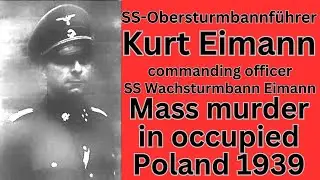
The SS-Wachsturmbann Eimann was responsible for guarding the prisoners. This was a police unit created by the Nazi-controlled authorities of the Free City of Gdańsk in the summer of 1939. Heinrich Himmler, during a secret visit to the city considered the existing forces to be too weak and as a result, in July 1939, the 1,500-strong SS-Heimwehr Danzig formation was created - partly composed of SS men illegally transferred to Danzig from the territory of the Reich. However, these forces were still considered insufficient, and therefore, by order of the Senate of the Free City of Gdańsk of 3 July 1939, another unit was established headed by SS-Obersturmbannführer Kurt Eimann, the former commander of the 36th SS Regiment, whose subordinates formed the core of the new unit. As was common at the time, the unit took the name of its commander. The costs of its maintenance and equipment were borne by the Danzig police from the sums allocated by the Reich Ministry of Finance to the authorities of the Free City of Gdańsk. Organizationally, the SS-Wachsturmbann was subordinated directly to the authorities of the Senate of the Free City of Gdańsk and to the police president Helmut Froeböss. After the outbreak of war and the annexation of the Free City into the Reich – Gauleiter Albert Forster and the police chief of the Schutzpolizei in Gdańsk were in charge.
Before the fighting broke out, the SS-Wachsturmbann served as a "police auxiliary battalion". At the end of August 1939, the unit had about 550 people, divided into five companies, including one motorised. In overall command was SS-Sturmbannführer Max Pauly. He was then the commander of the 71st SS Regiment in Gdańsk. He was later to be the commander of the Stutthof and Neuengamme concentration camps. For the moment, he was at Neufahrwasser overseeing the imprisonment of Polish people who had lived in the Polish corridor and Free City of Danzig whilst commandant at Neufahrwasser was SS Hauptsturmfuhrer Franz Christoffel.

Доступные форматы для скачивания:
Скачать видео mp4
-
Информация по загрузке: