How to Download PDFs from a Django Backend with Sencha ExtJS Authentication
Автор: vlogize
Загружено: 2025-10-04
Просмотров: 1
Learn how to effectively download PDFs from a Django backend while ensuring secure authentication in your `Sencha ExtJS` application.
---
This video is based on the question https://stackoverflow.com/q/63630414/ asked by the user 'retokiefer' ( https://stackoverflow.com/u/465903/ ) and on the answer https://stackoverflow.com/a/63635137/ provided by the user 'Arthur Rubens' ( https://stackoverflow.com/u/10196301/ ) at 'Stack Overflow' website. Thanks to these great users and Stackexchange community for their contributions.
Visit these links for original content and any more details, such as alternate solutions, latest updates/developments on topic, comments, revision history etc. For example, the original title of the Question was: Sencha ExtJS PDF Download
Also, Content (except music) licensed under CC BY-SA https://meta.stackexchange.com/help/l...
The original Question post is licensed under the 'CC BY-SA 4.0' ( https://creativecommons.org/licenses/... ) license, and the original Answer post is licensed under the 'CC BY-SA 4.0' ( https://creativecommons.org/licenses/... ) license.
If anything seems off to you, please feel free to write me at vlogize [AT] gmail [DOT] com.
---
How to Download PDFs from a Django Backend with Sencha ExtJS Authentication
If you're working with a complex frontend built in Sencha ExtJS and a Python/Django backend, you might have encountered challenges when trying to download PDFs with proper authentication. This can be particularly tricky since many methods, like using an iFrame or window.open, won't allow you to pass authentication tokens seamlessly. In this post, we will guide you through an effective solution using Ext.Ajax requests to download PDFs while handling authentication.
The Challenge
Your situation might look something like this:
You have a frontend in Sencha ExtJS.
Your backend is based on Django which handles authentication.
You need to securely download PDF files from your backend.
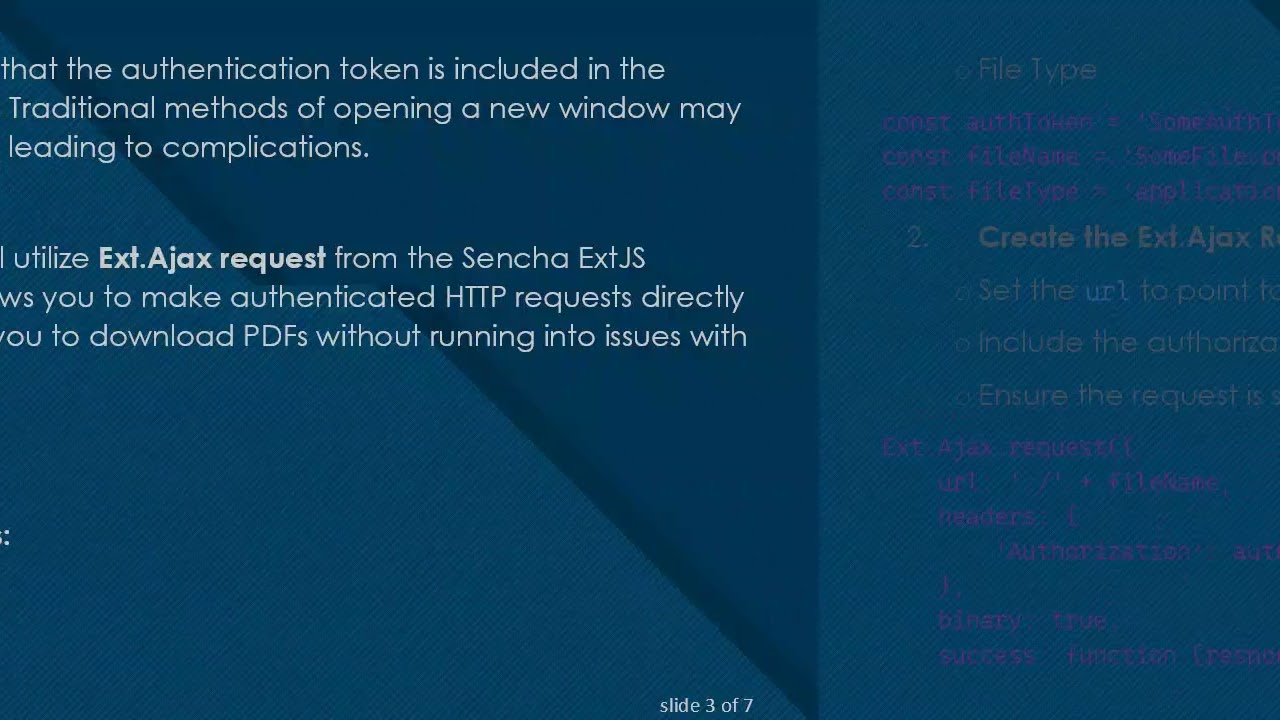
The primary issue is ensuring that the authentication token is included in the request to fetch the PDF file. Traditional methods of opening a new window may not facilitate this effectively, leading to complications.
The Solution
To solve this problem, we will utilize Ext.Ajax request from the Sencha ExtJS framework. This method allows you to make authenticated HTTP requests directly to your backend, enabling you to download PDFs without running into issues with authentication.
Step-by-step Guide
Here’s how to set this up:
Define Your Variables:
Authentication Token
PDF File Name
File Type
[[See Video to Reveal this Text or Code Snippet]]
Create the Ext.Ajax Request:
Set the url to point to your Django endpoint for PDF downloads.
Include the authorization header with your token.
Ensure the request is set for binary data.
[[See Video to Reveal this Text or Code Snippet]]
Handling the Successful Response:
Once you successfully receive the response (PDF), create a Blob.
Use URL.createObjectURL to generate a link to the Blob, and programmatically trigger a download using an anchor tag.
[[See Video to Reveal this Text or Code Snippet]]
Handling Errors:
In cases where the request fails, make sure to log the status or handle the error accordingly.
[[See Video to Reveal this Text or Code Snippet]]
Conclusion
By following the above steps, you can effectively download PDFs from your Django backend within your Sencha ExtJS application while ensuring that authentication is properly managed. This solution provides a seamless user experience that keeps your application secure.
Let this guide help you implement PDF downloads effectively in your project! If you have any further questions or run into issues, feel free to reach out for assistance.
Доступные форматы для скачивания:
Скачать видео mp4
-
Информация по загрузке: