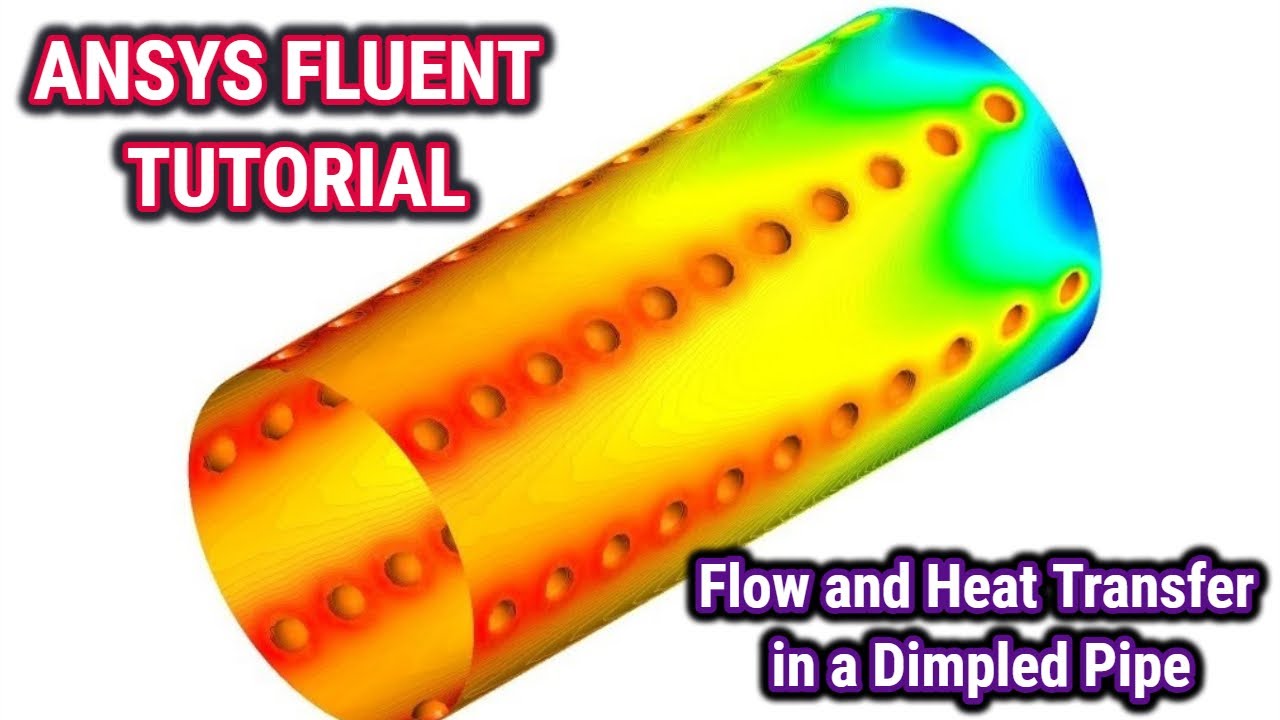
ANSYS Fluent Tutorial | Variable Wall Temperature Setup in ANSYS Fluent Without UDF | ANSYS Tutorial
Автор: Ansys-Tutor
Загружено: 2020-04-04
Просмотров: 39841
ANSYS Fluent Tutorial | How to Apply Variable Wall Temperature Boundary Condition in ANSYS Fluent Without UDF
Welcome to our latest ANSYS Fluent tutorial, where we dive into the technique of applying a variable wall temperature boundary condition without using a User-Defined Function (UDF). This method is particularly useful for simulations where you need to define a temperature profile along a surface, but want to avoid the complexity of writing and integrating a UDF.
In this step-by-step guide, you will learn:
How to set up a simulation with a variable wall temperature.
Methods to define temperature gradients or specific temperature distributions directly within ANSYS Fluent.
Tips for ensuring accuracy and stability in your simulation results.
This tutorial is ideal for students, researchers, and professionals looking to expand their CFD skills and explore advanced boundary condition setups in ANSYS Fluent. By the end of this video, you'll be able to confidently apply variable temperature profiles in your own projects, improving your simulations' realism and precision.
Don't forget to like, share, and subscribe to our channel for more in-depth ANSYS tutorials. If you have any questions or suggestions, please leave a comment below—we’d love to hear from you!
There is a longitudinal variation in the pipe wall temperature from 300K to 350 K . Assign the variable Pipe Wall temperature boundary condition to the pipe wall, which is the function of pipe length. Find the Temperature distribution on the pipe & rise in fluid temperature.
What will you Learn from this tutorial?
✔ How to create a cylindrical geometry using Primitives.
✔ Creation of O-Grid Meshing in ANSYS Meshing.
✔ Assigning Variable Temperature Boundary conditions to a wall.
✔ Applications of Named Expressions in ANSYS Fluent.
✔ Solver Setup.
✔ CFD -Post Processing.
Meshing tips:
1. Understand the Problem
Physics Knowledge: Identify regions with complex flow patterns and plan your mesh accordingly, especially for turbulent flows where boundary layer resolution is crucial.
2. Choose the Right Meshing Technique
Structured vs. Unstructured: Use structured meshes for simple geometries and unstructured meshes for complex ones. Consider hybrid meshes for different regions to balance accuracy and cost.
3. Prioritize Mesh Quality
Aspect Ratio and Skewness: Keep aspect ratios close to 1:1 and avoid high skewness (above 0.5) to ensure accuracy and convergence.
4. Refine Critical Areas
Boundary Layers and Gradients: Use finer mesh in boundary layers and high-gradient regions. Consider Adaptive Mesh Refinement (AMR) for automatic refinement.
5. Use Inflation Layers
Boundary Layer Resolution: Apply inflation layers with a smooth growth rate (1.2 to 1.5) to accurately capture boundary layers.
6. Simplify Geometry
Remove Small Features: Simplify geometry by removing irrelevant features and use symmetry to reduce computational domain size.
7. Conduct Mesh Convergence Studies
Mesh Independence: Ensure your results are mesh-independent by refining the mesh until key outputs stabilize.
8. Utilize Automatic Tools
Automated Meshing: Start with automated tools but refine critical areas manually using local mesh controls.
9. Use Parallel Meshing for Large Models
Efficiency: Leverage parallel meshing to speed up the process for large or complex models.
10. Iterate and Improve
Iterative Process: Start with a basic mesh, run simulations, and refine based on solver feedback and convergence behavior.
These streamlined tips will help you create a well-optimized mesh for accurate and efficient simulations.
ANSYS Fluent without UDF":
ANSYS Fluent
CFD
Variable Wall Temperature
Boundary Condition
ANSYS tutorial
Computational Fluid Dynamics
No UDF
Temperature Gradient
Fluent simulation
ANSYS Fluent boundary conditions
Fluent meshing
Heat transfer simulation
Thermal analysis
ANSYS Fluent tips
Engineering simulation
Fluent modeling
Fluid dynamics
ANSYS Fluent training
Wall temperature setup
Temperature profile ANSYS
#ansysfluent #ansysworkbench #ANSYSCFD

Доступные форматы для скачивания:
Скачать видео mp4
-
Информация по загрузке: