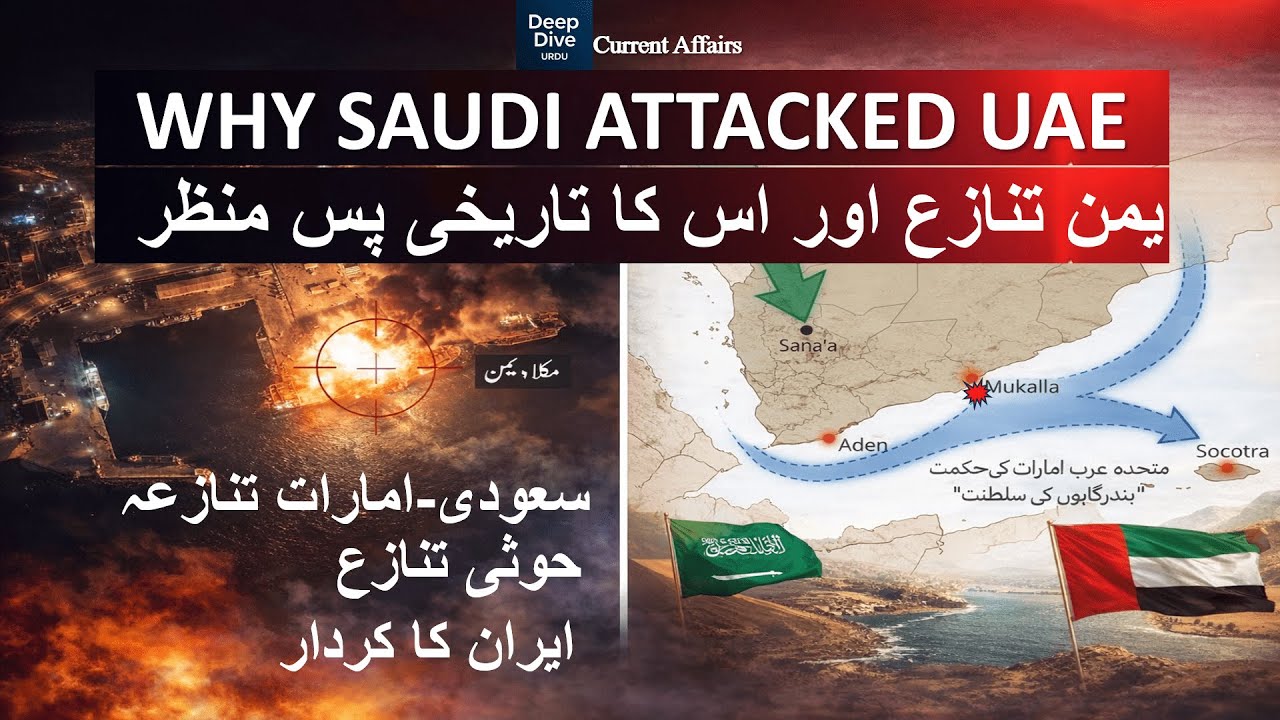
Why Saudi Arabia Attacked UAE, Yemen Conflict Explained, Historical facts, Houti Conflict & Pakistan
Автор: Deep Dive Urdu
Загружено: 2026-01-01
Просмотров: 192
SaudiWelcome to a comprehensive analysis of one of the world's most devastating yet developing crises, Saudi Arabian F15 attacks UAE's Shipment in Yemen. In this deep-dive exploration, we examine the origins, escalation, key stakeholders, and far-reaching implications of a conflict that has transformed an entire nation into a battlefield while the international community watches helplessly.
The Backdrop: Yemen Before 2014
Yemen's journey toward conflict did not begin in a vacuum. The Arab Spring of 2011 toppled President Ali Abdullah Saleh, who had ruled since 1990, creating a political vacuum that would eventually consume the nation. What followed was a period of instability and fragmentation, with various factions competing for power and influence. However, the situation dramatically escalated in 2014 when the Houthis—a Shiite insurgency originating from northern Yemen—captured the capital city of Sanaa in a rapid military advance. This takeover triggered alarm bells not only in Yemen but across the entire region, particularly in Saudi Arabia and the Gulf Cooperation Council (GCC), who viewed the Houthi rise as an Iranian attempt to establish a foothold on Saudi Arabia's doorstep.
The Conflict Begins: Saudi Intervention & Regional Dimensions
In March 2015, Saudi Arabia, perceiving the Houthi ascendancy as an existential threat to its regional dominance and security, launched a military intervention backed by a coalition of over ten nations—including the United States, Britain, and other Western states. Riyadh's initial assessment was optimistic: a swift, six-week military operation to defeat the Houthis and restore the internationally recognized government. This proved to be a catastrophic miscalculation. Instead of quick victory, Saudi Arabia found itself ensnared in a prolonged conflict that has cost the kingdom substantially in military resources, diplomatic credibility, and strategic position.
The cornerstone of Saudi Arabia's rationale was viewing the Houthis as an Iranian proxy—a perspective not without merit, as Iran has indeed provided military advisors, advanced drone and missile technology, ammunition, and financial support to the Houthi movement. However, this framing oversimplifies a more complex reality. The conflict is fundamentally rooted in Yemen's internal power struggles, compounded by regional competition between Iran and Saudi Arabia.
The Major Players: Understanding the Complexity
The Yemeni conflict is not a simple binary struggle. Multiple actors, each with distinct objectives and capabilities, have transformed Yemen into a multi-sided civil war:
The Houthis (Ansar Allah): Originating from the Zaidist Shiite tradition in northern Yemen's Saada province, the Houthis have evolved from a marginalized insurgency into a formidable military and political force. They now control northern Yemen—territory inhabited by approximately 80 percent of Yemen's population, including the capital Sanaa. Under Iranian support, they have developed sophisticated military capabilities, including ballistic missiles, cruise missiles, and weaponized drones. Their asymmetric warfare strategy against Saudi Arabia has proven effective, with attacks on Saudi oil facilities, military installations, and civilian infrastructure causing both economic damage and political embarrassment to Riyadh.
The Saudi-led Coalition: Comprising Saudi Arabia, the United Arab Emirates, Egypt, Morocco, and others, this coalition has conducted over a decade of air campaigns, ground operations, and blockades. However, despite years of military dominance in airpower and resources, the coalition has failed to achieve its primary objective: eliminating Houthi control and restoring the internationally recognized government.
Conclusion
The Yemen conflict represents a profound failure of international diplomacy, humanitarian response capacity, and regional conflict management. A nation once recognized for its historical and civilizational significance has been reduced to rubble. Over 21 million people face humanitarian catastrophe, millions more are displaced, and critical global maritime routes remain destabilized. Yet, Yemen remains a secondary concern in international discourse, overshadowed by other conflicts and geopolitical competitions.
#YemenConflict #HumanitarianCrisis #MiddleEastGeopolitics #CurrentAffairs #RedSea #InternationalRelations #SaudiArabia #houthi #houthiyeman #houthiconflict #saudiarabia #uae #pakistan #Saudivsuae
Saudi Arabia Attacks UAE, Yemen conflict, Yemen war, Yemen crisis, humanitarian crisis, Middle East geopolitics, Saudi Arabia Yemen, Houthis, Red Sea attacks, geopolitical analysis, current affairs, international relations, Bab el-Mandeb, shipping lanes, Middle East conflict, UN peacekeeping, Iran Saudi Arabia, Yemen conflict explained, geopolitics explained, deep dive analysis, intellectual discourse, book analysis, current events, global affairs, foreign policy analysis
Доступные форматы для скачивания:
Скачать видео mp4
-
Информация по загрузке: