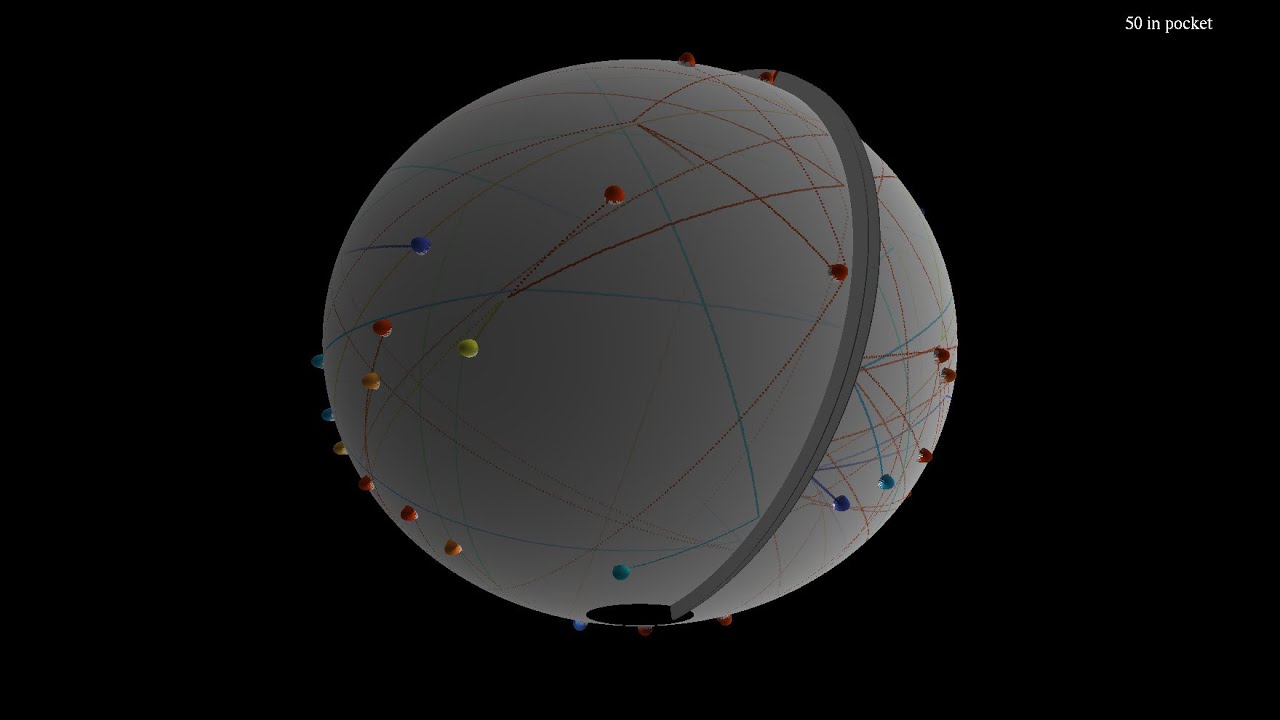
Particles on a sphere with dimples
Автор: Nils Berglund
Загружено: 2026-01-20
Просмотров: 212
This is a variant of the video • Spherical pool with pockets inside depress... of a version of "spherical pool", but without the pockets. Instead, there are merely depressions in the sphere that can trap particles for an amount of time, without swallowing them.
The depressions are modeled by rotation-symmetric potentials centered at the vertices of a regular dodecahedron, that exert a central force on the particles, as if the vertices were attracting. This is different from the situation where the particles follow geodesics on a deformed sphere, which would require computing the deformed metric, but the result should not be very different. In fact, in the spirit of general relativity, there should exist a specific deformation compatible with the observed trajectories.
There is no friction acting on the particles, and also no thermostat. The motion of the particles is governed solely by a Lennard-Jones interaction between them.
The video has two parts, showing the same simulation with two different representations:
3D view: 0:00
2D view: 1:19
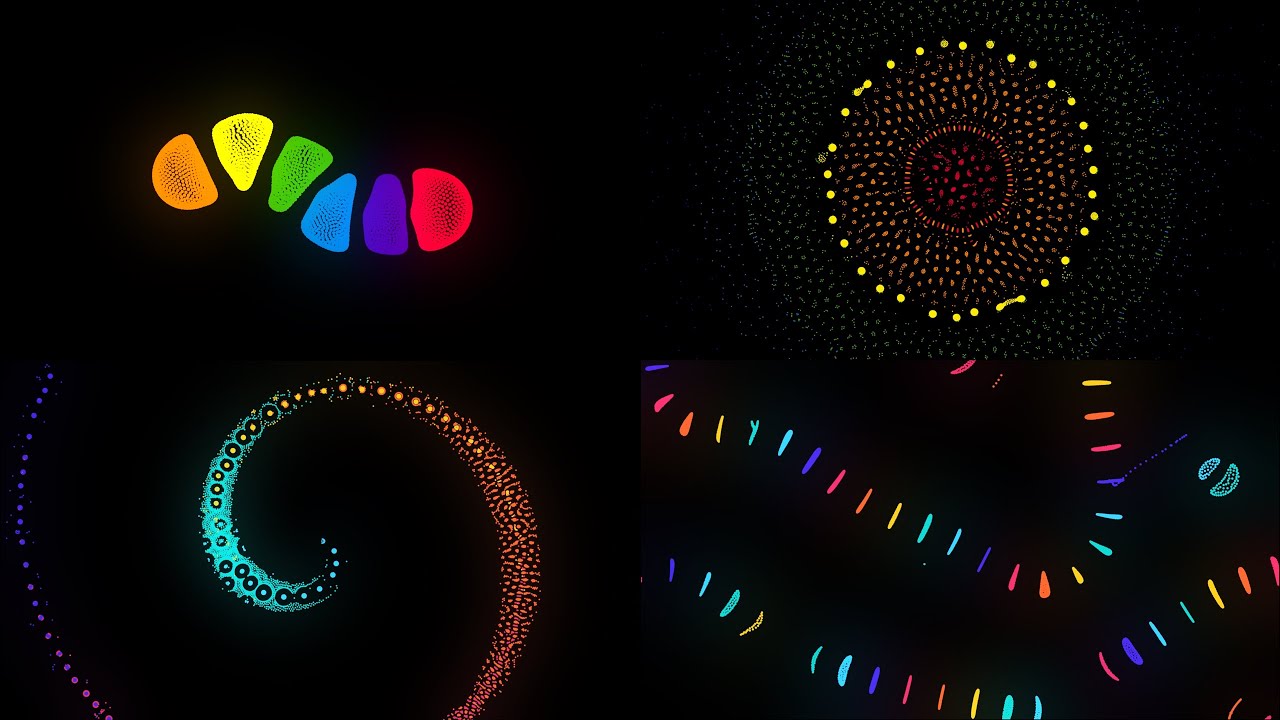
In both parts, the color of the particles depends on their kinetic energy. In part 2, the background color depends of the value of the potential, potential wells or dimples appear in darker blue. The 2D part shows an equirectangular projection, meaning that the x- and y-coordinates are proportional to the longitude and latitude of the particles. Particles move in apparently curved lines due to the projection - you see similar paths for spacecraft and satellites orbiting the Earth. Particles should actually have elongated elliptical shapes when approaching the poles, but we chose not to do this here. This is also why atoms of the same molecule can appear to be far from each other near the poles. In the 3D parts, the observer moves around the sphere in a plane containing the center of the sphere. The number of particles that have fallen into pockets over time is shown at the top right.
To save on computation time, particles are placed into a "hash grid", each cell of which contains between 3 and 10 particles. Then only the influence of other particles in the same or neighboring cells is taken into account for each particle.
Render time: 3D part: 16 minutes 22 seconds
2D part: 2 minutes 28 seconds
Compression: crf 28
ffmpeg added noise option: -vf noise=alls=10:allf=t+u
Color scheme: Turbo, by Anton Mikhailov
https://gist.github.com/mikhailov-wor...
Music: "Future Girl" by RKVC@rkvc
Current version of the C code used to make these animations:
https://github.com/nilsberglund-orlea...
https://www.idpoisson.fr/berglund/sof...
Some outreach articles on mathematics:
https://images.math.cnrs.fr/auteurs/n...
(in French, some with a Spanish translation)
#particles #sphere #LennardJones

Доступные форматы для скачивания:
Скачать видео mp4
-
Информация по загрузке: