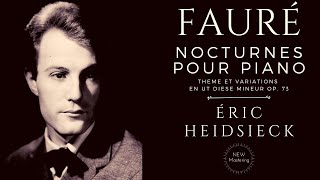
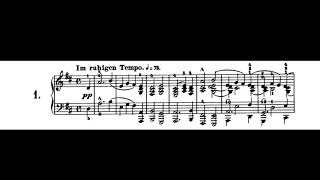
Gabriel Fauré - Thème et Variations Op. 73 (1895)
Автор: Bartje Bartmans
Загружено: 2015-09-27
Просмотров: 94617
Gabriel Urbain Fauré (12 May 1845 – 4 November 1924) was a French composer, organist, pianist and teacher. He was one of the foremost French composers of his generation, and his musical style influenced many 20th-century composers. Among his best-known works are his Pavane, Requiem, Sicilienne, nocturnes for piano and the songs "Après un rêve" and "Clair de lune". Although his best-known and most accessible compositions are generally his earlier ones, Fauré composed many of his most highly regarded works in his later years, in a more harmonically and melodically complex style.
Please support my channel:
https://ko-fi.com/bartjebartmans
Thème et variations, for piano in C sharp minor, Op. 73 (1895)
Dedication: A Mademoiselle Thérèse Roger
Tema: Quasi adagio
Var. 1: Lo stesso tempo
Var. 2: Più mosso
Var. 3: Un poco più mosso
Var. 4: Lo stesso tempo
Var. 5: Un poco più mosso
Var. 6: Molto adagio
Var. 7: Allegro moderato
Var. 8: Andante molto moderato
Var. 9: Quasi adagio
Var. 10: Allegro vivo
Var. 11: Andante molto moderato espressivo
Jean-Philippe Collard, piano
Description by Robert Cummings [-]
The Thème et variations here is a large piece, usually having a duration well over a quarter-hour. It came a year after Fauré's Nocturne in D flat major No. 6, which ended a six-year hiatus from writing piano music for the composer. Fauré was also in the process of evolving his keyboard style toward bolder harmonic and thematic means of expression, but this work is largely conservative, even exhibiting hints of Schumann, especially in the main theme. That theme, marked Quasi adagio, is stately and presented in short, somewhat repetitive-sounding phrases. It has an expressive depth in its mixture of the noble and gloomy, of elegance and splendor. The first variation does not stray far in mood or in thematic change, but the second is lively and playful, exuding brilliant, almost Rachmaninovian colors. The ensuing variant is moderately paced, but still quite playful in its greater muscle. The music in the Molto Adagio sixth variation may offer the greatest depth here, and that in the Andante molto moderato eighth variation, the dreamiest and most serene. With the tenth variation, the music turns quite lively and colorful, and in the concluding 11th, the mood shifts to a quiet, reserved manner at the outset to a serenely triumphant one at the end.

Доступные форматы для скачивания:
Скачать видео mp4
-
Информация по загрузке: