How to Use Excel to Calculate Value at Risk (VaR) | Value at Risk Explained
Автор: Matt Macarty
Загружено: 2019-08-01
Просмотров: 89454
@MattMacarty
*Master the calculation of Value at Risk (VaR), the essential statistical measure of downside risk.* In this advanced financial modeling tutorial, we demonstrate the *Parametric VaR* method using the Normal Distribution to estimate the maximum potential loss over a specific time horizon and confidence level.
We cover both single-security VaR and the more complex multi-asset VaR, using portfolio volatility as the core input.
---
⏱️ Video Chapters / Timestamps
0:00 - Introduction: What is Value at Risk (VaR)?
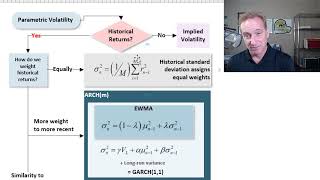
0:31 - Non-Parametric vs. Parametric VaR methods
1:00 - The required inputs: Portfolio Value, Volatility, Time Horizon, and Confidence Level
1:47 - The problem with VaR: What happens beyond the confidence level?
2:42 - *Example 1: Single-Security VaR (Apple)*
3:30 - Using the *`NORMS.INV`* function to find the confidence Z-score (2.33 standard deviations)
4:05 - Calculating Single-Day and Multi-Day VaR
5:15 - *Example 2: Multi-Security VaR (Apple & Gold)*
5:46 - Calculating Portfolio Volatility for two securities (Manual formula)
6:55 - The full portfolio volatility formula explained
7:35 - Risk reduction benefits from diversification
7:52 - Final Multi-Asset VaR Calculation
8:45 - The need for Matrix Math in larger portfolios (10+ assets)
---
🔎 Summary of Skills Learned
*Theory:* Understand the statistical assumptions of Parametric VaR (Normal Distribution).
*Functions:* Learn to use the `NORMS.INV` function in conjunction with the standard deviation.
*Application:* Calculate a 99% confidence VaR for both a single stock and a diversified portfolio, while correctly adjusting the volatility for the time horizon using the square root rule [04:17].
---

Доступные форматы для скачивания:
Скачать видео mp4
-
Информация по загрузке:





![Как сжимаются изображения? [46 МБ ↘↘ 4,07 МБ] JPEG в деталях](https://ricktube.ru/thumbnail/Kv1Hiv3ox8I/mqdefault.jpg)