How to Conditionally Set Height in Ionic: A Step-by-Step Guide
Автор: vlogize
Загружено: 2025-08-22
Просмотров: 0
Discover how to conditionally adjust the height of your Ionic components for an engaging user experience. Learn easy-to-implement techniques for sleek UI design.
---
This video is based on the question https://stackoverflow.com/q/64115148/ asked by the user 'Margherita Garello' ( https://stackoverflow.com/u/14359632/ ) and on the answer https://stackoverflow.com/a/64115196/ provided by the user 'H S W' ( https://stackoverflow.com/u/8584904/ ) at 'Stack Overflow' website. Thanks to these great users and Stackexchange community for their contributions.
Visit these links for original content and any more details, such as alternate solutions, latest updates/developments on topic, comments, revision history etc. For example, the original title of the Question was: How to conditionally set height in ionic?
Also, Content (except music) licensed under CC BY-SA https://meta.stackexchange.com/help/l...
The original Question post is licensed under the 'CC BY-SA 4.0' ( https://creativecommons.org/licenses/... ) license, and the original Answer post is licensed under the 'CC BY-SA 4.0' ( https://creativecommons.org/licenses/... ) license.
If anything seems off to you, please feel free to write me at vlogize [AT] gmail [DOT] com.
---
How to Conditionally Set Height in Ionic: A Step-by-Step Guide
If you are developing an application using the Ionic framework, you might encounter a situation where you want to adjust the height of a component based on user interactions, such as clicks. This feature can significantly enhance user experience by making your app feel more dynamic and responsive. In this guide, we will tackle the question of how to conditionally set height in Ionic, allowing components to expand or collapse based on user input.
Understanding the Problem
You've created a component in Ionic that displays various pieces of information in a structured format. However, you want users to have the option to expand or reduce the viewable area of this information, providing a cleaner interface that only shows essential data when needed. The goal is to adjust the height of your component based on whether it is expanded or collapsed, but you're not sure how to implement this functionality.
Scenario Example
You have HTML defined as follows:
[[See Video to Reveal this Text or Code Snippet]]
And the corresponding CSS for your component is set to a fixed height:
[[See Video to Reveal this Text or Code Snippet]]
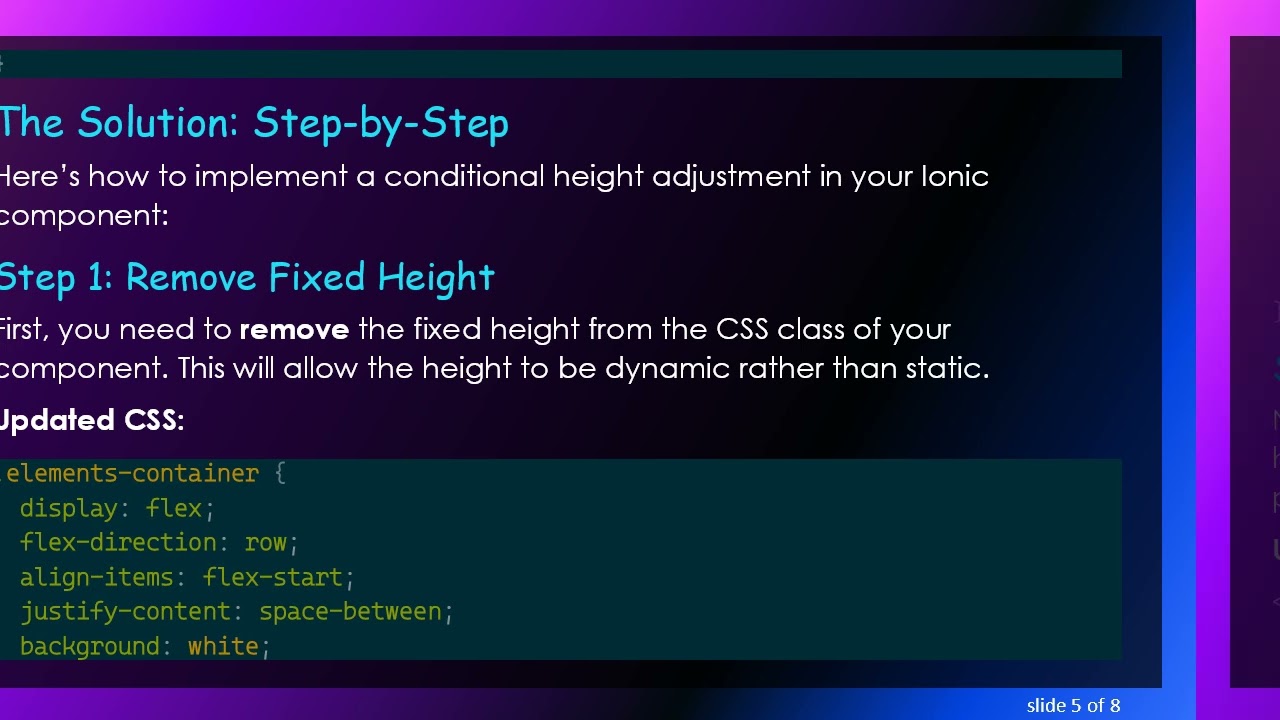
The Solution: Step-by-Step
Here’s how to implement a conditional height adjustment in your Ionic component:
Step 1: Remove Fixed Height
First, you need to remove the fixed height from the CSS class of your component. This will allow the height to be dynamic rather than static.
Updated CSS:
[[See Video to Reveal this Text or Code Snippet]]
Step 2: Implement Conditional Height in HTML
Next, modify the HTML for your .elements-container. This change will bind the height of the container to the expanded state of your item. You will use Angular’s property binding to achieve this.
Updated HTML:
[[See Video to Reveal this Text or Code Snippet]]
Conclusion
By following the steps outlined above, you can successfully implement conditional height adjustments in your Ionic components. This not only improves the visual presentation of your application but improves user interactions, making them feel more engaged with the content.
Feel free to try out these adjustments and customize the heights as per your design needs. Happy coding in Ionic!
Доступные форматы для скачивания:
Скачать видео mp4
-
Информация по загрузке: