Alistair Nunn (2024) Quantum and thermodynamic perspectives on ageing
Автор: The Guy Foundation
Загружено: 2024-05-24
Просмотров: 572
Quantum and thermodynamic perspectives on ageing, and 2024 Spring Series summary.
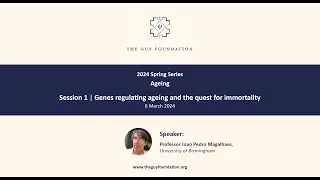
Professor Alistair Nunn, The Guy Foundation and University of Westminster.
The Guy Foundation 2024 Spring Series.
Start: 00:00
Betony Adams (introduction): 01:16
Professor Alistair Nunn: 13:26
Abstract:
Life can be viewed as an emergent property of the planet that is driven by entropy to equilibrate energy potentials via dissipation. It may have started in an alkaline thermal vent where upwelling hydrogen met carbon dioxide containing seawater. The transfer of electrons and protons was likely encouraged by FeS like compounds, leading to self-organising far from equilibrium autocatalytic networks and evolution of complex chemistry; these processes may well have relied on quantum mechanics. The movement of these ions could have also generated electric fields, which helped in stabilising these emerging systems. In time, these became recognisable as life, and further evolved to use other chemical energy sources to create their own proton gradients using electron transport chains, as well as photons, which gave rise to photosynthesis. At some point, bacteria and Archaea underwent symbiosis to form the modern eukaryote, with the former becoming the mitochondrion.
Today, nearly all life dissipates energy by uncoupling and futile cycling, so maintaining adaptive bioelectric fields. It is thus informative that manipulation of uncoupling can modulate redox and inflammation, which supports the role of mitochondria in inflammation and hormesis. If we view these phenomena from the perspective of adaptive thermodynamics to maintain dissipation, they could be applied to all scales of life – from the molecular all the way up to species. Critically, each dissipating “negentropic” component is disposable if it fails – as it could damage other functioning dissipating units, which suggests a role for natural selection, and of course, use of information and memory. Not only would this result in the evolution of complexity, and more robust systems, but also of programmed cell death and the “deconstruct to reconstruct” principle following damage. In effect, dissipative failure recapitulates phylogeny.
This may explain “inflammaging”, and why proteostasis and management of redox are likely the oldest markers of ageing: maintaining functional proteins has been key from the beginning. Life evolves to become more adaptable, usually by cooperation and complexity, but if the stress is too great, it has to recapitulate phylogeny, relying more on genetics and simplicity. This is replicated in individual organisms, which can, to some degree, regenerate components via a process intimately linked to inflammation – an ability that is lost as the organism ages, probably through natural stochastic degradation of molecular fidelity. This also highlights the possibility that this process results in a reducing ability to maintain quantum effects, which themselves are key in detecting changes in the environment. It would therefore seem that those factors that tend to ensure dissipation and structure, such as movement, are essential for functional longevity. It might also explain why calorie restriction can increase longevity, as too much energy would force replication due to loss of internal order – cells, due to thermodynamics, can only get so big. Indeed, biosynthesis is likely the earliest form of dissipation, while energy restriction and the need to move drove new modes of dissipation. The origins of hormesis are thus ancient.
In summary, if life is viewed at the global scale, every component is expendable if dissipation starts to fail, if this happens, the damaged “nodes” are removed. This global homeostatic system is reliant on the flow of electrons and protons, which channel through highly evolved proteins that lose fidelity, so renewal has to occur – hinting that ageing is an evitable component of maintaining dissipation and entropy. As suggested by Hayflick, although all organisms age due to the loss of molecular fidelity, individual longevity seems to have evolved from enhanced repair mechanisms, which does hint at methods to slow ageing. However, survival of life on earth is ultimately achieved by natural selection of the fittest dissipating units; the fastest evolving will be the simpler ones - hence why inflammation/hormesis are essentially scale free. Finally, if, as it seems, entropy has driven the emergence of life, which with technology is accelerating dissipation, anything that might stop this, for instance, nuclear war, raises the question about the emergence of artificial intelligence as another mechanism to prevent this by removing the damaging “node”. Is this “entropy’s dark laughter” and something humans, in particular, should heed?
Visit our website: https://www.theguyfoundation.org
Find out about other conferences and meetings: https://www.theguyfoundation.org/our-...

Доступные форматы для скачивания:
Скачать видео mp4
-
Информация по загрузке:




![Эффект Джанибекова [Veritasium]](https://image.4k-video.ru/id-video/N9HlQ-XVnFk)
