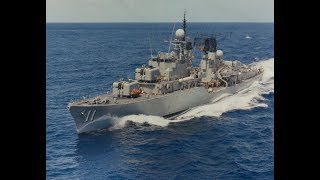
Diamantina Big Country Special; Sailing to Brisbane as a Museum Exhibit at - South Brisbane Dry Dock
Автор: Queensland Maritime Museum
Загружено: 2021-05-03
Просмотров: 10566
Original Broadcast on the ABC, free-to-air network.
This YouTube produced from the DVD lending Library of the
Queensland Maritime Museum QMM, for the enjoyment and education of supporters of the QMM.
As per DVD case note permissions.
Following a period of almost 13 years in Reserve, Diamantina recommissioned on 22 June 1959 as an Oceanographic Research Ship, under the command of Lieutenant Commander Bruce D Gordon RAN. She then commenced oceanographic survey duty, mainly off the Western Australian coast and in the Indian Ocean and Java Sea. She carried scientists from the Commonwealth Scientific and Industrial Research Organisation (CSIRO) during most of these surveys, but also assisted the Australian Army Survey team on the north west coast of Australia.
In February 1960, scientists aboard Diamantina discovered a fissure in the ocean floor west of Cape Leeuwin which dropped to depths of over 4000 fathoms. Now known as the Diamantina Trench, it is believed to be the deepest recorded water in the Indian Ocean.
HMAS Diamantina changed pennant numbers four times during her commission. They were F377, K377, A266 and GOR266.
HMAS Diamantina changed pennant numbers four times during her commission. They were F377, K377, A266 and GOR266.
Diamantina visited Cocos Island for the 46th anniversary of the HMAS Sydney/SMS Emden engagement. The Governor of Western Australia, Lieutenant General Sir Charles Gairdner KCMG KCVO KBE CB, who had travelled on the ship from Onslow in Western Australia, unveiled a commemorative plaque on 9 November.
Between survey cruises, Diamantina assisted in the Royal Australian Navy training programme by giving junior recruits from HMAS Leeuwin the opportunity to train at sea. During the Royal Visit to Western Australia in March 1963, she was escort to the Royal Yacht Britannia.
Diamantina's role as a survey and training ship continued into the 1970s. Among ports visited were Singapore, Colombo, Mauritius, Subic Bay, Hong Kong, Noumea and New Guinea. On 1 October 1971, officers and sailors from Diamantina participated in the Christmas Island Territory Day celebrations and in November of the same year the ship visited Jakarta. While in Jakarta problems of mutual interest were discussed with officers of the Indonesian Navy.
The visit to Christmas Island was one of many visits, as Diamantina made regular voyages to the island waters carrying out surveys and tests for the Royal Australian Navy Research Laboratories (RANRL).
In September 1978 the ship visited Funafuti Atoll in the Fijian islands for a survey and channel marking. A new precedent was set for Diamantina in February 1979 when a female scientist was embarked among the trials team and in May 1979 CSIRO scientists joined the ship for Global Weather Experiments.
Diamantina was showing definite signs of age when in July 1979 her Commanding Officer, Lieutenant Commander Burns, reported that he had been rudely awoken early one morning with 'a brew in the face.' One of the watch on deck had been sitting in the wheelhouse having a brew when he moved his chair. Unfortunately the chair landed on a wasted section of the deck immediately above the head of the Commanding Officer's bunk and the chair leg had come through the deck followed by the brew. A few days later a corrosion hole and a crack in the keel was discovered. While inspecting these problems a further hole was created when a diving knife was pushed through the keel.
On 9 October 1979 Diamantina sailed from Fremantle after a 20 year association with Western Australia and on 22 October she departed Sydney for her last hydrographic survey.
During her final cruise around Sydney Harbour on 23 November 1979, the ship flew her paying off pennant supported by six helium filled meteorological balloons. One hundred and thirty guests were embarked for the cruise including her original Commanding Officer, Commander Maurice Rose, and Scouts and Cubs from the Diamantina Scout Group (Canberra).
Diamantina paid off on 29 February 1980. As the last of the war time frigates still in service with the Royal Australian Navy, she had steamed 615,755 miles since first commissioning.

Доступные форматы для скачивания:
Скачать видео mp4
-
Информация по загрузке: