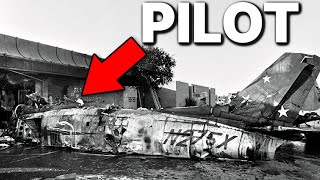
The Crazy Pilot who Carried a P-38 home
Автор: FlakAlley
Загружено: 2025-11-16
Просмотров: 107627
Going to therapy is a sign of strength, not weakness. My paid partner BetterHelp
makes therapy simple, with 10% off your first month to help you get started:
https://betterhelp.com/flakalley
In March 1945, two P-38 Lightning pilots collided over the Pacific during a storm. Trapped together in piggyback, Lt. Robert Shropshire refused to abandon his wounded wingman, Wallace Smith. Their final flight became a story of loyalty, courage, and sacrifice that time forgot. The Crazy Pilot who Carried a P-38 home
Support our work for $1 or more on Patreon, Every little helps
/ sgtvittie
Consider becoming a Channel member to directly support us
Simply click the "Join" button next to subscribe
#b17 #history
NOTE : The Footage and Thumbnail of this video is the best closest representation to what happened. It is not the actual footage.
Music Source
• 1 Hour of Ambient Fantasy Music [ Royalty ...
• Sad Dramatic Emotional Epic Music - My Spi...
• ROYALTY FREE Heroic Music | Superhero Epic...
Background history on the p-38 Lightning
The Lockheed P-38 Lightning was one of the most distinctive and versatile American fighter aircraft of World War II. Designed by the young engineer Clarence “Kelly” Johnson and his team at Lockheed’s Skunk Works, the P-38 was unlike anything else in the sky when it first flew in 1939. With its twin-boom design, central nacelle for the cockpit, and counter-rotating propellers, the Lightning was instantly recognizable — and deadly effective.
Conceived in response to a 1937 U.S. Army Air Corps requirement for a high-altitude, high-speed interceptor, the P-38 pushed aviation technology to its limits. Powered by two turbo-supercharged Allison V-1710 engines, it could exceed 400 mph — an astonishing speed for its era. The aircraft’s unique configuration offered both power and survivability: with two engines, a pilot could return home even if one failed, a valuable asset on long missions over water or hostile territory.
The P-38’s armament was concentrated in its nose, giving it a powerful and precise punch. It carried four .50-caliber machine guns and a 20mm cannon — all aligned along the aircraft’s centerline. This arrangement eliminated the need for gun convergence, allowing Lightning pilots to deliver accurate fire at longer ranges than most single-engine fighters.
Early variants such as the P-38D and P-38E saw limited combat, but as the war expanded, later models like the P-38F and P-38G became central to Allied air power in multiple theaters. In the Pacific, where long-range missions were essential, the Lightning quickly earned a fearsome reputation. It served as a fighter, bomber escort, photo-reconnaissance aircraft, and even a ground-attack platform.
One of the P-38’s most famous missions was the interception of Admiral Isoroku Yamamoto, the architect of the Pearl Harbor attack, in April 1943. Using precise intelligence and the P-38’s exceptional range, American pilots flew 435 miles from Guadalcanal to ambush Yamamoto’s transport aircraft, successfully shooting it down. The operation demonstrated the Lightning’s strategic reach and precision.
In Europe, the P-38 served with distinction in the Mediterranean and Western Fronts. It excelled as a high-altitude escort fighter before being gradually replaced by the P-51 Mustang in late 1944. However, its twin engines and stability made it a favorite among reconnaissance pilots. The unarmed F-4 and F-5 photo-Lightning variants provided crucial intelligence for Allied planners, photographing enemy positions from North Africa to Normandy and beyond.
Later models, such as the P-38J and P-38L, featured improved cooling systems, more powerful engines, and “dive recovery flaps” that helped pilots regain control during high-speed descents — a major advancement that saved countless lives. The P-38L, the final and most produced version, could reach speeds of over 420 mph and carry bombs, rockets, or drop tanks, making it one of the most flexible fighters of the war.
Although the Lightning’s performance in the cold, cloudy skies of Europe was sometimes limited by engine reliability issues and cockpit heating problems, in the vast expanses of the Pacific it truly came into its own. Its range, firepower, and ruggedness made it the backbone of long-range fighter operations and earned it the nickname “the Fork-Tailed Devil” — a name given by German pilots who both feared and respected it.
By the war’s end, P-38s had destroyed over 10,000 enemy aircraft. Many of America’s top aces, including Major Richard Bong (40 victories) and Major Thomas McGuire (38 victories), achieved their legendary scores flying the Lightning.
After 1945, the P-38 was gradually phased out of front-line service but continued to fly in secondary roles into the early 1950s. Its legacy, however, remains unmatched — a symbol of innovation, bravery, and the daring spirit of early American aviation engineering.

Доступные форматы для скачивания:
Скачать видео mp4
-
Информация по загрузке: