Screening for Antibiotic Resistance in Environmental Samples
Автор: PennWest California
Загружено: 2021-11-15
Просмотров: 306
Student: Payton Hlatky-Walters
Category: Class Project
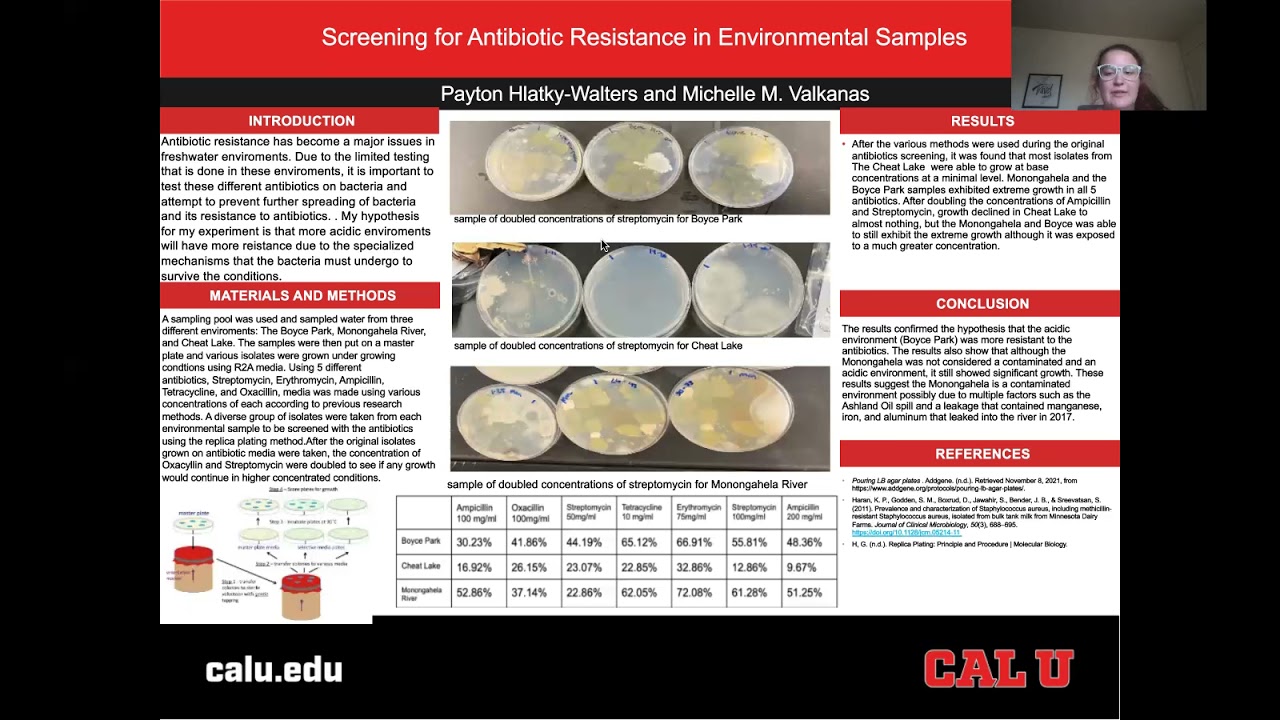
In acidic environments, antibiotic resistance can be possible due to the bacteria in the environments that are able to live and evolve in these environments. It is unknown about the level of resistance that can be present in bacteria in different bodies of water in the surrounding areas. Samples were taken from three different bodies of water including Boyce Park AMD (acidic environment), Cheat Lake, and the Monongahela River. The isolates were grown on media containing Streptomycin, Erythromycin, Ampicillin, Tetracycline, and Oxacillin to test the theory that bacteria from acidic environments will be more prone to antibiotic resistance. A diverse group of isolates were taken from each environmental sample to be screened with the antibiotics. Almost all isolates from each environment were able to grow on all of the antibiotic plates except Streptomycin. The plates with Streptomycin were able to see some growth but isolates barely grew from the acidic environment sample (Boyce Park). Using the results from the first round of replica plating, the concentrations of Oxacillin and Streptomycin were doubled to see if the growth was limited and bacterial growth from Cheat Lake and The Boyce were limited as predicted but the Monongahela still grew almost all the isolates from the previous plates. These results suggest that the Monongahela River could be contaminated from an outside source that is leading to antibiotic resistance. The screening of freshwater sources for antibiotic resistance is important because these bacterias found in the environments may infect humans/animals and increase the risk that novel resistance bacteria may arise and spread in communities.
Доступные форматы для скачивания:
Скачать видео mp4
-
Информация по загрузке: