How to Use Custom Types in Godot with GDExtension: A Troubleshooting Guide
Автор: vlogize
Загружено: 2025-08-07
Просмотров: 5
Discover effective strategies for compiling and troubleshooting custom types in Godot 4 using GDExtension. This guide answers common issues and offers solutions for smoother development.
---
This video is based on the question https://stackoverflow.com/q/77406781/ asked by the user 'shackra' ( https://stackoverflow.com/u/2020214/ ) and on the answer https://stackoverflow.com/a/77408765/ provided by the user 'SilicDev' ( https://stackoverflow.com/u/20614914/ ) at 'Stack Overflow' website. Thanks to these great users and Stackexchange community for their contributions.
Visit these links for original content and any more details, such as alternate solutions, latest updates/developments on topic, comments, revision history etc. For example, the original title of the Question was: Using custom types in Godot with GDExtension
Also, Content (except music) licensed under CC BY-SA https://meta.stackexchange.com/help/l...
The original Question post is licensed under the 'CC BY-SA 4.0' ( https://creativecommons.org/licenses/... ) license, and the original Answer post is licensed under the 'CC BY-SA 4.0' ( https://creativecommons.org/licenses/... ) license.
If anything seems off to you, please feel free to write me at vlogize [AT] gmail [DOT] com.
---
Troubleshooting Custom Types in Godot with GDExtension
Developing an addon for Godot 4 using GDExtension can be an exciting yet challenging journey. One common hurdle developers face is compiling issues arising from type errors, especially when working with custom types. In this guide, we will break down the source of these compilation errors and provide a step-by-step solution for getting your custom types up and running.
Understanding the Problem
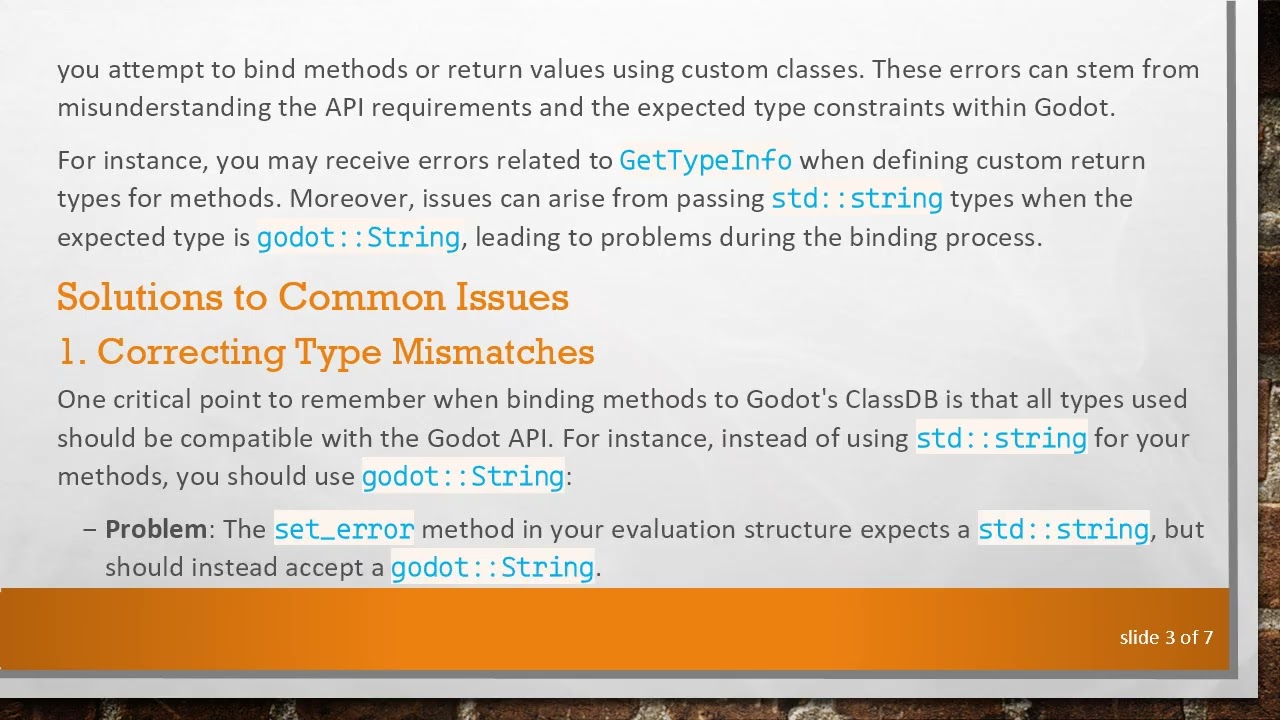
You may encounter problems when trying to compile your source code in Godot with the GDExtension feature. Specific errors might highlight incompatibilities in types, particularly when you attempt to bind methods or return values using custom classes. These errors can stem from misunderstanding the API requirements and the expected type constraints within Godot.
For instance, you may receive errors related to GetTypeInfo when defining custom return types for methods. Moreover, issues can arise from passing std::string types when the expected type is godot::String, leading to problems during the binding process.
Solutions to Common Issues
1. Correcting Type Mismatches
One critical point to remember when binding methods to Godot's ClassDB is that all types used should be compatible with the Godot API. For instance, instead of using std::string for your methods, you should use godot::String:
Problem: The set_error method in your evaluation structure expects a std::string, but should instead accept a godot::String.
Solution: Change the parameter type of your method to godot::String:
[[See Video to Reveal this Text or Code Snippet]]
This allows Godot to directly manage the memory and conversion of String types, preventing any mismatches with std::string.
2. Binding Methods Properly
When binding methods, ensure that you utilize Godot API types for all parameters and return values. Review your class binding function, _bind_methods, to verify that you correctly bind methods using Godot's types:
[[See Video to Reveal this Text or Code Snippet]]
This practice ensures that your class methods are correctly recognized by Godot's binding system.
3. Handling Return Types with Care
As per Godot’s GDExtension guidelines, the method binder primarily supports godot::Object pointers as both return and parameter types. If you aim to return custom types:
If the custom type inherits from godot::RefCounted, consider utilizing godot::Ref<T> to correctly manage object lifetimes and references.
4. Understanding Class Structures and Headers
It's essential to navigate Godot's updated structure concerning class headers. For instance, if you believe that the Resource type is absent, remember that it exists within the godot_cpp/classes/resource.hpp header. Always ensure your includes are correctly defined to access needed functionality.
5. Alternative Approaches to Returning Error Information
If returning errors with GDExtension doesn't meet your needs effectively, consider implementing custom error handling methods or utilizing godot::Variant for more flexible return types. This can enable more robust feedback mechanisms within your custom classes.
Conclusion
Building custom types in Godot 4 using GDExtension can briefly become complicated due to type mismatches and binding limitations. However, by adhering to Godot's type constraints, binding methods with proper API types, and ensuring correct inheritance structures, you can resolve compilation issues effectively. Continue experimenting, and don’t hesitate to refer back to the Godot documentation for further clarification and updates. Happy coding!
Доступные форматы для скачивания:
Скачать видео mp4
-
Информация по загрузке: