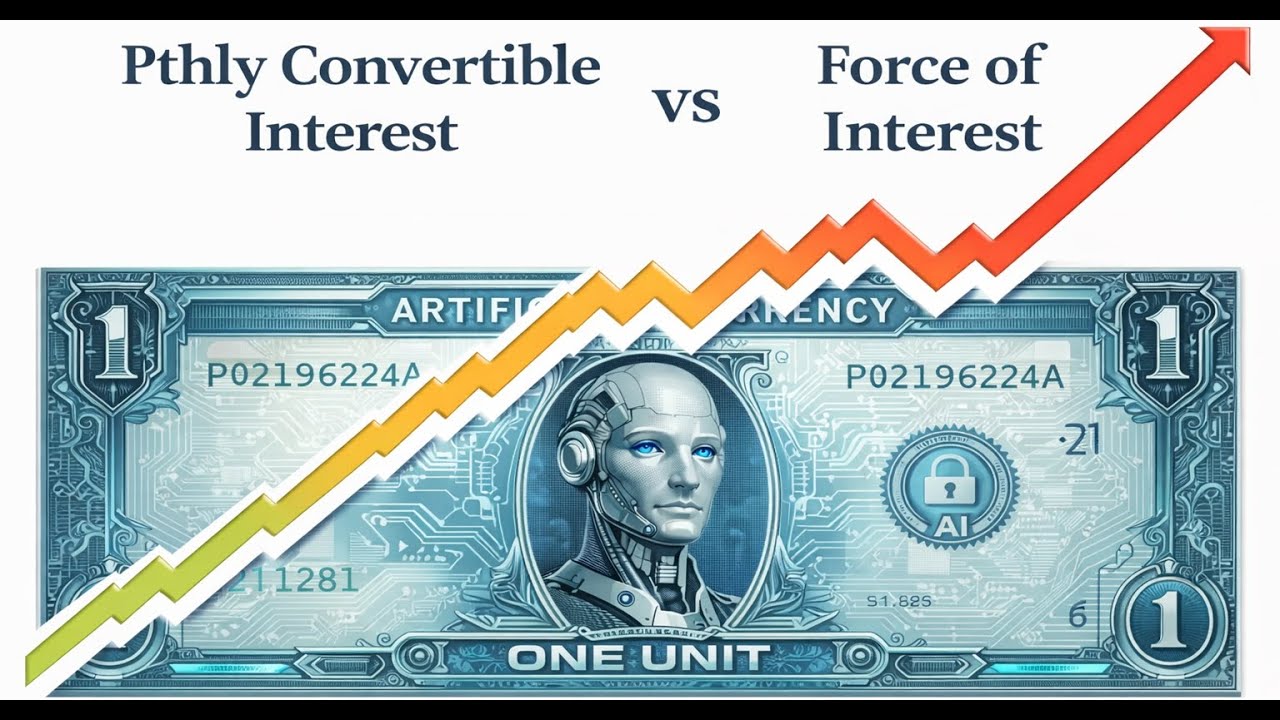
How to Calculate Accumulated and Discounted Value with δ(t) force of interest ?CM1 Actuarial Science
Автор: ExploreWithPratap
Загружено: 2026-01-16
Просмотров: 14
How to Calculate Accumulated and Discounted Value with δ(t)? When Force of Interest Depends on Time
Linkedin / pratap-padhi
Website https://smearseducation.com/
Join my FREE Skool Community to get all updates and support https://www.skool.com/sme-education-9...
Watch my previous recordinds on CS2 Time Series 👉 • Master Time Series Forecasting:Guide to AR...
CS2 Risk Modelling and Survival Analysis 👉 • What is a Stochastic Process? Easy explana...
For my CM1 Previous recorded videos watch 👉 • How to calculate simple interest | Fundame...
👉 • CM1 Y Part2 Class1- A beginner's introduct...
Detailed timestamps
0:00 – 1:30
Force of interest vs constant force of interest
Understanding δ(t) as a function of time
1:31 – 3:20
Graph of δ(t). Linear increase and constant sections
Functional value at boundary points
3:21 – 6:10
Piecewise functions, limits, and continuity intuition
Why a function cannot be one-to-many
6:11 – 9:30
Future value and present value using δ and δ(t)
Exponential form with integrals
9:31 – 12:40
Introduction to VT and VN notation
When VT is allowed and when it is not
12:41 – 16:30
Why V5 / V3 ≠ V2 under variable force of interest
Correct interpretation of discounting intervals
16:31 – 19:50
When constant δ or constant i simplifies everything
Link between δ, i, and vⁿ
19:51 – 23:20
Deriving VT for piecewise δ(t)
Case 1. t is less than 5
Case 2. t is great than or equal to 5
23:21 – 26:40
Applying VT to a past exam question
Present value of a sum due after many years
26:41 – 32:10
Finding equivalent nominal rate convertible monthly
Matching continuous and monthly compounding
32:11 – 35:30
Continuous payment streams
Meaning of ρ(t) and rate of payment
35:31 – 38:30
Three common continuous payment cases
Only payments vary
Only interest varies
Both vary
38:31 – 42:10
Payments over sub-intervals like 6 to 10
How to discount correctly to time 0
This video breaks down a high-scoring CS1 past exam question on force of interest with time-varying rates. You learn how to think, not memorize. Every step is linked to exam logic and common student mistakes.
What this class solves clearly
• Difference between force of interest δ and time-dependent force δ(t)
• How to read and interpret piecewise interest functions
• Why boundary points matter in actuarial questions
• When a function fails if definitions overlap
• How to sketch δ(t) graphs and interpret growth behavior
Core actuarial concepts explained step by step
• Accumulation and discounting using force of interest
• Correct use of exponential integrals
• Difference between
– e^(nδ)
– e^(∫δ(t)dt)
• Why formulas change when δ depends on time
VT notation. This is where most students fail.
• Meaning of VT as present value of 1 due at time t
• When VT notation is allowed
• Why VT requires time starting at 0
• Why V5 / V3 ≠ V2 when δ(t) varies
• Why interval length alone is misleading
• Physical intuition using changing interest environments
Piecewise force of interest. Exam critical.
• Case 1. t is less than 5
• Case 2. t greater than or equal to 5
• How to split integrals correctly
• How continuity and limits affect interpretation
• How to derive VT symbolically for both cases
Past exam problem walkthrough
• Deriving VT in closed form
• Applying VT to compute present value of a future sum
• Why VT for 3 years differs from VT for 7 years
• How examiners test logic, not calculation
Equivalence of interest rates
• Converting continuous force results to nominal rates
• Finding rate convertible monthly from continuous setup
• Matching equivalent present values across banks
• Why examiners ask this conversion
Continuous payment streams. Advanced CS1 topic.
• Meaning of ρ(t) as rate of payment
• Present value of continuous income
• How to discount infinitesimal payments
• Why integration replaces summation
Three continuous payment scenarios you must master
Constant payment, constant interest
Variable payment, constant interest
Variable payment, variable interest
Also covered
• Why VT symbols break when start time is not equal to 0
• Why you cannot shortcut discounting under δ(t)
• How to think like an examiner
• Where students lose marks despite correct formulas
Who this video is for
• CS1 students struggling with force of interest
• Students confused by VT and Vⁿ notation
• Anyone losing marks in continuous interest questions
• Students aiming for conceptual clarity, not shortcuts
How to study this video
• Pause and redraw graphs
• Rewrite integrals yourself
• Practice both cases t is less than 5 5 and t greater than or equal to 5
• Re-solve without symbols once
• Then re-solve using VT notation

Доступные форматы для скачивания:
Скачать видео mp4
-
Информация по загрузке: