Static Electricity. Friction, Charge, and Electrostatic Forces - KS3 Science - Pre GCSE - Physics
Автор: SciRevisionLM
Загружено: 2025-12-04
Просмотров: 0
Four Shocking Truths About Static Electricity
Introduction: The Everyday Zap
We’ve all felt it: that tiny, sharp zap when you touch a metal doorknob after walking across a carpet. It’s a common, if slightly annoying, part of everyday life. But this familiar phenomenon is driven by fascinating physics that are often misunderstood. Static electricity is more than just a random spark; it's a build-up of electric charge governed by some surprising rules. This article will reveal a few truths about the science behind that static shock.
1. You're Not Creating Charge, You're Just Moving It
The first surprising fact is that when you create static electricity, you aren't creating electrical charge from nothing. Most objects around us are naturally neutral, containing an equal number of positive and negative charges that cancel each other out.
When you rub two insulators together, like a balloon on a jumper, friction doesn't create new charges. Instead, it simply transfers existing electrons—the tiny particles that carry a negative charge—from one object to the other. The jumper loses electrons, leaving it with a net positive charge, while the balloon gains those same electrons, giving it a net negative charge. This isn't just a technicality; it’s a fundamental shift in thinking. Static electricity isn't about making charge, it's about unbalancing the charge that exists all around us.
2. It’s All About the Electrons: Why Only Negative Charges Move
Here’s a counter-intuitive point: during the process of creating static electricity, only negative charges (electrons) are transferred. You might assume that positive charges could also move, but they are locked in place.
To understand why, we have to look at the structure of an atom. Every atom has a heavy nucleus at its center containing positive charges (protons). Orbiting this nucleus are light, mobile electrons. Because the electrons are on the edge of the atom and have very little mass, they can easily escape and be transferred to other objects through friction. The protons, however, are tightly bound within the heavy nucleus and cannot easily move. This is the fundamental reason why an object becomes positively charged by losing electrons, not by gaining positive charges.
3. The Magic of Attraction: How Charged Objects Stick to Neutral Ones
You’ve probably seen a balloon, after being rubbed on your hair, stick to a neutral wall. How can a charged object be attracted to something that has no overall charge? The answer lies in a process called "polarisation of charge."
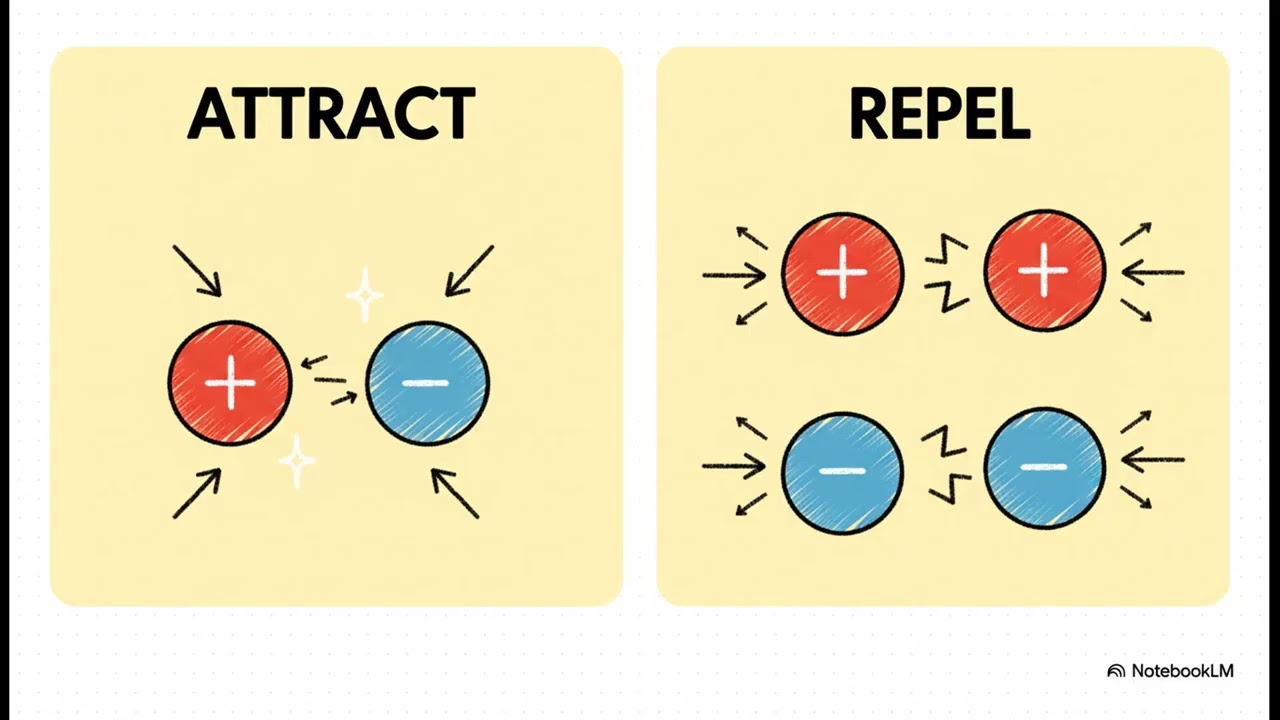
When the negatively charged balloon approaches the neutral wall, its negative field repels the mobile electrons on the wall's surface. These electrons move slightly further away, leaving the surface of the wall with a temporary area of net positive charge. This newly positive area then attracts the negatively charged balloon, allowing it to stick.
Polarisation of charge: When charges move or separate in a neutral object, leaving areas of net positive or negative charge.
This same principle explains how a charged comb can pick up neutral pieces of paper, attract an empty aluminum can, or even deflect a stream of water.
4. The Shocking Truth: What a Static Zap Actually Is
Finally, let’s connect these ideas back to that familiar static shock. Static electricity is, by definition, a build-up of electrical charge on an insulating object. Remember how friction transfers electrons? The same thing happens when you walk across a carpet—your body can accumulate excess electrons from the friction between your socks and the floor.
That startling zap you feel when you touch a metal doorknob is the sudden, violent balancing of the books. It's the rapid discharge of all those built-up electrons as they find a conductive path to escape. The spark is the visible evidence of countless electrons jumping across the tiny air gap between your finger and the doorknob, instantly neutralizing the charge imbalance you had built up.
Conclusion: A Hidden Force All Around Us
The simple "zap" of static electricity is a window into a hidden world governed by elegant and surprising rules at the atomic level. It's not about creating charge, but moving it. It's a one-way street where only electrons travel. And it’s powerful enough to make objects move without touching. Now that you know the secrets behind the spark, where else will you spot these invisible forces at play?
Доступные форматы для скачивания:
Скачать видео mp4
-
Информация по загрузке:


