Implementing resolveType Function and Initializing GraphQL Server in Express
Автор: vlogize
Загружено: 2025-09-17
Просмотров: 1
Discover how to properly set up a GraphQL server using Express, including implementing the `resolveType` function for union types. Learn best practices and troubleshooting methods in our detailed guide.
---
This video is based on the question https://stackoverflow.com/q/62956098/ asked by the user 'yoonvak' ( https://stackoverflow.com/u/11936984/ ) and on the answer https://stackoverflow.com/a/62956884/ provided by the user 'Herku' ( https://stackoverflow.com/u/3849167/ ) at 'Stack Overflow' website. Thanks to these great users and Stackexchange community for their contributions.
Visit these links for original content and any more details, such as alternate solutions, latest updates/developments on topic, comments, revision history etc. For example, the original title of the Question was: how to implement resolveType function / initialise graphQL server in express
Also, Content (except music) licensed under CC BY-SA https://meta.stackexchange.com/help/l...
The original Question post is licensed under the 'CC BY-SA 4.0' ( https://creativecommons.org/licenses/... ) license, and the original Answer post is licensed under the 'CC BY-SA 4.0' ( https://creativecommons.org/licenses/... ) license.
If anything seems off to you, please feel free to write me at vlogize [AT] gmail [DOT] com.
---
Implementing resolveType Function and Initializing GraphQL Server in Express: A Comprehensive Guide
GraphQL has become increasingly popular as a robust and efficient way to interact with APIs. However, developers often run into challenges while setting up their GraphQL servers. A common question arises: How do you implement the resolveType function and initialize a GraphQL server in Express?
In this post, we will break down the process of configuring a GraphQL server, the purpose of the rootValue, and how to properly implement the resolveType function for union types. Let's get started!
Setting Up a GraphQL Server in Express
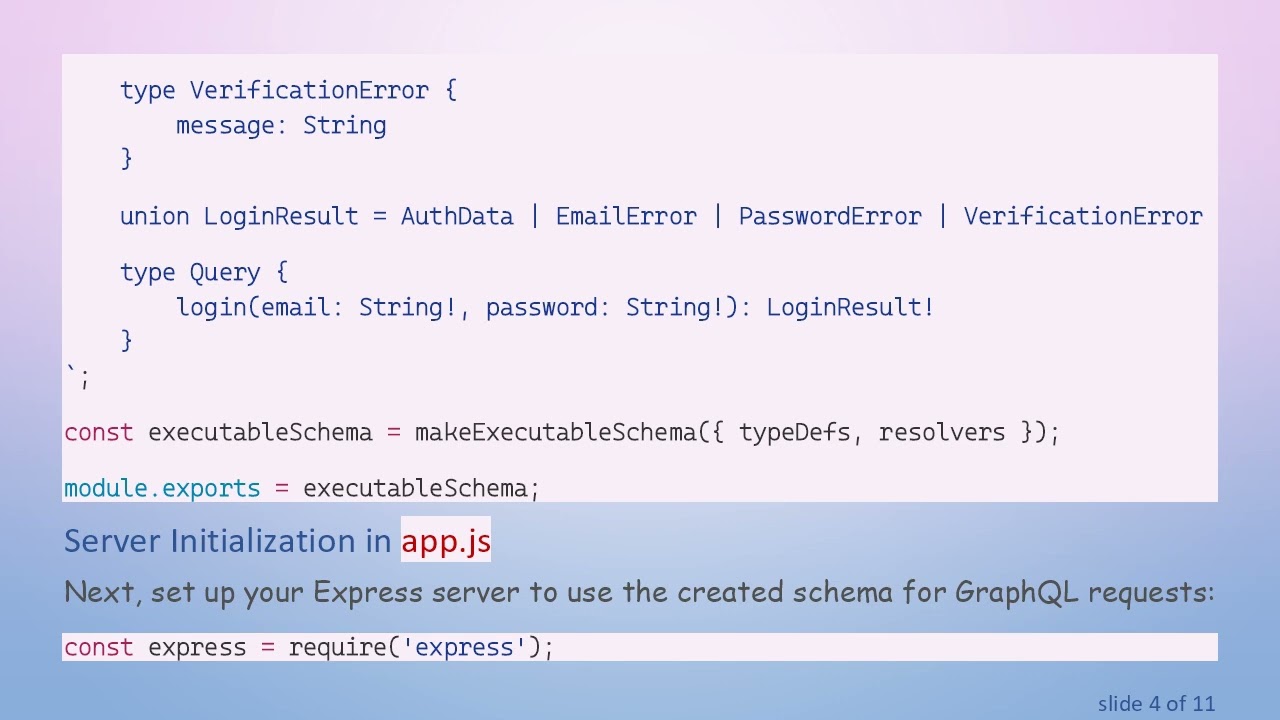
To begin, let's tackle the foundational issue of initializing a GraphQL server using Express. You need to ensure that you define and export an executableSchema correctly. Here's a simplified overview of the core elements you need:
Schema Creation with makeExecutableSchema
You create an executable schema using the makeExecutableSchema function from graphql-tools. Ensure that you define your types accurately:
[[See Video to Reveal this Text or Code Snippet]]
Server Initialization in app.js
Next, set up your Express server to use the created schema for GraphQL requests:
[[See Video to Reveal this Text or Code Snippet]]
Note: Passing executableSchema as both schema and rootValue is typically not required. The schema is primarily for defining your GraphQL types and resolvers, while rootValue is used less frequently but can hold context for query processing if needed.
Implementing the resolveType Function
Now that you've initialized your server and schema, you may encounter errors related to abstract types in GraphQL, specifically with union types like LoginResult. The error suggests that the GraphQL server couldn't determine the concrete type for a response.
To resolve this, you must implement the resolveType function within your union type:
Example of resolveType Function
[[See Video to Reveal this Text or Code Snippet]]
Understanding the Implementation
The __resolveType function determines the concrete type to return based on the properties available in the response.
Ensure that the strings returned (e.g., 'AuthData', 'EmailError') precisely match the type names defined in your schema.
It’s crucial that the values returned in __typename must exactly match the type names as defined in your GraphQL schema, to avoid errors like:
[[See Video to Reveal this Text or Code Snippet]]
Front-end Implementation
Finally, when querying from the frontend, ensure all possible types in your query are accounted for:
[[See Video to Reveal this Text or Code Snippet]]
Conclusion
Setting up a GraphQL server in Express can seem daunting, but by following the recommended practices and properly implementing features like the resolveType function for union types, you can avoid common pitfalls. Remember to always check that your types align and that your implementations serve the intended responses effectively. If you need further clarification or run into issues, don't hesitate to seek help from the community!
Доступные форматы для скачивания:
Скачать видео mp4
-
Информация по загрузке: