Convert Array of Inputted Files to Base64 Using FileReader in JavaScript
Автор: vlogize
Загружено: 2025-09-23
Просмотров: 0
Learn how to convert multiple files selected by users in a form to base64 format using JavaScript's FileReader API in a simple and effective way.
---
This video is based on the question https://stackoverflow.com/q/63491367/ asked by the user 'Sami Junior' ( https://stackoverflow.com/u/13710906/ ) and on the answer https://stackoverflow.com/a/63492622/ provided by the user 'mpstv' ( https://stackoverflow.com/u/14132148/ ) at 'Stack Overflow' website. Thanks to these great users and Stackexchange community for their contributions.
Visit these links for original content and any more details, such as alternate solutions, latest updates/developments on topic, comments, revision history etc. For example, the original title of the Question was: Convert array of inputted files to base64 using FileReader
Also, Content (except music) licensed under CC BY-SA https://meta.stackexchange.com/help/l...
The original Question post is licensed under the 'CC BY-SA 4.0' ( https://creativecommons.org/licenses/... ) license, and the original Answer post is licensed under the 'CC BY-SA 4.0' ( https://creativecommons.org/licenses/... ) license.
If anything seems off to you, please feel free to write me at vlogize [AT] gmail [DOT] com.
---
Convert Array of Inputted Files to Base64 Using FileReader in JavaScript
When developing web applications, handling file uploads is a common requirement. One common scenario is when you want users to submit multiple files through a form, and then you need to convert those files into a different format for easier processing or storage. In this guide, we’ll dive into how to convert an array of files uploaded by users into base64 encoding using JavaScript’s FileReader API.
Understanding the Problem
Imagine you have a form that allows users to select multiple image files for upload. Once the form is submitted, your goal is to convert each selected file into a base64 string, which can be easily transmitted over the internet. However, you might be struggling with how to effectively iterate through the array of files and perform the conversion.
Here’s a simplified version of the HTML form you might be working with:
[[See Video to Reveal this Text or Code Snippet]]
You likely already have the event handler set up to process the incoming files, but converting them to base64 can be tricky since it involves asynchronous operations.
The Solution
To solve this problem, you need to use the FileReader API, which provides an easy way to read the contents of files as strings, buffers, or data URLs. Since reading a file is an asynchronous operation, we can utilize JavaScript’s Promise to handle the conversion of multiple files seamlessly.
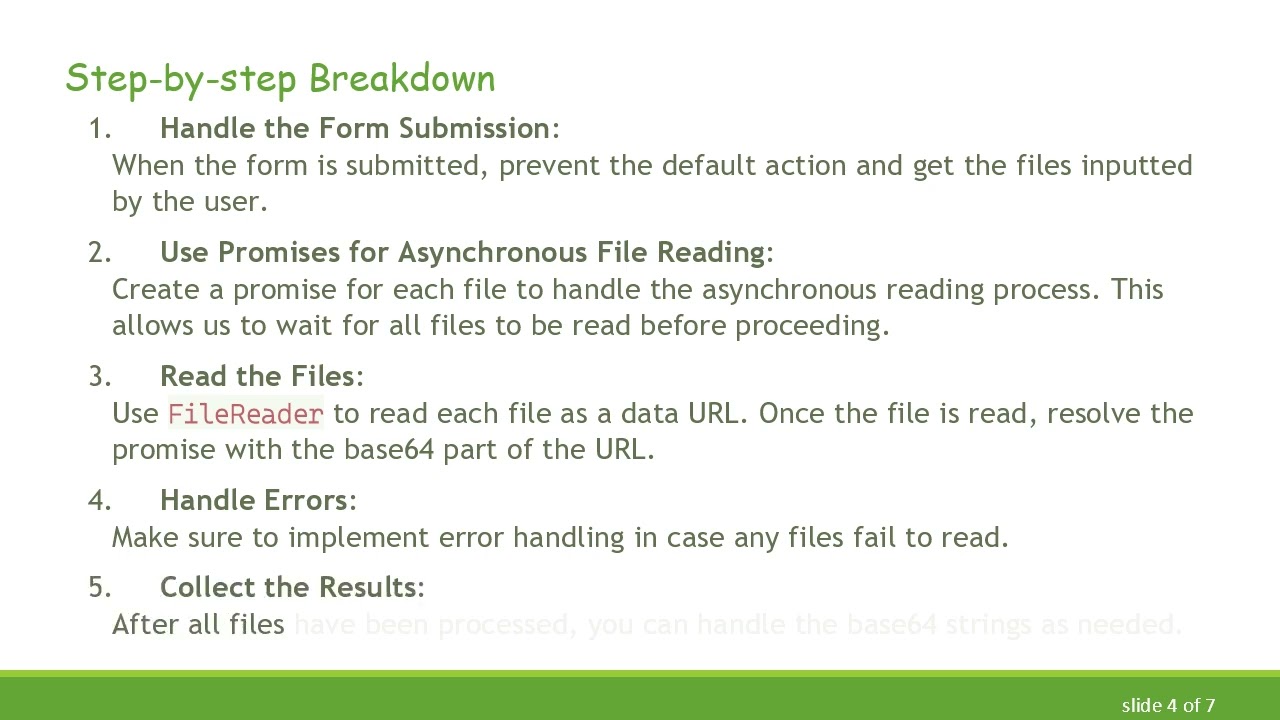
Step-by-step Breakdown
Handle the Form Submission:
When the form is submitted, prevent the default action and get the files inputted by the user.
Use Promises for Asynchronous File Reading:
Create a promise for each file to handle the asynchronous reading process. This allows us to wait for all files to be read before proceeding.
Read the Files:
Use FileReader to read each file as a data URL. Once the file is read, resolve the promise with the base64 part of the URL.
Handle Errors:
Make sure to implement error handling in case any files fail to read.
Collect the Results:
After all files have been processed, you can handle the base64 strings as needed.
Here’s the refactored JavaScript code that implements these steps:
[[See Video to Reveal this Text or Code Snippet]]
Key Takeaways
Asynchronous Operations: Remember that the FileReader works asynchronously; using Promises helps manage this complexity effectively.
Base64 Conversion: The actual base64 string is obtained by splitting the data URL returned by FileReader.
Error Handling: Always include error handling in your file reading process to enhance user experience and debugability.
Conclusion
Converting an array of files from user input into base64 strings using JavaScript’s FileReader is straightforward when you understand how to utilize Promises to handle asynchronous operations. By following the structured approach outlined in this post, you can successfully achieve the desired result and enhance the functionality of your web applications. Remember to test your implementation to ensure it works properly across different browsers and devices.
Now you have the tools you need to handle file uploads more effectively in your JavaScript applications! Happy coding!
Доступные форматы для скачивания:
Скачать видео mp4
-
Информация по загрузке:










![Как сжимаются изображения? [46 МБ ↘↘ 4,07 МБ] JPEG в деталях](https://image.4k-video.ru/id-video/Kv1Hiv3ox8I)
