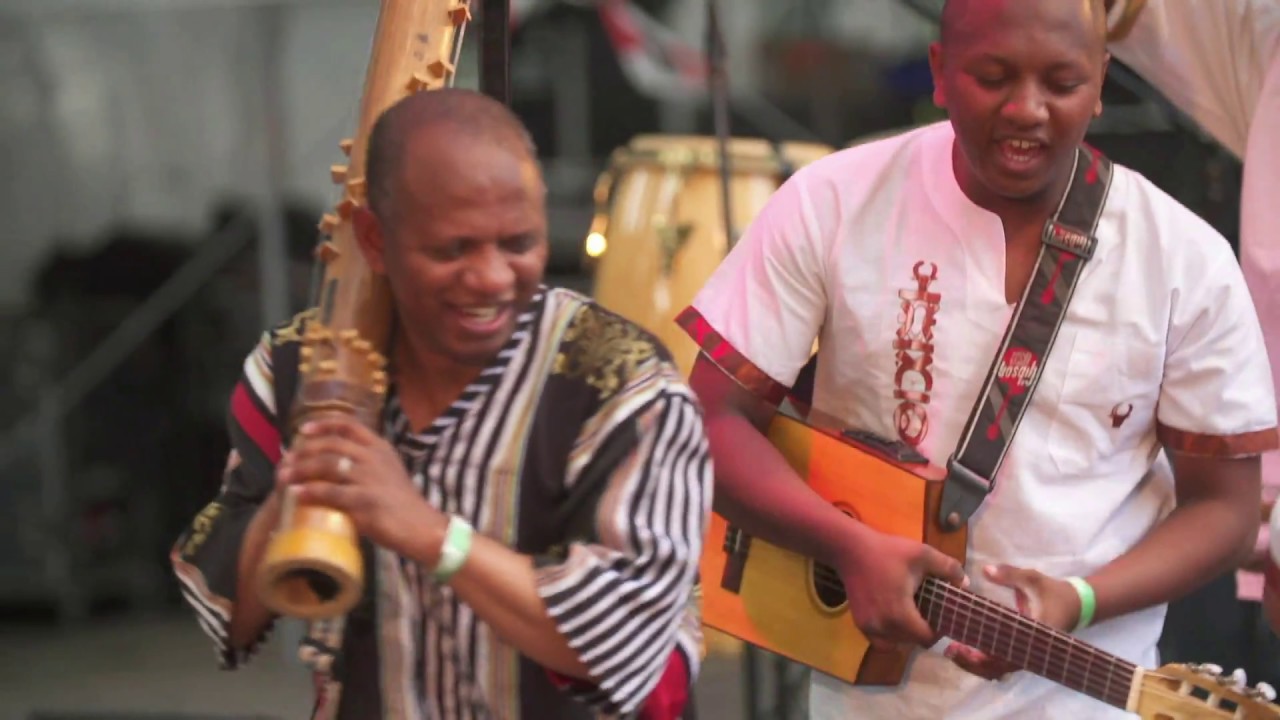
Rajery - "prince of the valiha".
Автор: Ton Kraayenvanger
Загружено: 2014-04-28
Просмотров: 13212
Germain Randrianarisoa -- better known to world music fans as Rajery -- is a talented singer, songwriter and percussionist who, on his home isle of Madagascar, is hailed as the "prince of the valiha".
The son of a poor farmer, Rajery lost the use of the fingers on his right hand before his first birthday and had to face amputation. Despite his handicap, the young boy was determined to do the same things as other children his age. Tenacious by nature, he refused to take the easy option of begging, and vowed to work.
And he spent a happy childhood in Ambohimanga (a neighbourhood on one of the many hills surrounding the Madagascan capital, Antananarivo), growing up on a musical diet of church hymns and the traditional folk sounds of the upper plateaux. Even as a young boy Rajery displayed great stubbornness and an incredible strength of will and, rather than resorting to begging on the streets with his handicap, he decided to work.
At the age of 15 Rajery also decided to teach himself to play the valiha, a tubular harp made of bamboo which produces melodious notes that veer between the sound of the harp, the harpsichord, the kora and the sanza. The valiha, which originally comes from Indonesia, has been adopted as the national instrument of Madagascar. Indeed, these days the valiha is to Madagascar what the kora is to sub-Saharan countries. Rajery plucked away at his valiha strings over the years, developing his own original playing technique as he worked by day as an accountant.
In 1983, Rajery began playing professionally with the group Tsilavina, updating the traditional valiha repertoire. The enterprising young musician went on to create the first major valiha orchestra, bringing together 23 soloists who each played a different form of the instrument. (The valiha has undergone many radical shape changes in its Madagascan history). Later in 1993, Rajery also came up with the innovative idea of organising the first national Valiha Week in Antananarivo, in an attempt to popularise the instrument across the island and better acquaint his compatriots with valiha-playing techniques.
Abhorring the expression "despite his handicap", Rajery went on to set himself countless other challenges, establishing himself not only as a gifted valiha-maker, but also a talented singer and songwriter. Meanwhile, he also set up a local association to help Antananarivo's street kids and out all his spare time and energy into working as a music therapist.
It was through his French friends that the "prince of the valiha" finally came into contact with Christian Mousset, the man who had launched the "Musiques Métisses" world 'fusion' festival in Angoulême. Bowled over by Rajery's talent, Mousset got him into a studio in 1997 to record a debut CD album entitled Dorotanety (Bushfire). Released on Mousset's legendary "Label Bleu", Rajery's album garnered a number of good reviews and heralded the start of his international career.
In September 2001 Rajery went on to record a second album entitled Fanamby (The Challenge) with his quartet. This acoustic masterpiece pulled off the 'challenge' of fusing Madagascar's traditional music heritage with his own musical culture. On Fanamby the 'a cappella' polyphonies the group Senge had brought the world stood back to back with swinging Jaojoby-style salegy beats and the melodious blues of the upper Plateaux and the heady rhythms of Antandroy dances fused with the infectious groove of the "rija Betsileo".

Доступные форматы для скачивания:
Скачать видео mp4
-
Информация по загрузке:




![B.B. King - The Thrill Is Gone [Crossroads 2010] (Official Live Video)](https://imager.clipsaver.ru/SgXSomPE_FY/max.jpg)