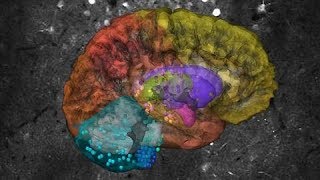
What does a thought look like, within the Brain?
Автор: 52 Living Ideas
Загружено: 2021-04-30
Просмотров: 2694
Watch 10+ Neuroscience Meetups here: • Neuroscience
Fundamental to any exploration of the human mind is the notion of thoughts and emotions.
In 1644 René Descartes wrote his famous proclamation, "Ego cogito, ergo sum" about thought, doubt, and existence. A year later he wrote his treatise on emotions, "The Passions of the Soul". In the time of Descartes, science had just begun to grasp that both thoughts and emotions occur in our brain. Prior to Descartes, and throughout antiquity, the Ancient Egyptians saw the heart as the most important organ where we existed: our essence and our soul. Later in the 4th century BCE, Aristotle wrote about emotion and thought, proclaiming that the heart was the source of both, and that the brain was simply a cooling organ meant to "cool the passions of the heart".
Today we believe all thoughts and emotions reside within the brain/mind. We are improving our understanding of how they arise, whether they are localized, and what exactly constitutes a thought or emotion. Most neuroscientists believe there is no observable difference between a thought's or emotion's existence within our brain, other than the brain regions they occur in. If one could see everything related to a thought or emotion, but they had no information on where in the brain it occurred, we would find it impossible to differentiate between them - because functionally they are identical.
We will discuss and see examples of cognition in the form of thoughts/emotions in action, and how they appear using present day measurement tools
To best understand the discussion, attendees are encouraged to watch the first two videos (about 20 minutes total). You may be shocked at our understanding of thoughts, as well as our capabilities in observing them within the working mind.
We will try to decipher topics including: does a specific thought/emotion, such as "I'm hungry," occur in a single place in our brain or in multiple regions? What about inter-related thoughts, for example will the two thoughts "I'm sleepy" and "I'm hungry" be present in overlapping brain regions, since they both share the common core of "I am feeling something"? If two different people each had the thought "I am at home," will their independent thoughts reside in the same/similar regions, within their respective brains?
How do thoughts exist in our brain: in a single neuron, among a group of neurons, "between" neurons, or in some other manner?
Also, Graph Theory is essential to our modern understanding of neuroscience, and so we will look at this further. This topic is at the center of the sub-field of computational neurobiology, which aims to elicit answers to some of the difficult questions we will discuss.
• What do you understand about thoughts and emotions?
• Do you believe they are similar, or distinctly different?
• Do you believe our brain does not always think?
• Do we use every or most regions of our brain, during thought?
• Are thoughts (& emotions) prevalent in our cortical (more recent) brain?
*****
If you have time, please WATCH IN ADVANCE these first two videos:
♦ VIDEO: Did you know we can "read" what a person is thinking (within limits).
• The New Science of Thought Imaging | Marce... [22 minutes]
♦ VIDEO: An actual thought visualized in someone's brain:
• Tracking the Brain as it Generates an Antonym [9 seconds]
This brief video uses color-coding to show active "thinking" (in red).
It shows "thoughts" in someone's mind, when they were asked to:
a) listen to a word/sound (this is shown in yellow)
b) think of its opposite/antonym (this is shown in red)
c) say the antonym (this is shown in blue)
Note: The video is brief, so pausing or replaying it may help.
○ ARTICLE: What are thoughts made of?
https://engineering.mit.edu/engage/as...
○ VIDEO: The Science of Thinking
• The Science of Thinking [12 minutes]

Доступные форматы для скачивания:
Скачать видео mp4
-
Информация по загрузке: