How to Transform Data from GraphQL Server using Vue Composition API
Автор: vlogize
Загружено: 2025-10-06
Просмотров: 0
Learn how to effectively transform the data received from a GraphQL server using the Vue Composition API in your front-end applications.
---
This video is based on the question https://stackoverflow.com/q/63874662/ asked by the user 'abi' ( https://stackoverflow.com/u/9338223/ ) and on the answer https://stackoverflow.com/a/63981337/ provided by the user 'abi' ( https://stackoverflow.com/u/9338223/ ) at 'Stack Overflow' website. Thanks to these great users and Stackexchange community for their contributions.
Visit these links for original content and any more details, such as alternate solutions, latest updates/developments on topic, comments, revision history etc. For example, the original title of the Question was: Transform data after it received from graphql server using vue-composition api
Also, Content (except music) licensed under CC BY-SA https://meta.stackexchange.com/help/l...
The original Question post is licensed under the 'CC BY-SA 4.0' ( https://creativecommons.org/licenses/... ) license, and the original Answer post is licensed under the 'CC BY-SA 4.0' ( https://creativecommons.org/licenses/... ) license.
If anything seems off to you, please feel free to write me at vlogize [AT] gmail [DOT] com.
---
Transform Data from GraphQL Server using Vue Composition API
When developing a front-end application, it’s common to fetch data from a GraphQL server. As a beginner, you might find yourself grappling with how to manipulate and display this data effectively in Vue.js, especially if you are utilizing the composition API. If you've encountered difficulties in transforming data retrieved via GraphQL in your Vue components, you're not alone. Let’s take a closer look at the process and how to overcome this challenge.
Understanding the Challenge
After executing a GraphQL query using the useQuery method provided by @ vue/apollo-composable, you may find that you're unable to work directly with the response data returned in a way that you need. In the given scenario:
The result from the GraphQL server is wrapped in a Vue ref, making it a reactive variable.
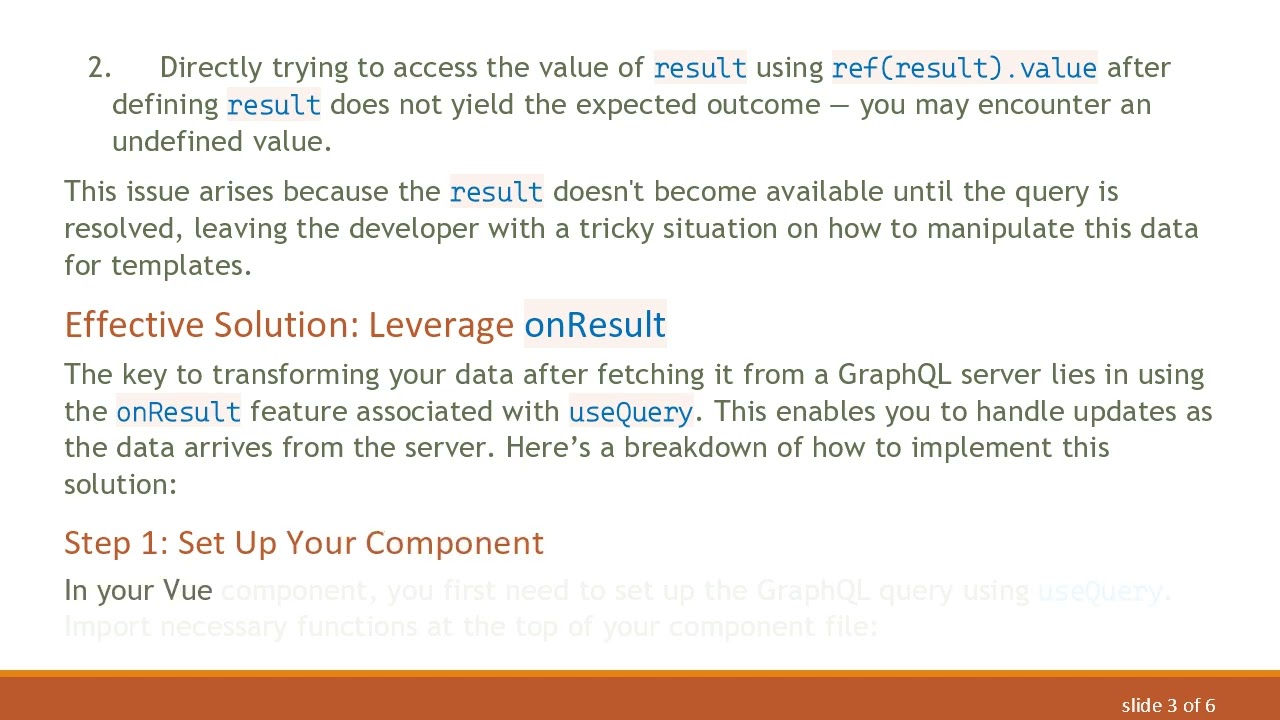
Directly trying to access the value of result using ref(result).value after defining result does not yield the expected outcome — you may encounter an undefined value.
This issue arises because the result doesn't become available until the query is resolved, leaving the developer with a tricky situation on how to manipulate this data for templates.
Effective Solution: Leverage onResult
The key to transforming your data after fetching it from a GraphQL server lies in using the onResult feature associated with useQuery. This enables you to handle updates as the data arrives from the server. Here’s a breakdown of how to implement this solution:
Step 1: Set Up Your Component
In your Vue component, you first need to set up the GraphQL query using useQuery. Import necessary functions at the top of your component file:
[[See Video to Reveal this Text or Code Snippet]]
Step 2: Define Your Data Structure
Within the setup function, declare your reactive variables. You’ll create an object to hold your transformed data:
[[See Video to Reveal this Text or Code Snippet]]
Step 3: Fetching Data with useQuery
Implement useQuery and set up the onResult method to handle incoming data and apply transformations.
[[See Video to Reveal this Text or Code Snippet]]
Step 4: Accessing Transformed Data in Templates
Now that you have transformed your data, you can access instruments.instruments and instruments.filteredInstruments in your templates without any issue. Use v-for or other directives as needed to display the data properly.
Wrap Up
By using the onResult method provided by useQuery, you can effectively transform and filter your GraphQL results after they are fetched. This method allows you to reactively handle incoming data and manipulate it for your component needs. Following the outlined steps will enable you to use the Vue Composition API proficiently in your application and facilitate a better data experience.
Feel free to experiment further with other transformations needed based on your specific application requirements. Happy coding!
Доступные форматы для скачивания:
Скачать видео mp4
-
Информация по загрузке:








![CNN [#483] Kiedy będziesz we właściwym czasie i miejscu?](https://image.4k-video.ru/id-video/XGyH9wlbosg)