How to Dump HTTP Content-type with FastAPI
Автор: vlogize
Загружено: 2025-09-30
Просмотров: 5
Learn how to capture and print HTTP headers and body in FastAPI for debugging and data handling.
---
This video is based on the question https://stackoverflow.com/q/63731584/ asked by the user 'olle.holm' ( https://stackoverflow.com/u/14217490/ ) and on the answer https://stackoverflow.com/a/63748456/ provided by the user 'Yagiz Degirmenci' ( https://stackoverflow.com/u/13161155/ ) at 'Stack Overflow' website. Thanks to these great users and Stackexchange community for their contributions.
Visit these links for original content and any more details, such as alternate solutions, latest updates/developments on topic, comments, revision history etc. For example, the original title of the Question was: How to dump http "Content-type: application/json;" in FastAPI
Also, Content (except music) licensed under CC BY-SA https://meta.stackexchange.com/help/l...
The original Question post is licensed under the 'CC BY-SA 4.0' ( https://creativecommons.org/licenses/... ) license, and the original Answer post is licensed under the 'CC BY-SA 4.0' ( https://creativecommons.org/licenses/... ) license.
If anything seems off to you, please feel free to write me at vlogize [AT] gmail [DOT] com.
---
How to Dump HTTP Content-type with FastAPI: A Step-by-Step Guide
When working with webhooks and APIs, you may find yourself needing to capture and inspect incoming requests. FastAPI is an excellent choice for setting up web services in Python, but how do you log the entire HTTP request, including headers and body, similar to the Linux command nc -l 9000? In this post, we’ll dive deeper into how to achieve that in FastAPI.
Understanding the Problem
You might have a custom tool that sends JSON data via webhooks, and you need to listen on a specified port to dump this data for analysis. This includes capturing the HTTP headers and body content. The primary concern is how to set up your FastAPI application to print this information to the console every time a request is received.
Solution: Using FastAPI's Request Object
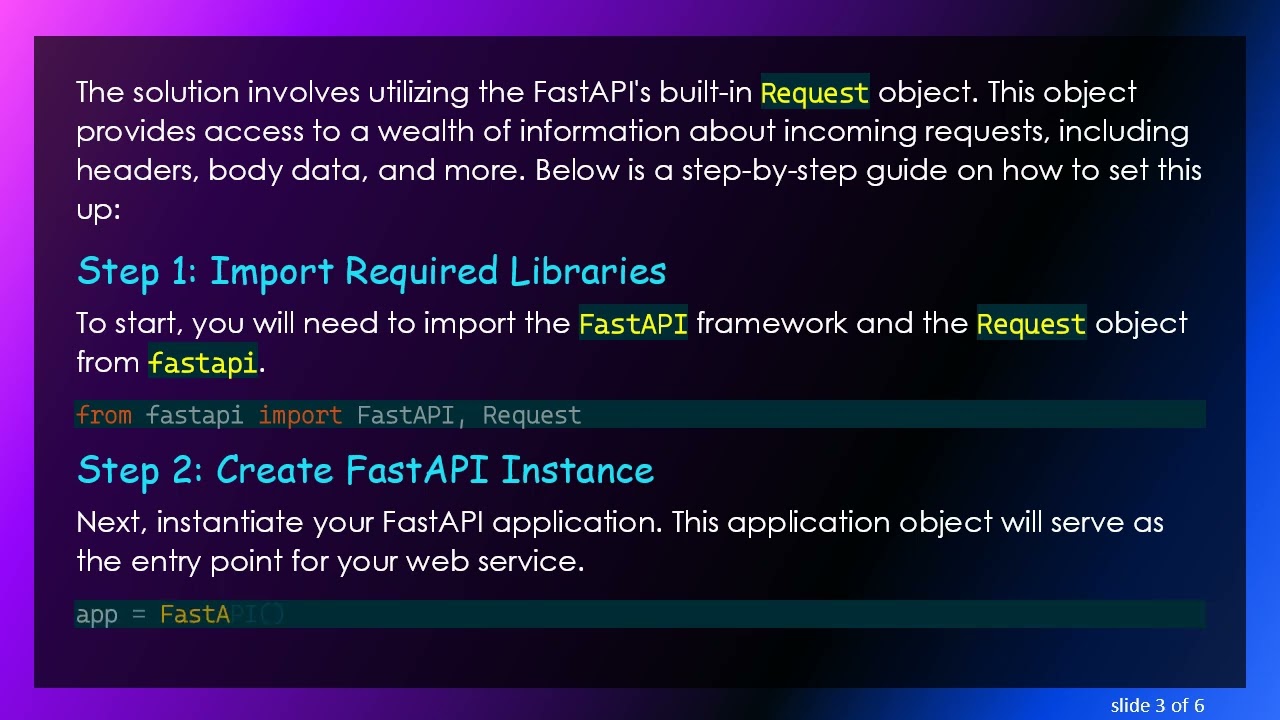
The solution involves utilizing the FastAPI's built-in Request object. This object provides access to a wealth of information about incoming requests, including headers, body data, and more. Below is a step-by-step guide on how to set this up:
Step 1: Import Required Libraries
To start, you will need to import the FastAPI framework and the Request object from fastapi.
[[See Video to Reveal this Text or Code Snippet]]
Step 2: Create FastAPI Instance
Next, instantiate your FastAPI application. This application object will serve as the entry point for your web service.
[[See Video to Reveal this Text or Code Snippet]]
Step 3: Define the Endpoint
Now, define an endpoint (for example, the root / path) that will listen for incoming requests. The function should accept a parameter of type Request to provide access to the request data.
[[See Video to Reveal this Text or Code Snippet]]
Step 4: Sending a Request
When you send a request to this endpoint (e.g., using a tool like Postman or curl), the FastAPI application will log the headers to the console. For example, the output might look like this:
[[See Video to Reveal this Text or Code Snippet]]
Step 5: Extracting Specific Header Values
If you only need to capture a specific header, such as the Accept header, you can modify the function as follows:
[[See Video to Reveal this Text or Code Snippet]]
In this case, the output will simply be:
[[See Video to Reveal this Text or Code Snippet]]
Conclusion
By following these steps, you can easily capture incoming HTTP requests in FastAPI and log essential information like headers and body to the terminal. This practice is invaluable for debugging and ensuring your webhook receiver behaves as expected. With FastAPI's powerful Request object at your disposal, you can efficiently handle and inspect incoming data.
Feel free to explore further by adding functionality to handle the request body or implement additional endpoints as needed. Happy coding!
Доступные форматы для скачивания:
Скачать видео mp4
-
Информация по загрузке: