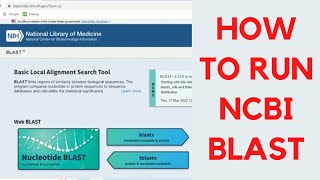
Bioinformatics: NCBI Home Page | Lecture 1 (Part 1) by Dr. Muhammad Naveed
Автор: Dr. Muhammad Naveed
Загружено: 2019-11-06
Просмотров: 61291
Bioinformatics Databases: NCBI: Nucleotide: Gene: Genome: Protein: PubMed:
The National Center for Biotechnology Information (NCBI)[1][2] is part of the United States National Library of Medicine (NLM), a branch of the National Institutes of Health (NIH). The NCBI is located in Bethesda, Maryland and was founded in 1988 through legislation sponsored by Senator Claude Pepper.
The NCBI houses a series of databases relevant to biotechnology and biomedicine and is an important resource for bioinformatics tools and services. Major databases include GenBank for DNA sequences and PubMed, a bibliographic database for the biomedical literature. Other databases include the NCBI Epigenomics database. All these databases are available online through the Entrez search engine. NCBI was directed by David Lipman,[2] one of the original authors of the BLAST sequence alignment program[3] and a widely respected figure in bioinformatics. He also led an intramural research program, including groups led by Stephen Altschul (another BLAST co-author), David Landsman, Eugene Koonin, John Wilbur, Teresa Przytycka, and Zhiyong Lu. David Lipman stood down from his post in May 2017.[4]
GenBank
Main article: GenBank
NCBI has had responsibility for making available the GenBank DNA sequence database since 1992.[5] GenBank coordinates with individual laboratories and other sequence databases such as those of the European Molecular Biology Laboratory (EMBL) and the DNA Data Bank of Japan (DDBJ).[5]
Since 1992, NCBI has grown to provide other databases in addition to GenBank. NCBI provides Gene, Online Mendelian Inheritance in Man, the Molecular Modeling Database (3D protein structures), dbSNP (a database of single-nucleotide polymorphisms), the Reference Sequence Collection, a map of the human genome, and a taxonomy browser, and coordinates with the National Cancer Institute to provide the Cancer Genome Anatomy Project. The NCBI assigns a unique identifier (taxonomy ID number) to each species of organism.[6]
The NCBI has software tools that are available by WWW browsing or by FTP. For example, BLAST is a sequence similarity searching program. BLAST can do sequence comparisons against the GenBank DNA database in less than 15 seconds.
Entrez
The Entrez Global Query Cross-Database Search System is used at NCBI for all the major databases such as Nucleotide and Protein Sequences, Protein Structures, PubMed, Taxonomy, Complete Genomes, OMIM, and several others.[10] Entrez is both indexing and retrieval system having data from various sources for biomedical research. NCBI distributed the first version of Entrez in 1991, composed of nucleotide sequences from PDB and GenBank, protein sequences from SWISS-PROT, translated GenBank, PIR, PRF , PDB and associated abstracts and citations from PubMed. Entrez is specially designed to integrate the data from several different sources, databases and formats into a uniform information model and retrieval system which can efficiently retrieve that relevant references, sequences and structures.[11]
Gene
Gene has been implemented at NCBI to characterize and organize the information about genes. It serves as a major node in the nexus of genomic map, expression, sequence, protein function, structure and homology data. A unique GeneID is assigned to each gene record that can be followed through revision cycles. Gene records for known or predicted genes are established here and are demarcated by map positions or nucleotide sequence. Gene has several advantages over its predecessor, LocusLink, including, better integration with other databases in NCBI, broader taxonomic scope, and enhanced options for query and retrieval provided by Entrez system.[12]
Protein
Protein database maintains the text record for individual protein sequences, derived from many different resources such as NCBI Reference Sequence (RefSeq) project, GenBank, PDB and UniProtKB/SWISS-Prot. Protein records are present in different formats including FASTA and XML and are linked to other NCBI resources. Protein provides the relevant data to the users such as genes, DNA/RNA sequences, biological pathways, expression and variation data and literature. It also provides the pre-determined sets of similar and identical proteins for each sequence as computed by the BLAST. The Structure database of NCBI contains 3D coordinate sets for experimentally-determined structures in PDB that are imported by NCBI. The Conserved Domain database (CDD) of protein contains sequence profiles that characterize highly conserved domains within protein sequences. It also has records from external resources like SMART and Pfam. There is another database in protein known as Protein Clusters database which contains sets of proteins sequences that are clustered according to the maximum alignments between the individual sequences as calculated by BLAST.[13]
#NCBI #Nuleotide #Databases

Доступные форматы для скачивания:
Скачать видео mp4
-
Информация по загрузке: