Resolving the Ksqldb MAP Function Issue for Custom UDF Handling
Автор: vlogize
Загружено: 2025-09-16
Просмотров: 1
Encountering `null` outputs when using the MAP function in Ksqldb? Discover how to effectively use `AS_MAP()` to achieve desired results even with null values in your data.
---
This video is based on the question https://stackoverflow.com/q/62674452/ asked by the user 'Sanjay Nayak' ( https://stackoverflow.com/u/10875944/ ) and on the answer https://stackoverflow.com/a/62793517/ provided by the user 'Sanjay Nayak' ( https://stackoverflow.com/u/10875944/ ) at 'Stack Overflow' website. Thanks to these great users and Stackexchange community for their contributions.
Visit these links for original content and any more details, such as alternate solutions, latest updates/developments on topic, comments, revision history etc. For example, the original title of the Question was: MAP scalar function issue in Ksqldb
Also, Content (except music) licensed under CC BY-SA https://meta.stackexchange.com/help/l...
The original Question post is licensed under the 'CC BY-SA 4.0' ( https://creativecommons.org/licenses/... ) license, and the original Answer post is licensed under the 'CC BY-SA 4.0' ( https://creativecommons.org/licenses/... ) license.
If anything seems off to you, please feel free to write me at vlogize [AT] gmail [DOT] com.
---
Resolving the Ksqldb MAP Function Issue for Custom UDF Handling
In the realm of streaming databases and data processing, handling null values can often present challenges, particularly when utilizing functions to manipulate data structures like maps. This problem becomes even more apparent when working with KSQLDB (KSQL for Apache Kafka). In this guide, we will discuss a typical issue related to the use of the MAP scalar function in KSQLDB, and how to effectively resolve it by using AS_MAP() instead.
The Problem: MAP Function Outputs Null
The issue arises when you have a custom User-Defined Function (UDF) that takes a Map<String, String> as input. Consider the following scenario: you are creating a KSQL stream and populating it with MAP data, but encounter an unexpected behavior.
The Setup
Let's start with the KSQL stream you are attempting to create:
[[See Video to Reveal this Text or Code Snippet]]
You then test the query with insert statements like:
[[See Video to Reveal this Text or Code Snippet]]
Here are the actual and preferred outputs you expect:
Actual Output:
[[See Video to Reveal this Text or Code Snippet]]
Preferred Output:
[[See Video to Reveal this Text or Code Snippet]]
The Issue Explained
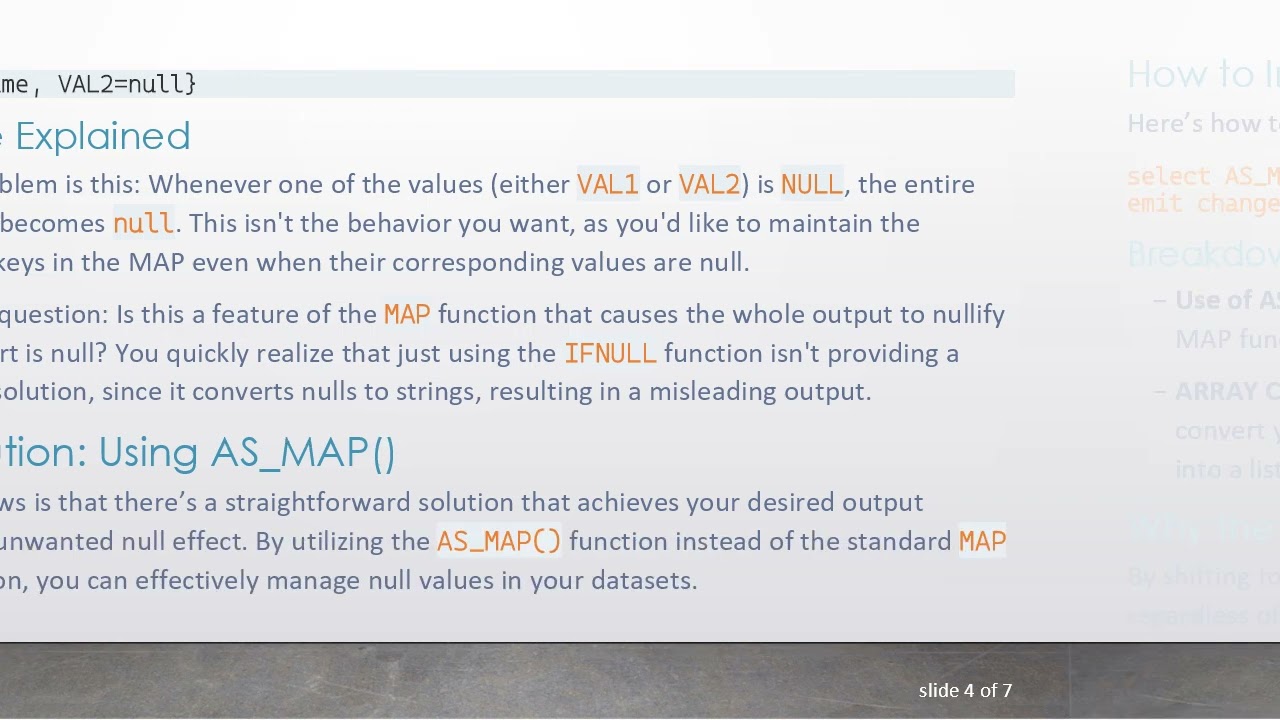
The core problem is this: Whenever one of the values (either VAL1 or VAL2) is NULL, the entire MAP output becomes null. This isn't the behavior you want, as you'd like to maintain the presence of keys in the MAP even when their corresponding values are null.
This raises a question: Is this a feature of the MAP function that causes the whole output to nullify when any part is null? You quickly realize that just using the IFNULL function isn't providing a satisfactory solution, since it converts nulls to strings, resulting in a misleading output.
The Solution: Using AS_MAP()
The good news is that there’s a straightforward solution that achieves your desired output without the unwanted null effect. By utilizing the AS_MAP() function instead of the standard MAP scalar function, you can effectively manage null values in your datasets.
How to Implement AS_MAP
Here’s how to modify your KSQL query to achieve the preferred output:
[[See Video to Reveal this Text or Code Snippet]]
Breakdown of the Solution
Use of AS_MAP: This function is designed for exactly this kind of scenario where the standard MAP function falls short.
ARRAY Conversion: The AS_MAP function takes lists as input; hence the use of ARRAY to convert your keys (['VAL1', 'VAL2']) and values ([VAL1, CAST(VAL2 as STRING)]) into a list format.
Why the Change Matters
By shifting to the AS_MAP() function, you ensure that each key remains present in the output, regardless of whether its associated value is null. The outputs will be as follows:
Modified Output:
[[See Video to Reveal this Text or Code Snippet]]
This approach not only retains the structure of your data but also provides clarity in your dataset analysis.
Conclusion
Dealing with null values in any data stream can be tricky, but utilizing the right functions in KSQLDB can help mitigate these issues effectively. By employing AS_MAP() instead of the standard MAP, you can manage your key-value pairs accurately while maintaining the integrity of your data, making analysis and further processing seamless.
If you are tackling similar challenges within KSQLDB or other data streaming environments, remember to think critically about the functions you use and how they handle edge cases like null values. Happy querying!
Доступные форматы для скачивания:
Скачать видео mp4
-
Информация по загрузке:


