How to Properly Type the onIonChange Event Handler in Ionic React Using TypeScript
Автор: vlogize
Загружено: 2025-09-26
Просмотров: 1
Discover how to correctly type the `onIonChange` event handler in Ionic React with TypeScript. Learn effective solutions and best practices.
---
This video is based on the question https://stackoverflow.com/q/63077247/ asked by the user 'rakitin' ( https://stackoverflow.com/u/981556/ ) and on the answer https://stackoverflow.com/a/63082568/ provided by the user 'Aaron Saunders' ( https://stackoverflow.com/u/122313/ ) at 'Stack Overflow' website. Thanks to these great users and Stackexchange community for their contributions.
Visit these links for original content and any more details, such as alternate solutions, latest updates/developments on topic, comments, revision history etc. For example, the original title of the Question was: Ionic react: How to properly type (typescript) event object parameter in delegated anonymous onIonChange event handler
Also, Content (except music) licensed under CC BY-SA https://meta.stackexchange.com/help/l...
The original Question post is licensed under the 'CC BY-SA 4.0' ( https://creativecommons.org/licenses/... ) license, and the original Answer post is licensed under the 'CC BY-SA 4.0' ( https://creativecommons.org/licenses/... ) license.
If anything seems off to you, please feel free to write me at vlogize [AT] gmail [DOT] com.
---
How to Properly Type the onIonChange Event Handler in Ionic React Using TypeScript
When developing applications with Ionic React, you may encounter scenarios where using TypeScript for type safety becomes challenging. One common issue arises when trying to properly type the event object parameter in delegated anonymous onIonChange event handlers, especially when using libraries like react-hook-form. This guide aims to solve that problem by providing clear steps to type the onIonChange event correctly.
The Problem Statement
In a practical scenario, a developer using react-hook-form with an IonCheckbox component may face typing errors. When modifying the state based on the onIonChange event, the developer needs to ensure they are using the correct event types. Failing to do so could lead to TypeScript compiler errors or even runtime issues.
Common Issues Faced
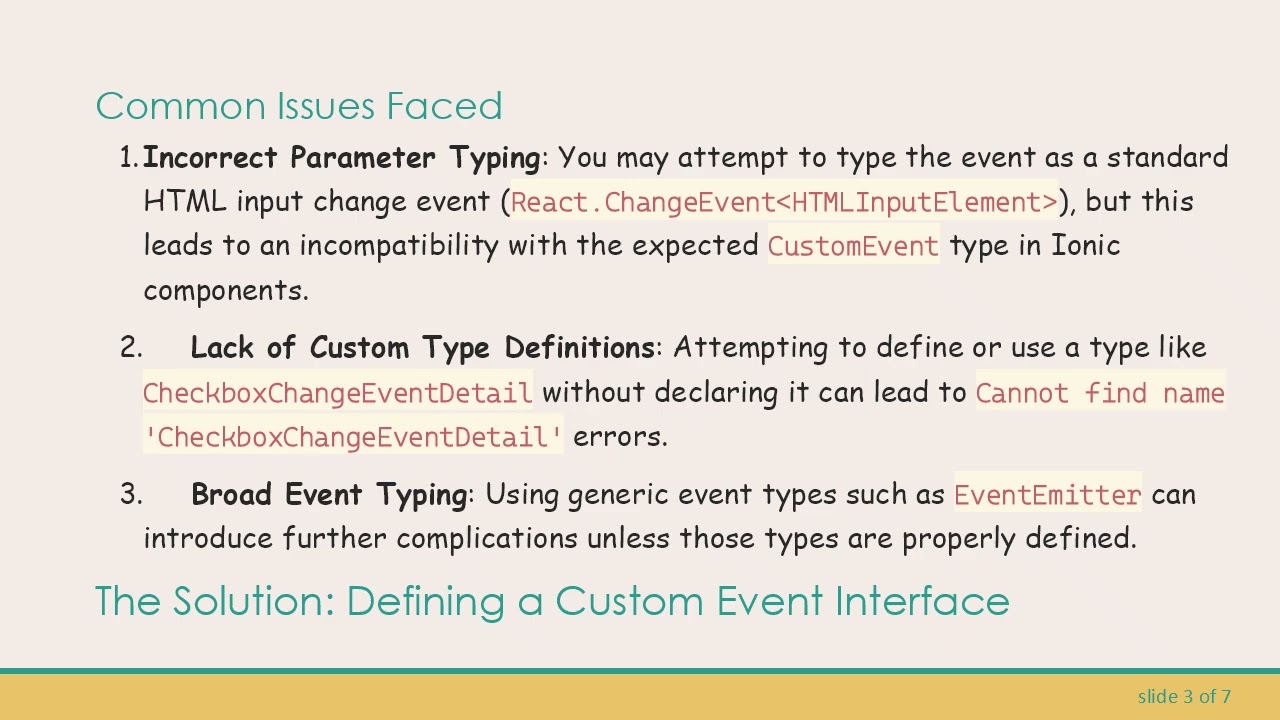
Incorrect Parameter Typing: You may attempt to type the event as a standard HTML input change event (React.ChangeEvent<HTMLInputElement>), but this leads to an incompatibility with the expected CustomEvent type in Ionic components.
Lack of Custom Type Definitions: Attempting to define or use a type like CheckboxChangeEventDetail without declaring it can lead to Cannot find name 'CheckboxChangeEventDetail' errors.
Broad Event Typing: Using generic event types such as EventEmitter can introduce further complications unless those types are properly defined.
The Solution: Defining a Custom Event Interface
To address the typing issues effectively, follow these straightforward steps to establish the necessary interface and utilize it within your component.
Step 1: Create the Custom Event Interface
You need to define an interface that outlines the shape of the event details you expect. Here’s how you can do it:
[[See Video to Reveal this Text or Code Snippet]]
Step 2: Implement the Event Handler with Proper Typing
Now that you have the interface, you can implement the onIonChange handler in your IonCheckbox component. Here is the modified code:
[[See Video to Reveal this Text or Code Snippet]]
Key Points in the Above Code:
Type Definition: The CustomEvent<CheckboxChangeEventDetail> provides TypeScript with the necessary context on what the event's detail object should contain.
State Management: The onChange method is called with the value of e.detail.checked, ensuring that your state management aligns with the expected value from the checkbox.
Debugging Information: The console.log(e) statement helps track the event object in the console, aiding in debugging if needed.
Conclusion
By following these steps, you can properly type the onIonChange event handler in your Ionic React apps using TypeScript. This approach not only enhances code readability but also ensures type safety, making your development experience smoother and more robust. Avoid ignoring TypeScript errors with @ ts-ignore comments and instead, define clear custom types to leverage the full benefits of TypeScript.
Remember, implementing these typing practices from the start will reduce bugs and improve the maintainability of your project. Happy coding!
Доступные форматы для скачивания:
Скачать видео mp4
-
Информация по загрузке:








![JavaScript - Полный Курс JavaScript Для Начинающих [11 ЧАСОВ]](https://image.4k-video.ru/id-video/CxgOKJh4zWE)


![Python - Полный Курс по Python [15 ЧАСОВ]](https://image.4k-video.ru/id-video/cfJrtx-k96U)