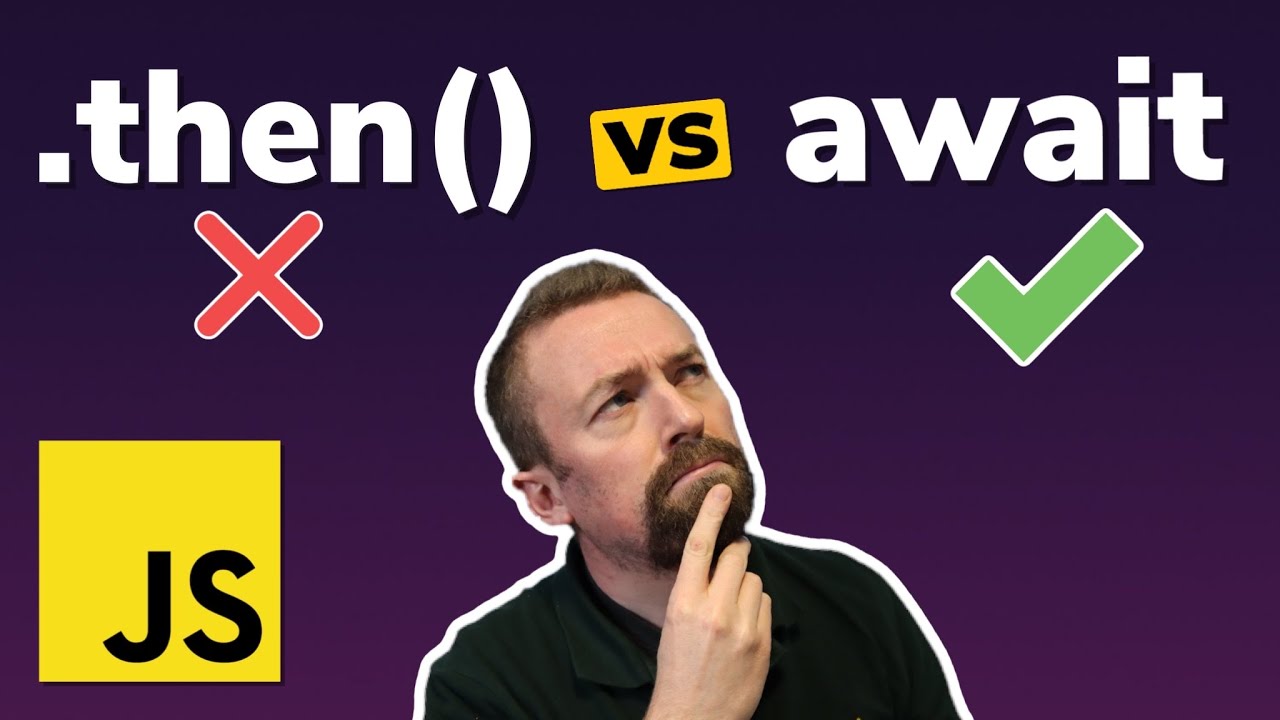
Understanding Promise Error Handling: Why .catch() Can Call .then()
Автор: vlogize
Загружено: 2025-05-28
Просмотров: 0
Dive into the world of JavaScript promises to discover why the order of `.catch()` and `.then()` can impact your error handling. Learn how to manage errors effectively in this guide!
---
This video is based on the question https://stackoverflow.com/q/66931012/ asked by the user 'Trystan Sarrade' ( https://stackoverflow.com/u/6061090/ ) and on the answer https://stackoverflow.com/a/66931234/ provided by the user 'charlietfl' ( https://stackoverflow.com/u/1175966/ ) at 'Stack Overflow' website. Thanks to these great users and Stackexchange community for their contributions.
Visit these links for original content and any more details, such as alternate solutions, latest updates/developments on topic, comments, revision history etc. For example, the original title of the Question was: Why Promise.catch() also call .then() if it is not in the right order?
Also, Content (except music) licensed under CC BY-SA https://meta.stackexchange.com/help/l...
The original Question post is licensed under the 'CC BY-SA 4.0' ( https://creativecommons.org/licenses/... ) license, and the original Answer post is licensed under the 'CC BY-SA 4.0' ( https://creativecommons.org/licenses/... ) license.
If anything seems off to you, please feel free to write me at vlogize [AT] gmail [DOT] com.
---
Understanding Promise Error Handling: Why .catch() Can Call .then()
In the realm of JavaScript, promises are a fundamental part of managing asynchronous operations. They provide a cleaner way to handle asynchronous logic, particularly when it comes to dealing with errors. But you might have stumbled upon a puzzling situation when working with promises: Why does .catch() also call .then() if it’s not in the right order? Let's break down this common conundrum and clarify how promise chaining works in JavaScript.
The Problem
Consider the following promise code:
[[See Video to Reveal this Text or Code Snippet]]
In this example, calling testpromise() results in an error being logged, but it also logs "Then". This seems counterintuitive, especially when you compare it with this slightly modified version:
[[See Video to Reveal this Text or Code Snippet]]
Here, if you catch an error, "Then" is not logged. This raises the question: is there a bug in how promises work? Why does the order of .catch() and .then() matter?
Understanding the Promise Behavior
Promises and Chaining
Promises in JavaScript have a distinctive chaining behavior:
Each promise returns a new promise after every .then() or .catch().
If the current promise is resolved, the next .then() in the chain is executed.
If it’s rejected, the next .catch() is invoked.
The Role of .catch()
The .catch() method not only handles errors but also returns a new promise. If you handle the error in the .catch(), the promise is considered resolved again, which allows processing to continue down the chain.
Example Breakdown:
Let's visualize the behavior of the promise using this simplified example:
[[See Video to Reveal this Text or Code Snippet]]
First catch gets logged because an error is encountered.
The value returned in the catch ('Catch message') is sent to the next .then(), which results in logging "from first catch = Catch message".
Chaining further down
But what happens if you apply another promise in the chain:
[[See Video to Reveal this Text or Code Snippet]]
Here Not called will never execute because New Error causes the chain to reject again, rolling over to the second .catch().
Conclusion
The takeaway here is clear: the order of your .catch() and .then() matters. When you place .catch() before .then(), you're no longer guaranteed that the promise will resolve in a way that allows subsequent .then() calls to execute successfully. It’s critical to understand how promises behave to maintain clean error handling and effective flows in your asynchronous code.
By memorizing these principles and practicing proper promise chaining, your JavaScript promises will become more manageable and easier to debug. Feel empowered to write robust code and tackle any promise-related challenges that come your way!

Доступные форматы для скачивания:
Скачать видео mp4
-
Информация по загрузке: