Understanding TypeScript's type inference with Function Type Guards
Автор: vlogize
Загружено: 2025-10-12
Просмотров: 0
Learn why TypeScript's type inference may fail with function type guards and how to properly implement checks for null values.
---
This video is based on the question https://stackoverflow.com/q/64030017/ asked by the user 'Petro Ivanenko' ( https://stackoverflow.com/u/14110050/ ) and on the answer https://stackoverflow.com/a/64030094/ provided by the user 'Brian Pfretzschner' ( https://stackoverflow.com/u/4252929/ ) at 'Stack Overflow' website. Thanks to these great users and Stackexchange community for their contributions.
Visit these links for original content and any more details, such as alternate solutions, latest updates/developments on topic, comments, revision history etc. For example, the original title of the Question was: Typescript type inference does not work with function type guards
Also, Content (except music) licensed under CC BY-SA https://meta.stackexchange.com/help/l...
The original Question post is licensed under the 'CC BY-SA 4.0' ( https://creativecommons.org/licenses/... ) license, and the original Answer post is licensed under the 'CC BY-SA 4.0' ( https://creativecommons.org/licenses/... ) license.
If anything seems off to you, please feel free to write me at vlogize [AT] gmail [DOT] com.
---
Understanding TypeScript's type inference with Function Type Guards
TypeScript is a powerful programming language that adds optional static typing to JavaScript. One of its benefits is type inference, which allows the compiler to automatically deduce the type of a variable based on its value. However, you may run into situations where TypeScript's type inference does not behave as expected, especially when dealing with function type guards. In this guide, we'll explore a specific case involving function type guards and why you might encounter compilation errors, even when your logic seems sound.
The Problem: Compilation Errors with Function Type Guards
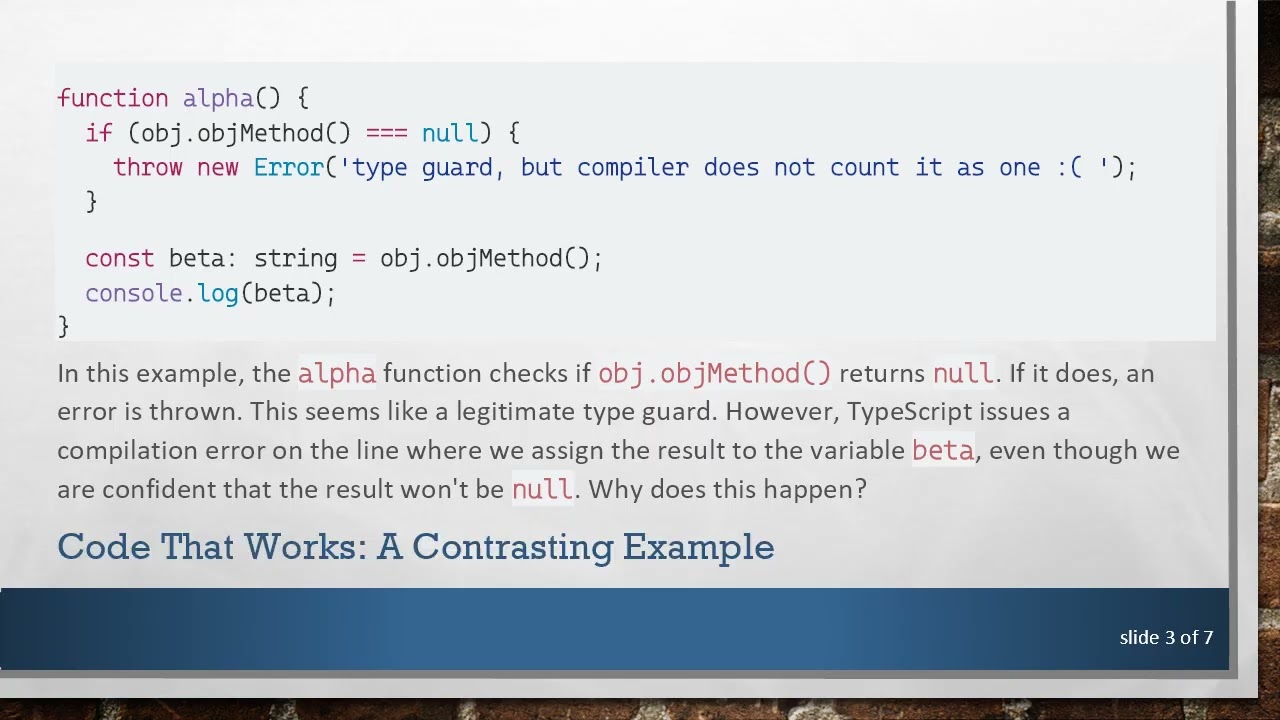
Consider the following code snippet:
[[See Video to Reveal this Text or Code Snippet]]
In this example, the alpha function checks if obj.objMethod() returns null. If it does, an error is thrown. This seems like a legitimate type guard. However, TypeScript issues a compilation error on the line where we assign the result to the variable beta, even though we are confident that the result won't be null. Why does this happen?
Code That Works: A Contrasting Example
On the other hand, consider the following code snippet which behaves as expected:
[[See Video to Reveal this Text or Code Snippet]]
In this version, we first assign the result of obj.objMethod() to a variable named result. The null check is then performed on result, and the assignment to beta happens without any complications. This is due to TypeScript safely inferring that the value of result cannot change after its assignment.
The Explanation: Why TypeScript Fails Here
TypeScript's type inference behavior stems from its inability to guarantee that the objMethod() will always return the same value on subsequent calls. Here’s what’s happening:
Variable vs. Function Call: When you directly call obj.objMethod() within the if statement, TypeScript cannot assure that it will return a non-null value in subsequent calls. This uncertainty is inherent because the method could return a non-null value during one call and a null during another.
Const Variables and Type Guards: On the other hand, when you assign the result of obj.objMethod() to a constant variable (e.g., result), TypeScript recognizes that the variable cannot change. By checking result for null, you are effectively establishing a boundary where TypeScript can confidently assert that the value will not be null when you assign it to beta.
Key Takeaways
To avoid these type inference issues in TypeScript:
Assign the Result: Always assign the output of a function that can return multiple types to a variable before performing checks. This way, TypeScript can track the value and its type consistently.
Understand Type Guard Mechanisms: Grasp how TypeScript interprets type guards and how it evaluates conditions based on variable assignments.
Conclusion
While TypeScript is robust, it does have caveats when it comes to type inference and function type guards. By adhering to some best practices—such as assigning function results to variables before performing checks—you can leverage TypeScript's type system more effectively and avoid unexpected compilation errors. Happy coding!
Доступные форматы для скачивания:
Скачать видео mp4
-
Информация по загрузке:







![Курс Python с Абсолютного нуля! [12 часов из 80] Python курс - качественный старт для начинающих!](https://image.4k-video.ru/id-video/lYMLLI-MJek)


