Building a Seamless Reactive Web Service with Spring Boot
Автор: vlogize
Загружено: 2025-07-30
Просмотров: 1
Discover how to create a high-performing REST API using Spring Boot's Reactive WebFlux. Learn about client compatibility and maximizing service efficiency.
---
This video is based on the question https://stackoverflow.com/q/67991772/ asked by the user 'jana' ( https://stackoverflow.com/u/7202656/ ) and on the answer https://stackoverflow.com/a/67998407/ provided by the user 'Oten' ( https://stackoverflow.com/u/12895663/ ) at 'Stack Overflow' website. Thanks to these great users and Stackexchange community for their contributions.
Visit these links for original content and any more details, such as alternate solutions, latest updates/developments on topic, comments, revision history etc. For example, the original title of the Question was: Spring Boot Reactive WebService
Also, Content (except music) licensed under CC BY-SA https://meta.stackexchange.com/help/l...
The original Question post is licensed under the 'CC BY-SA 4.0' ( https://creativecommons.org/licenses/... ) license, and the original Answer post is licensed under the 'CC BY-SA 4.0' ( https://creativecommons.org/licenses/... ) license.
If anything seems off to you, please feel free to write me at vlogize [AT] gmail [DOT] com.
---
Understanding the Challenge: Building a High-Performance REST API
In today's fast-paced digital landscape, applications need to handle high request volumes without compromising performance. When building your REST API, you may find yourself wondering about the best approach to meet these demands. Specifically, you might consider using Spring Boot Reactive (WebFlux) or Spring Boot Async to manage concurrency effectively.
However, as diverse clients connect to your API, a key concern arises—will your chosen framework support all types of clients seamlessly? In this post, we will delve into the intricacies of building a robust, reactive web service and clarify the compatibility of different clients.
The Promise of Reactive Programming in Spring Boot
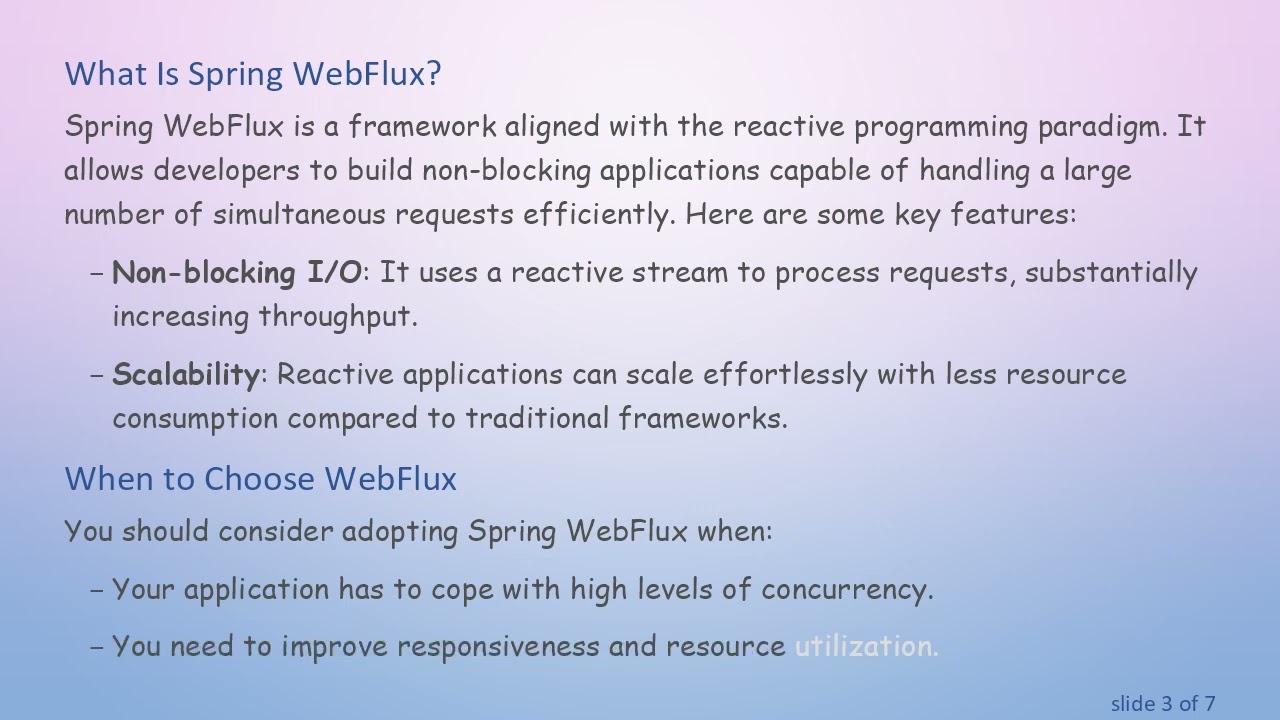
What Is Spring WebFlux?
Spring WebFlux is a framework aligned with the reactive programming paradigm. It allows developers to build non-blocking applications capable of handling a large number of simultaneous requests efficiently. Here are some key features:
Non-blocking I/O: It uses a reactive stream to process requests, substantially increasing throughput.
Scalability: Reactive applications can scale effortlessly with less resource consumption compared to traditional frameworks.
When to Choose WebFlux
You should consider adopting Spring WebFlux when:
Your application has to cope with high levels of concurrency.
You need to improve responsiveness and resource utilization.
You want to maintain a high throughput under variable loads.
Client Compatibility: A Major Concern
When developing a reactive REST API, it’s vital to understand the implications of client compatibility. A common question is whether clients using traditional synchronous methods, like RestTemplate, can consume a reactive service.
The Answer to Client Compatibility
Yes! Your non-blocking or traditional clients can still consume a reactive service that you build. Here’s why:
Reactive APIs are designed to work with a variety of clients. Clients that utilize synchronous methods will still be able to make requests and receive responses from your reactive service.
Backwards Compatibility: Spring's design ensures that even clients using RestTemplate (a blocking client) can interact with your APIs without requiring them to switch to WebClient, which is optimized for reactive programming.
How to Build a Seamless Reactive Web API
To create a reactive REST API using Spring Boot that can cater to both reactive and traditional requests, follow these steps:
Initialize Your Spring Boot Application: Set up a new Spring Boot project with the necessary dependencies for WebFlux.
Define Your Data Model: Create the necessary data structures and models that your API will work with.
Create Reactive Repositories: Use Spring Data's reactive repositories to manage CRUD operations asynchronously.
Build Your REST Controllers: Implement controllers that will handle incoming requests, returning Mono or Flux (the reactive types provided by Project Reactor):
[[See Video to Reveal this Text or Code Snippet]]
Test with Different Clients: Ensure that both RestTemplate and WebClient clients can successfully call your newly created API endpoints.
Conclusion
Building a REST API using Spring Boot Reactive not only enhances performance but also ensures that various clients can engage with your service without a hitch. By employing WebFlux, you harness the power of non-blocking operations while maintaining compatibility with traditional synchronous clients.
In summary, you can confidently build a high-performance API that serves a diverse clientele, irrespective of their underlying technology stack. The key takeaway? Your non-blocking clients will seamlessly interact with your reactive services. So why
Доступные форматы для скачивания:
Скачать видео mp4
-
Информация по загрузке:


