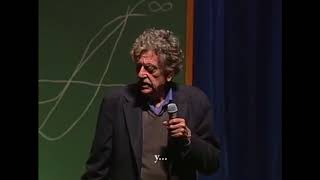
"I'm a First Amendment absolutist": Kurt Vonnegut Interview (1991)
Автор: TMH
Загружено: 2024-04-02
Просмотров: 720
Kurt Vonnegut (November 11, 1922 – April 11, 2007) was an American writer and humorist known for his satirical and darkly humorous novels. In a career spanning over 50 years, he published fourteen novels, three short-story collections, five plays, and five nonfiction works; further collections have been published after his death.
Born and raised in Indianapolis, Vonnegut attended Cornell University but withdrew in January 1943 and enlisted in the US Army. As part of his training, he studied mechanical engineering at the Carnegie Institute of Technology (now Carnegie Mellon University) and the University of Tennessee. He was then deployed to Europe to fight in World War II and was captured by the Germans during the Battle of the Bulge. He was interned in Dresden, where he survived the Allied bombing of the city in a meat locker of the slaughterhouse where he was imprisoned. After the war, he married Jane Marie Cox, with whom he had three children. Vonnegut adopted three of his sister's sons after she died of cancer and her husband was killed in a train accident. He and his wife both attended the University of Chicago, while he worked as a night reporter for the City News Bureau.
Vonnegut published his first novel, Player Piano, in 1952. The novel received positive reviews but was not commercially successful at the time. In the nearly 20 years that followed, he published several novels that were well regarded, two of which—The Sirens of Titan (1959) and Cat's Cradle (1963)—were nominated for the Hugo Award for best science fiction or fantasy novel of the year. He published a short-story collection titled Welcome to the Monkey House in 1968. His breakthrough was his commercially and critically successful sixth novel, Slaughterhouse-Five (1969). The book's anti-war sentiment resonated with its readers amidst the ongoing Vietnam War, and its reviews were generally positive. Slaughterhouse-Five rose to the top of The New York Times Best Seller list and made Vonnegut famous. He gave speeches, lectures, and commencement addresses; he received awards and honors.
Later in his career, Vonnegut published autobiographical essays and short-story collections, such as Fates Worse Than Death (1991) and A Man Without a Country (2005). After his death, he was hailed as one of the most important contemporary writers and a dark humor commentator on American society. His son Mark published a compilation of his unpublished works, Armageddon in Retrospect, in 2008. In 2017, Seven Stories Press published Complete Stories, a collection of Vonnegut's short fiction, including five previously unpublished stories. Complete Stories was collected and introduced by Vonnegut friends and scholars Jerome Klinkowitz and Dan Wakefield. Scholarly works have examined Vonnegut's writing and humor.
Vonnegut's life and work also share similarities with that of Adventures of Huckleberry Finn writer Mark Twain. Both shared pessimistic outlooks on humanity and a skeptical take on religion and, as Vonnegut put it, were both "associated with the enemy in a major war", as Twain briefly enlisted in the South's cause during the American Civil War, and Vonnegut's German name and ancestry connected him with the United States' enemy in both world wars. He also cited Ambrose Bierce as an influence, calling "An Occurrence at Owl Creek Bridge" the greatest American short story and deeming any who disagreed or had not read the story "twerps".
Vonnegut called George Orwell his favorite writer and admitted that he tried to emulate Orwell. "I like his concern for the poor, I like his socialism, I like his simplicity", Vonnegut said. Vonnegut also said that Orwell's Nineteen Eighty-Four and Brave New World by Aldous Huxley heavily influenced his debut novel, Player Piano, in 1952. The novel also included ideas from mathematician Norbert Wiener's book Cybernetics: Or Control and Communication in the Animal and the Machine. Vonnegut commented that Robert Louis Stevenson's stories were emblems of thoughtfully put together works that he tried to mimic in his own compositions. Vonnegut also hailed playwright and socialist George Bernard Shaw as "a hero of [his]" and an "enormous influence".
Early on in his career, Vonnegut decided to model his style after Henry David Thoreau, who wrote as if from the perspective of a child, allowing Thoreau's works to be more widely comprehensible. Using a youthful narrative voice allowed Vonnegut to deliver concepts in a modest and straightforward way. Other influences on Vonnegut include The War of the Worlds author H. G. Wells and satirist Jonathan Swift. Vonnegut credited American journalist and critic H. L. Mencken for inspiring him to become a journalist.

Доступные форматы для скачивания:
Скачать видео mp4
-
Информация по загрузке: