PICENG422 Design of a Tennessee Eastman Plant
Автор: Bassam Alhamad
Загружено: 2020-03-26
Просмотров: 2149
This project aims to provide students with the opportunity to work in teams in order to solve an open system- Tennessee Eastman Process, industrial problem based on the design of the control system for one or more unit operations or complete plant. The Dynamic simulation software and base value data is made available as design aids to determine the steady state and dynamic data for the open system problem. The challenge is to perform the following tasks: (1) select the control system configuration (s). (2) Specify the measurement system and final control element, and (3) select and tune the process controllers. (4) Economical, Safety and environmental aspects. This will hasten the students in the development of employability skills such as project management, presentation of work, research and commercial awareness in order to support problem solving in a technical context. Practical issues or constraints - such as process economics, plant controllability, health, safety, environment and ethics - facing the professional in the workplace will also be perpetuated.
Statement of the Problem
Introduction
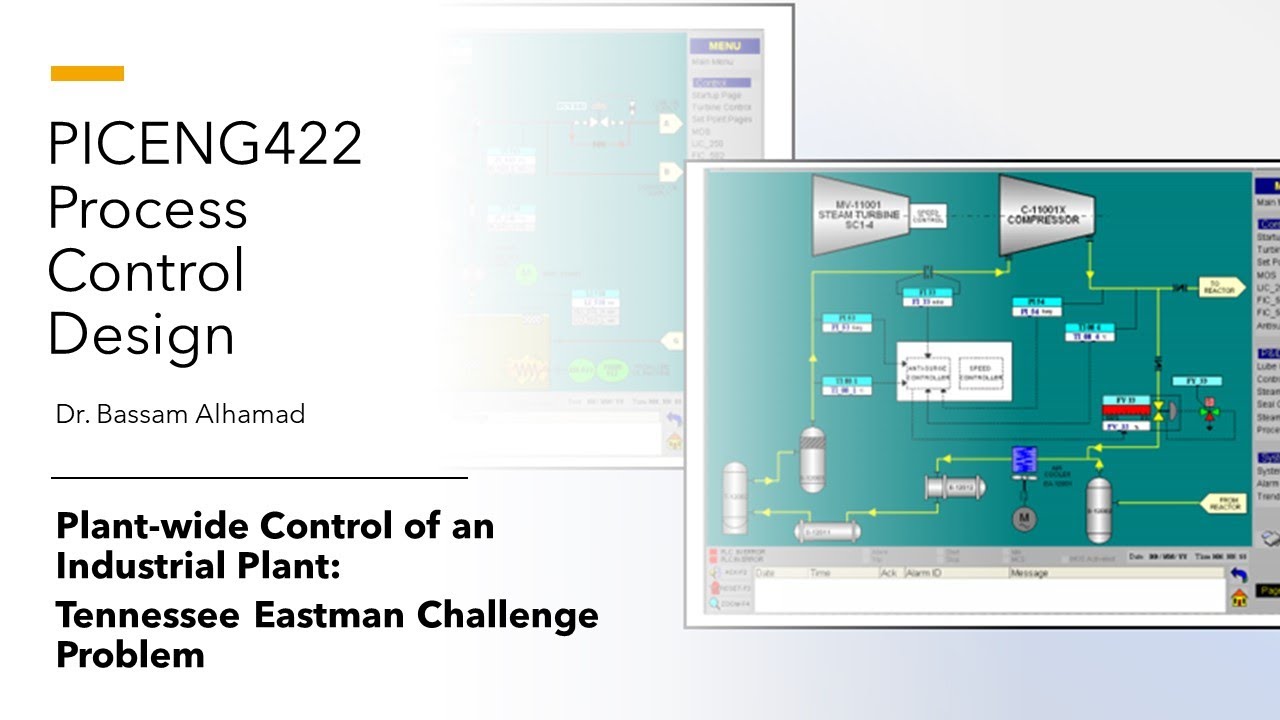
Downs and Vogel resented a complex control and optimization problem based on an industrial recycle reactor process. The Tennessee Eastman (TE) challenge process (see Fig. 1) was an open loop, unstable system consisting of four process units: an exothermic reactor, a flash separator, a reboiled stripper, and a recycle compressor. Depending on the current market demands, the process was operated at a fixed production rate or maximum production rate for three different product grades, shown in Table 1. A number of known and unknown process disturbances affected the feed compositions, feed flows, and reaction properties.
Gas reactants entered the reactor where the reactants undergo irreversible, exothermic, catalytic, gas phase reactions. The reaction rates were approximately first order and with an Arrhenius temperature dependence. The first reaction was more sensitive to temperature because of the higher activation energy. The products, due to moderate volatility, exit the reactor with unreacted gases.
The partial condenser recovered the products from the reactor exit gas stream. The stripper was used to minimize the loss of reactants D and E in the liquid product stream. The gas overhead from the stripper was combined with the compressed overhead from the separator and recycled back to the reactor. The purge stream was used to prevent buildup of excess reactants, the inert B, and the by-product F.
The control objectives for this process are typical for a chemical process:
1- Maintain process variables at desired values.
2- Keep process operating conditions within equipment constraints
3- Minimize variability of product rate and product quality during disturbances (stream 11).
4- Minimize movement of valves which affect other processes
5- Recover quickly and smoothly from disturbances, production rate changes or product mix changes
Scope of the Work
You are asked to produce two alternative proposals for TE process to cover the design of control strategy used for:
1. Decisions concerning the controller structure (Start up procedure).
2. Controller tuning parameters.
3. Design controllers to reject local disturbances.
4. Add stabilizing controllers
5. A multi-layered approach consisting of the following tasks given below has to be addressed:
IDV( 1) Step change
IDV(4) Step change
IDV(8) Random variation
IDV( 12), IDV(15) Simultaneous random variation and sticking valve.
Production rate change
Product mix change
Reactor operating pressure change
Magnitude
-15%
Make a step change to the variable(s) used to set the process production rate so that the product flow leaving the stripper column base changes from 14,228 to 12,094 kg h-1 MG/5OH to 4OG/6OH
Make a step change to the variable uwd to ensure correct product composition so that the product production rates of G and H change from 7038 kg h-1 G to 5630kgh-‘G and from 7038kgh-‘H to 8446kgh-‘H
-60 kPa
Make a step change so that the reactor operating pressure changes from 2705 to 2645 kPa
Purge gas composition of component B change
Step +2%
Make a step change so that the composition of component B in the gas purge changes from 13.82 to 15.82%
Доступные форматы для скачивания:
Скачать видео mp4
-
Информация по загрузке: