Популярное

Музыка Кино и Анимация Автомобили Животные Спорт Путешествия Игры Юмор

Интересные видео

2025 Сериалы Трейлеры Новости Как сделать Видеоуроки Diy своими руками

Топ запросов

смотреть а4 schoolboy runaway турецкий сериал смотреть мультфильмы эдисон
dTub
Скачать

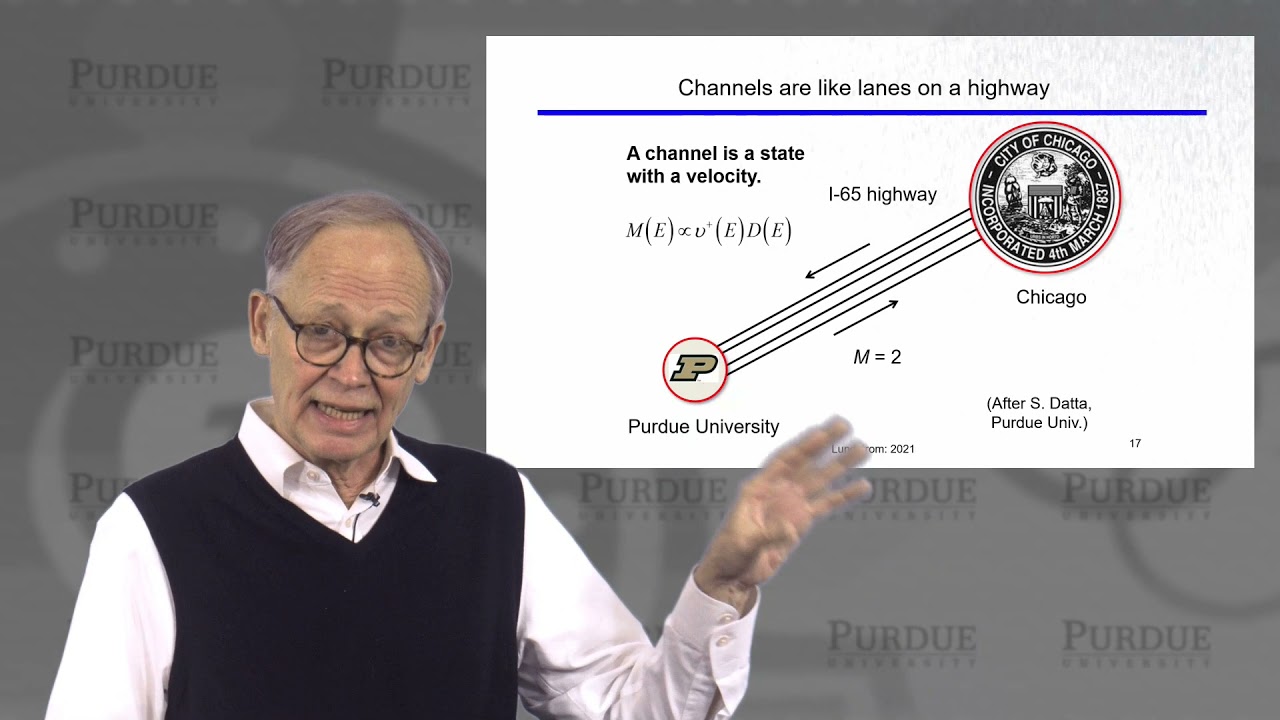
CE Purdue Semiconductor Fundamentals L4.1: Carrier Transport - Landauer Approach

Автор: nanohubtechtalks

Загружено: 2021-05-04

Просмотров: 5943

Описание:

Table of Contents available below.


This video is part of the course "Semiconductor Fundamentals" taught by Mark Lundstrom at Purdue University. The course can be found on nanoHUB.org at https://nanohub.org/courses/sfun or on edX at https://www.edx.org/course/semiconduc... .

This course provides the essential foundations required to understand the operation of semiconductor devices such as transistors, diodes, solar cells, light-emitting devices, and more. The material will primarily appeal to electrical engineering students whose interests are in applications of semiconductor devices in circuits and systems. The treatment is physical and intuitive, and not heavily mathematical.


Technology users will gain an understanding of the semiconductor physics that is the basis for devices. Semiconductor technology developers may find it a useful starting point for diving deeper into condensed matter physics, statistical mechanics, thermodynamics, and materials science. The course presents an electrical engineering perspective on semiconductors, but those in other fields may find it a useful introduction to the approach that has guided the development of semiconductor technology for the past 50+ years.


Table of Contents:
00:00 Lecture 4.1: The Current Equation
00:35 What causes a current?
00:51 What causes water to flow?
01:11 What causes water to flow?
01:35 What causes water to flow?
01:58 What causes water to flow?
02:12 Connection to the outside
02:48 Electron transport
03:30 Current in a nano device
04:09 Current in a nano device
04:19 Current in a nano device
05:15 Answer: The current equation
06:35 What is transmission?
07:40 Transmission and mean-free-path
09:31 Transmission
10:56 What is a channel?
11:23 Channels are like lanes on a highway
12:37 "Fermi window"
13:05 How current flows (T = 0 K)
15:22 What causes a current?
15:39 Fermi window under small bias
17:36 Voltage and electron energy
18:23 Fermi window: small bias
20:10 Current for a small voltage difference
20:51 Small bias conductance
21:14 Current in a bulk semiconductor
22:18 Current equation in the bulk
23:25 Current equation in the bulk
24:41 The quasi-Fermi level or electrochemical potential
26:10 Summary
CE Purdue Semiconductor Fundamentals L4.1: Carrier Transport - Landauer Approach

Поделиться в:

Доступные форматы для скачивания:

Скачать видео mp4

  • Информация по загрузке:
Скачать аудио mp3

Похожие видео

ECE Purdue Semiconductor Fundamentals L4.2a: Carrier Transport - Drift Current

ECE Purdue Semiconductor Fundamentals L4.2a: Carrier Transport - Drift Current

ECE Purdue Semiconductor Fundamentals L4.2b: Carrier Transport - Diffusion Current

ECE Purdue Semiconductor Fundamentals L4.2b: Carrier Transport - Diffusion Current

153. Система Электрон и Протон вместе дают невероятный результат! Теория групп вращений в физике.

153. Система Электрон и Протон вместе дают невероятный результат! Теория групп вращений в физике.

Долбануть по Ирану, отжать Гренландию | Обычный вторник Трампа? (English subtitles)

Долбануть по Ирану, отжать Гренландию | Обычный вторник Трампа? (English subtitles)

Внеплановая посадка Crew Dragon

Внеплановая посадка Crew Dragon

ECE Purdue Semiconductor Fundamentals L3.6: Equilibrium Carrier Concentration - Recap

ECE Purdue Semiconductor Fundamentals L3.6: Equilibrium Carrier Concentration - Recap

4 Hours Chopin for Studying, Concentration & Relaxation

4 Hours Chopin for Studying, Concentration & Relaxation

Scientists Just Discovered What Came Before the Big Bang—Here's What It Means

Scientists Just Discovered What Came Before the Big Bang—Here's What It Means

ECE Purdue Semiconductor Fundamentals L1.7: Свойства материалов — Обзор

ECE Purdue Semiconductor Fundamentals L1.7: Свойства материалов — Обзор

nanoHUB-U Nanoscale Transistors L3.1: The Ballistic Nanotransistor - Landauer Approach

nanoHUB-U Nanoscale Transistors L3.1: The Ballistic Nanotransistor - Landauer Approach

ECE Purdue Semiconductor Fundamentals L3.6: Equilibrium Carrier Concentration - Recap

ECE Purdue Semiconductor Fundamentals L3.6: Equilibrium Carrier Concentration - Recap

Fundamentals of Transistors | Week 4.01 - The Landauer Approach | Purdue University

Fundamentals of Transistors | Week 4.01 - The Landauer Approach | Purdue University

Charge transport in high mobility molecular semiconductors

Charge transport in high mobility molecular semiconductors

nanoHUB-U Nanoscale Transistors L4.1: The Quasi-Ballistic Nanotransistor - Carrier Scattering

nanoHUB-U Nanoscale Transistors L4.1: The Quasi-Ballistic Nanotransistor - Carrier Scattering

Purdue PHYS 342 L11.1: Electron States in Periodic Solids: Free Electron Model

Purdue PHYS 342 L11.1: Electron States in Periodic Solids: Free Electron Model

ECE Purdue Semiconductor Fundamentals L5.5: Semiconductor Equations - Recap

ECE Purdue Semiconductor Fundamentals L5.5: Semiconductor Equations - Recap

ECE Purdue Semiconductor Fundamentals L2.6: Quantum Mechanics - Recap

ECE Purdue Semiconductor Fundamentals L2.6: Quantum Mechanics - Recap

ECE Purdue Transistor Fundamentals L4.1: Transmission Theory of the MOSFET - The Landauer Approach

ECE Purdue Transistor Fundamentals L4.1: Transmission Theory of the MOSFET - The Landauer Approach

ECE Purdue Semiconductor Fundamentals L5.5: Semiconductor Equations - Recap

ECE Purdue Semiconductor Fundamentals L5.5: Semiconductor Equations - Recap

Purdue PHYS 342 L11.5: Electron States in Periodic Solids: Energy Gaps

Purdue PHYS 342 L11.5: Electron States in Periodic Solids: Energy Gaps

© 2025 dtub. Все права защищены.


  • Контакты
  • О нас
  • Политика конфиденциальности


Контакты для правообладателей: infodtube@gmail.com