Psychology Chapter 5 Questions
Автор: PaRa Freshman
Загружено: 2025-10-28
Просмотров: 2740
Explanations:
1. 🏛 motivation comes from the Latin word "Mover" meaning "to move." The other options are incorrect etymologies.
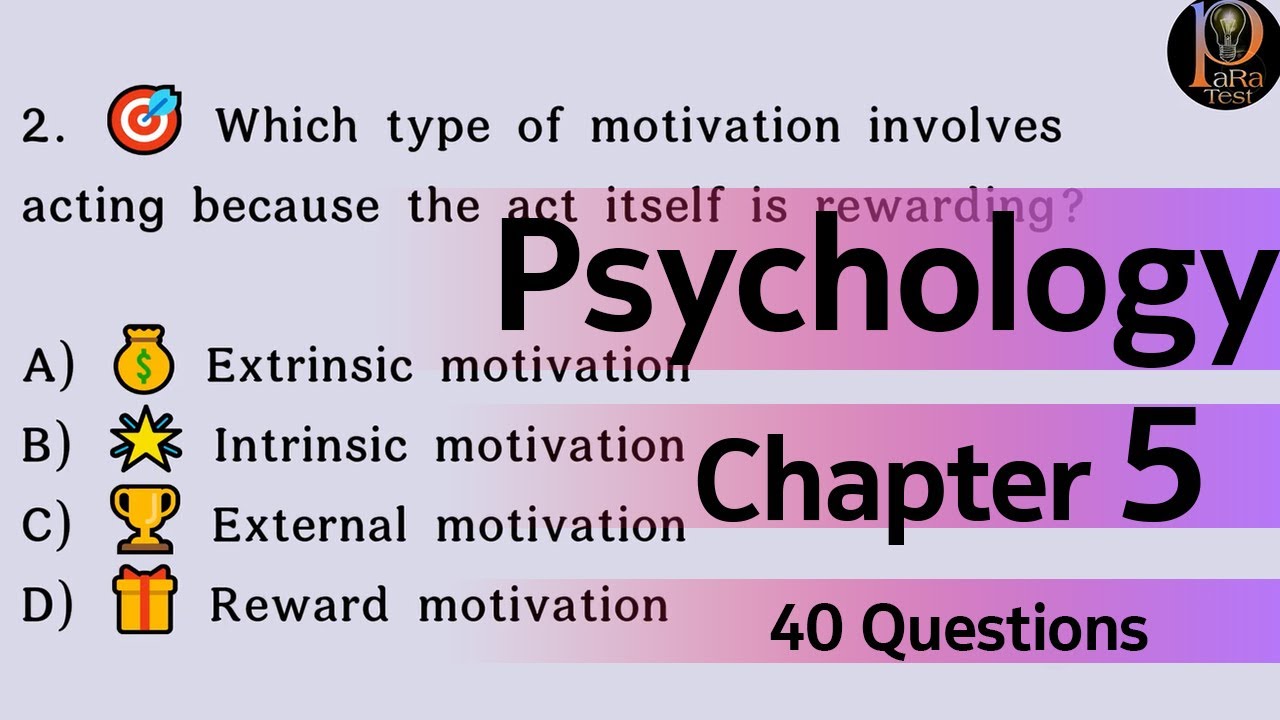
2. 🌟 Intrinsic motivation is defined as acting because the act itself is rewarding internally, while extrinsic involves external outcomes.
3. 💰 This example represents extrinsic motivation where external rewards (money) drive behavior, not internal satisfaction.
4. 🔬 Instinct approaches focus on biologically determined, innate patterns of behavior in both humans and animals.
5. ⚡️ A need is specifically defined as a requirement of material essential for organism survival, not desires or goals.
6. 🧠 Drive is the psychological tension that arises when an organism has a need, motivating behavior to reduce this tension.
7. 🏠 Primary drives involve basic survival needs like hunger and thirst, while secondary drives are learned.
8. 🎓 Secondary drives are acquired through experience or conditioning, such as need for money or social approval.
9. ⚖️ Homeostasis is defined as the body's tendency to maintain steady-state, like a thermostat keeping constant temperature.
10. 📊 Arousal approaches suggest people try to maintain optimal levels of stimulation, increasing when too low, decreasing when too high.
11. 🏆 Incentive approaches focus on external rewards and stimuli that "pull" behavior, contrasting with internal "push" of drives.
12. 🧠 Cognitive approaches emphasize thoughts, beliefs, expectations, and goals as sources of motivation.
13. 🌟 Acting because of love for teaching represents intrinsic motivation, as the activity itself provides satisfaction.
14. 🏠 Maslow's hierarchy states that physiological needs (food, water, shelter) must be satisfied before higher-level needs.
15. 🔒 Safety needs include security, order, law, stability, and freedom from fear - protection-related needs.
16. 👫 Love and belongingness involve social connections, friendship, intimacy, acceptance, and group membership.
17. 📊 Esteem needs are divided into self-esteem (dignity, achievement) and respect from others (status, prestige).
18. 🚀 Self-actualization involves realizing personal potential, self-fulfillment, and becoming everything one is capable of becoming.
19. 🎯 Approach-approach conflicts involve choosing between two desirable activities, like a movie or concert.
20. 😖 Avoidance-avoidance conflicts require selecting one of two undesirable alternatives, both being negative options.
21. 🎭 Approach-avoidance conflicts occur when one option has both attractive and unattractive features simultaneously.
22. 🌈 Multiple approach-avoidance involves several alternatives, each having both positive and negative characteristics.
23. 🚀 "motive" and "emotion" come from Latin meaning "to move."
24. 🔢 Emotion has three elements: physiology, behavior, and subjective experience.
25. ⚡️ Physiology of emotion involves sympathetic nervous system creating physical arousal like increased heart rate.
26. 😊 Behavioral component includes facial expressions, body movements, and actions that reveal feelings to others.
27. 🎯 Subjective experience involves interpreting and labeling feelings like anger, fear, happiness, etc.
28. ❤️ James-Lange theory states that physical arousal leads to emotional labeling: "I am afraid because I am aroused."
29. 🤝 Cannon-Bard theory proposes emotion and physiological arousal occur simultaneously, not sequentially.
30. ⚡️ Schachter-Singer requires both physical arousal and cognitive labeling based on environmental cues.
31. 🤝 The theory requires simultaneous physical arousal and cognitive interpretation of the situation to produce emotion.
32. 🧬 Instinct approach explains motivation through biologically determined, inherited behavioral patterns.
33. ⚡️ Libido is defined as instinctual energy from basic drives that creates psychological tension.
34. 📈 Arousal theory specifically explains why people sometimes seek to increase stimulation and excitement.
35. 🔄 drives "push" behavior while incentives "pull" behavior, working together rather than contradicting.
36. 💰 Studying for grades represents extrinsic motivation as it's driven by external rewards rather than love of learning.
37. 💝 Maslow's hierarchy shows love and belongingness needs must be satisfied before esteem needs can motivate behavior.
38. ⚖️ This represents approach-avoidance conflict as one decision (going out) has both positive aspects (fun) and negative (missed study time).
39. 🏷 Cultural differences primarily affect how emotions are labeled and interpreted, not the basic physiological responses.
40. 💭 Schachter-Singer theory emphasizes cognitive interpretation based on environmental cues to determine which emotion is experienced.
Доступные форматы для скачивания:
Скачать видео mp4
-
Информация по загрузке: