Disambiguate Pointer to Overloaded const Member Functions in C+ +
Автор: vlogize
Загружено: 2025-09-17
Просмотров: 0
Learn how to correctly disambiguate pointers to overloaded `const` member functions and operators in C+ + , including practical examples.
---
This video is based on the question https://stackoverflow.com/q/63091884/ asked by the user 'Alessandro Muntoni' ( https://stackoverflow.com/u/5851101/ ) and on the answer https://stackoverflow.com/a/63091936/ provided by the user 'HolyBlackCat' ( https://stackoverflow.com/u/2752075/ ) at 'Stack Overflow' website. Thanks to these great users and Stackexchange community for their contributions.
Visit these links for original content and any more details, such as alternate solutions, latest updates/developments on topic, comments, revision history etc. For example, the original title of the Question was: Disambiguate pointer to overloaded const member functions and member operator
Also, Content (except music) licensed under CC BY-SA https://meta.stackexchange.com/help/l...
The original Question post is licensed under the 'CC BY-SA 4.0' ( https://creativecommons.org/licenses/... ) license, and the original Answer post is licensed under the 'CC BY-SA 4.0' ( https://creativecommons.org/licenses/... ) license.
If anything seems off to you, please feel free to write me at vlogize [AT] gmail [DOT] com.
---
Understanding and Disambiguating Pointers to Overloaded Const Member Functions in C+ +
In C+ + , working with member functions and operator overloads can sometimes lead to confusion, particularly when it comes to overloaded functions. If you're working with a class that has overloaded member functions, the task of passing their addresses can present challenges. In this guide, we'll explore how to disambiguate pointers to overloaded const member functions and overloaded operators, using a compelling example.
The Problem
Let's consider a simple class, Point3, that represents a point in a three-dimensional space. This class has member functions that include operators and getters, which can lead to ambiguity when you need to pass their addresses as functional pointers. Here’s a quick overview of the class:
[[See Video to Reveal this Text or Code Snippet]]
As you can see, the Point3 class contains overloaded operators - and two versions of the x() member function. When you try to capture the address of these member functions using syntax like &Point3::operator- and &Point3::x, you are bound to run into issues.
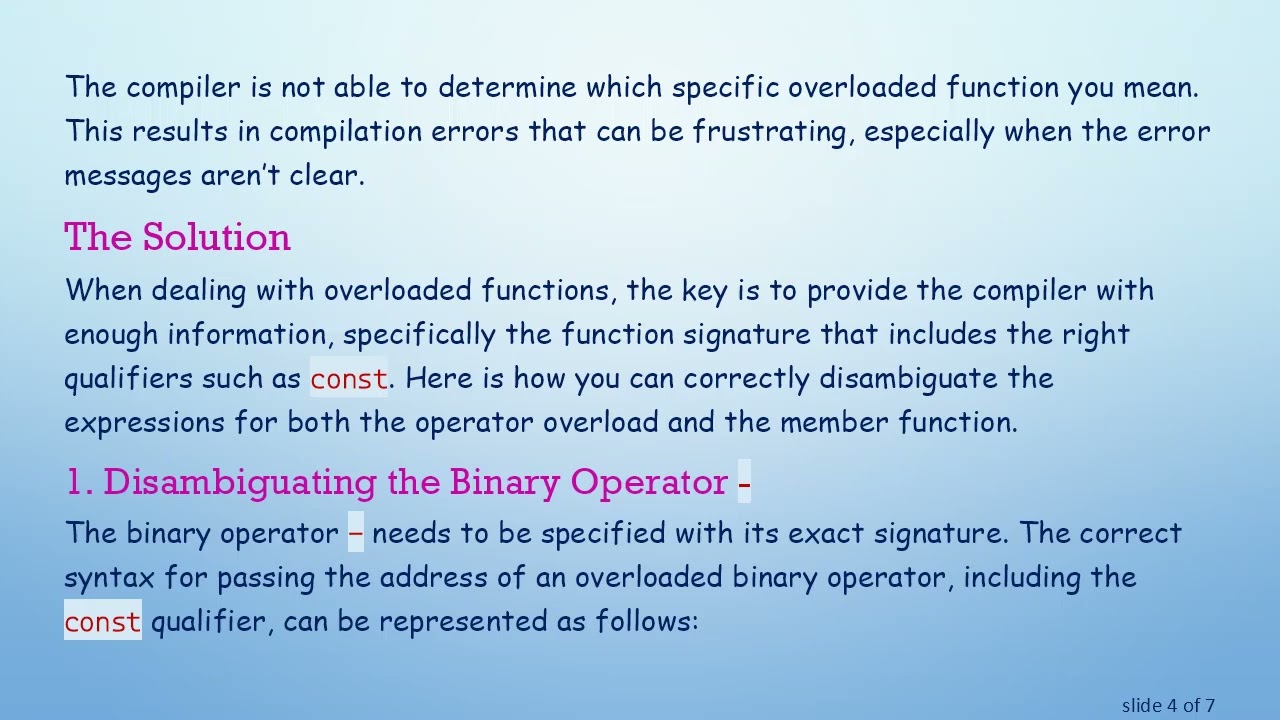
The compiler is not able to determine which specific overloaded function you mean. This results in compilation errors that can be frustrating, especially when the error messages aren’t clear.
The Solution
When dealing with overloaded functions, the key is to provide the compiler with enough information, specifically the function signature that includes the right qualifiers such as const. Here is how you can correctly disambiguate the expressions for both the operator overload and the member function.
1. Disambiguating the Binary Operator -
The binary operator - needs to be specified with its exact signature. The correct syntax for passing the address of an overloaded binary operator, including the const qualifier, can be represented as follows:
[[See Video to Reveal this Text or Code Snippet]]
Breakdown of the Signature:
Point3 (Point3::*): This states that we are dealing with a member function of Point3.
(Point3 const &): Indicates that the binary operator takes a reference to a constant Point3 object as a parameter.
const: Indicates that this operator will not modify the object upon which it is invoked.
2. Disambiguating the Getter Function x()
For the x() member function, you would similarly want to match the signature to the desired overload. Assuming you want to use the const version of the getter, the signature would look like this:
[[See Video to Reveal this Text or Code Snippet]]
Breakdown of the Signature:
(const float & (Point3::*)()): This specifies that x() returns a reference to a constant float.
const: Indicates that it is a member function which does not change the state of the Point3 object.
Conclusion
By specifying the exact signatures of the overloaded member functions and operators, you allow the compiler to correctly identify which function you intend to use. The process of disambiguation is crucial for any developer working with advanced C+ + features such as operator overloading and member function pointers.
Next time you encounter ambiguous overload errors, remember to pay attention to each function's signature details! Happy coding!
Доступные форматы для скачивания:
Скачать видео mp4
-
Информация по загрузке: