Understanding Java Recursion: Return Statements and State Management
Автор: vlogize
Загружено: 2025-08-26
Просмотров: 1
Dive into the workings of recursion in Java with this in-depth guide. Learn how return statements impact function behavior and understand stack frames for better coding practices.
---
This video is based on the question https://stackoverflow.com/q/64297761/ asked by the user 'Pirogov' ( https://stackoverflow.com/u/14427662/ ) and on the answer https://stackoverflow.com/a/64297903/ provided by the user 'Robert Harvey' ( https://stackoverflow.com/u/102937/ ) at 'Stack Overflow' website. Thanks to these great users and Stackexchange community for their contributions.
Visit these links for original content and any more details, such as alternate solutions, latest updates/developments on topic, comments, revision history etc. For example, the original title of the Question was: Java return with recursion function
Also, Content (except music) licensed under CC BY-SA https://meta.stackexchange.com/help/l...
The original Question post is licensed under the 'CC BY-SA 4.0' ( https://creativecommons.org/licenses/... ) license, and the original Answer post is licensed under the 'CC BY-SA 4.0' ( https://creativecommons.org/licenses/... ) license.
If anything seems off to you, please feel free to write me at vlogize [AT] gmail [DOT] com.
---
Understanding Java Recursion: Return Statements and State Management
Recursion is a powerful programming concept that is often both praised and feared by those learning languages like Java. It can simplify complex problems into manageable solutions, yet many beginners struggle to grasp how it works, particularly when it comes to return statements and the management of state during method calls.
The Problem: Confusion Around Return Values in Recursion
As a newcomer to Java, you might find yourself puzzled by the behavior of recursion functions, especially when it comes to maintaining the values of variables like n and k throughout the recursive calls. In the scenario you've described, with n starting at 0 and k at 10, understanding why n decreases to 9 upon returning can be confusing. Let's breakdown the example provided:
[[See Video to Reveal this Text or Code Snippet]]
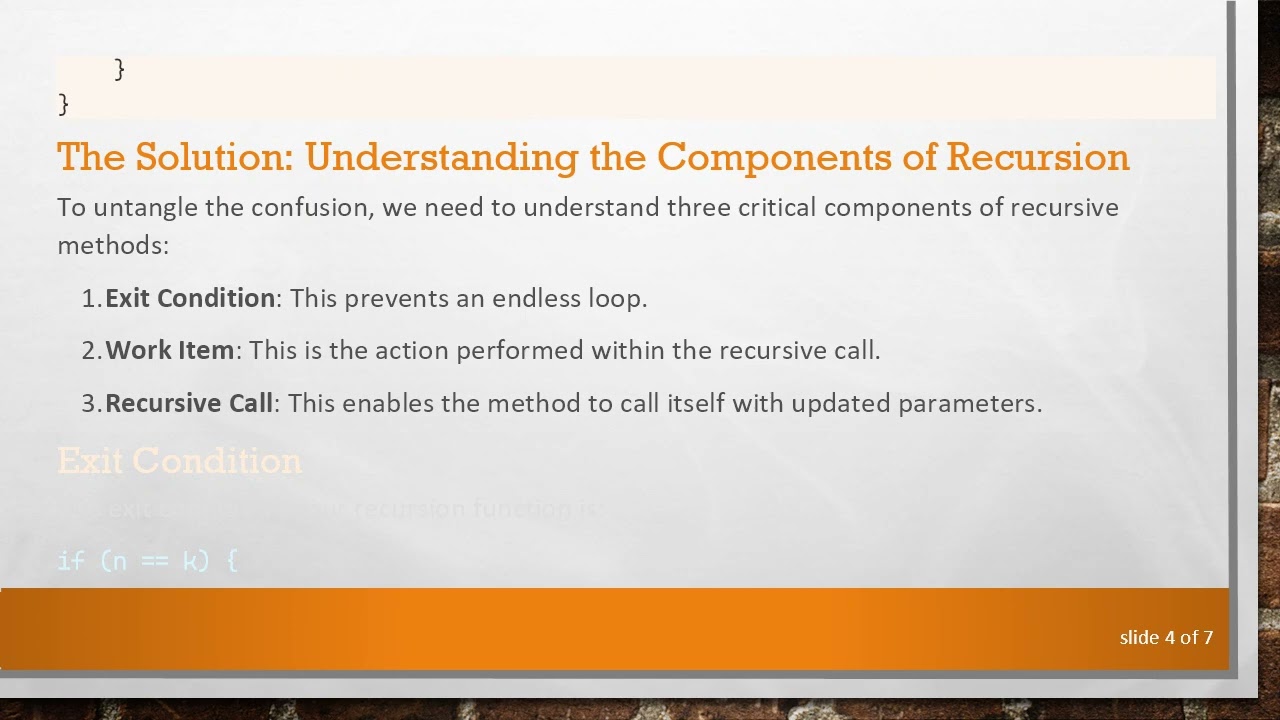
The Solution: Understanding the Components of Recursion
To untangle the confusion, we need to understand three critical components of recursive methods:
Exit Condition: This prevents an endless loop.
Work Item: This is the action performed within the recursive call.
Recursive Call: This enables the method to call itself with updated parameters.
Exit Condition
The exit condition in our recursion function is:
[[See Video to Reveal this Text or Code Snippet]]
This line checks whether n has reached k. If they are equal, the function returns, halting any further calls.
Work Items
Work items involve manipulating the parameters:
If n is less than k, the following occurs:
[[See Video to Reveal this Text or Code Snippet]]
Conversely, if k is greater than n, it changes as:
[[See Video to Reveal this Text or Code Snippet]]
Recursive Call
These lines invoke a recursive call:
[[See Video to Reveal this Text or Code Snippet]]
This is where the function runs again, but now with updated values of n or k.
Visualizing State with Stack Frames
A crucial concept to grasp in recursion is stack frames. When Java calls a method, it keeps track of its current state—including local variables and parameters—in a virtual 'stack'. Each recursive call creates a new stack frame, allowing the program to remember what each call's variables were, even if they are modified in subsequent calls.
Once a method completes, it returns by popping its stack frame off the stack, restoring the previous method’s state. This makes it easier to understand that changes to n and k are preserved separately across the different calls.
Key Takeaways
Last-In, First-Out (LIFO): Recursion operates like a stack of plates. Each new call creates a new stack frame on top until they resolve, and the last one added is the first one to finish.
Maintaining State: Each recursive function keeps a unique copy of its variables. This is why changing n to 9 doesn't affect the previous frame's n, allowing you to see 10 printed after the recursive call that increases n.
Understanding how recursion manages state and utilizes the stack can genuinely enhance your programming skills in Java. By breaking down the complexity into these manageable parts, you can begin to appreciate and use recursion effectively in your own projects.
Доступные форматы для скачивания:
Скачать видео mp4
-
Информация по загрузке:





![Python - Полный Курс по Python [15 ЧАСОВ]](https://image.4k-video.ru/id-video/cfJrtx-k96U)

