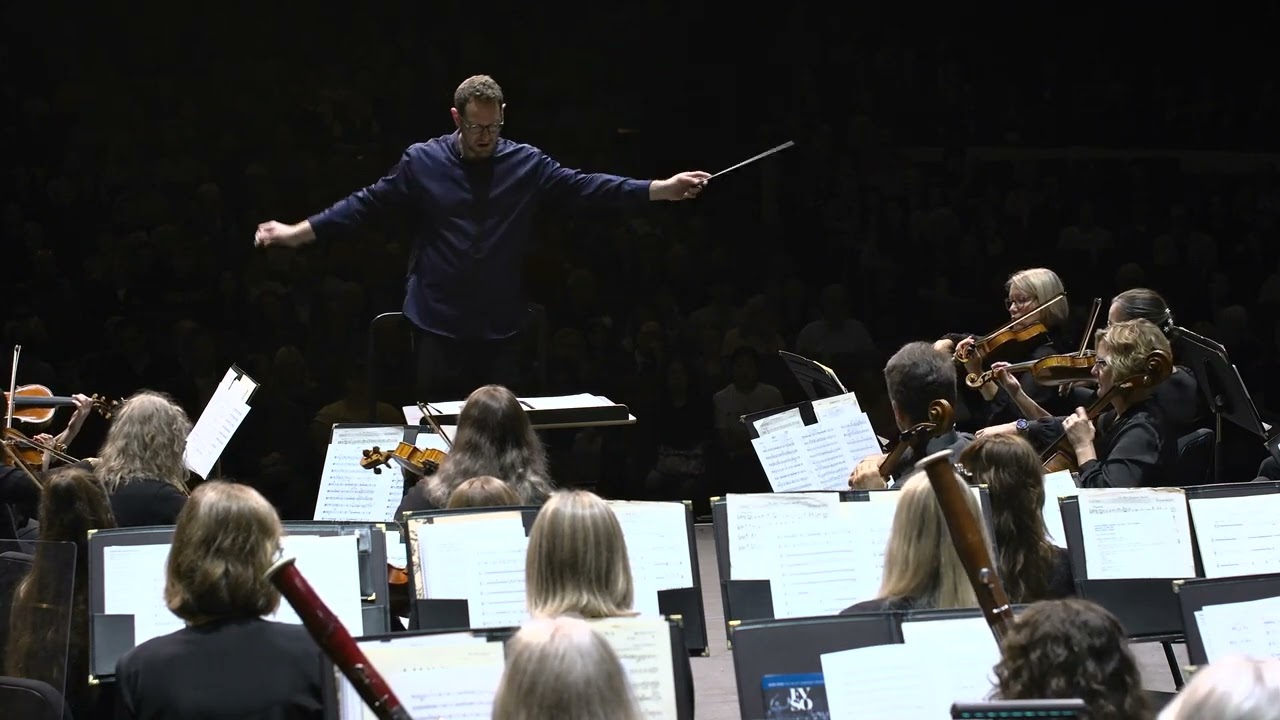
Brianna Ware: The Moirai | Fox Valley Symphony | Kevin Sütterlin
Автор: Kevin Sütterlin
Загружено: 2025-01-24
Просмотров: 325
Brianna Ware: The Moirai
Commissioned by April Ann and Kevin Sütterlin as a gift to the Fox Valley Symphony Orchestra, in honor of our dear friend and mother figure Danna Sue Browder Brown, who passed away on August 3, 2024 from a difficult cancer journey. “Momma Danna’s” bright, inimitable smile and laugh, her warm and love-filled hugs, her generous and kind spirit, and her sassy, witty sense of humor will always live on in our hearts.
World Premiere Performance
November 16, 2024. Fox Cities Performing Arts Center, Appleton, WI.
Program Note
The Morai is a programmatic work based on the ancient Greek myth of the “Morai,”more commonly known as “the Fates”. These weaving goddesses were named Clotho (“The Spinner”), Lachesis (“The Alloter”), and
Atropos (“The Inflexible”). The three daughters of Zeus and Themis were tasked with assigning destinies to mortals
at birth. “Clotho spun the thread of life, Lachesis measured its allotted length, and Atropos cut it off with her shears. Sometimes, each of the Fates was assigned to a specific period of time: Atropos – the past, Clotho –the present, and Lachesis – the future.”[1] The piece as a whole acts as an homage to the first movement of Ludwig van Beethoven’s
renowned Symphony No. 5. As a musical joke/ quote, I modified Beethoven’s famous “knocking on fate’s door” theme
(“bum bum bum bum”) and incorporated this new motive throughout the work. This motive acts as a nod to the past
while simultaneously pushing forward toward the future. The work opens triumphantly, sonically setting the location of this work on Mt. Olympus. The time has come for the
Morai to assign a destiny to a new human who is soon to be born into the world. Soon after the opening, the listener
can hear Lachesis measure out the life thread of the individual, represented by running sixteenth notes in the upper
woodwinds and strings. Following this, three solos can be heard: the first from the bassoon, second from the clarinet, and the final from the violin. Each of these solos is symbolic of a wail escaping the mouth of the mortal’s mother as she
is giving birth to her son. Each wail becomes more intense and with the final, extended exclamation in the violin, the human man is born. Following his birth, Clotho can be heard spinning the human’s life thread on her spinning
wheel. This motive can be heard in the harp’s (or piano/ celeste) undulating pattern and is emphasized in the first
sixteenth note of each grouping of four. Soft harmonic glissandi in the strings can be heard as the harp continues to play. These glissandi symbolize Lachesis measuring out the gossamer life threads of the man prior to handing them over to
Clotho to spin. As Clotho spins and the music continues, the human moves through life, aging from an infant to a
toddler; toddler to a boy; boy to a man. The music gradually gains speed as a musical representation of the man
continuing to age, drawing closer and closerto that ill-fated time when his life thread will be cut by Atropos. The work, along with the man’s life, reaches a sudden end, climaxing with violent rhythmic “cuts” in the winds and
first violins that symbolize Atropos' fateful scissors attempting to slice through the life thread. Furious glissandi in the
remaining strings and harp act as the man’s life thread fighting against the sharp blades of Atropos’ scissors, trying to
resist the shredding of its fibers. The work ends with the snapping of the man’s life thread, signaled by a ferocious
Bartok pizzicato in the strings paired with a loud crack of the slapstick.
Доступные форматы для скачивания:
Скачать видео mp4
-
Информация по загрузке: