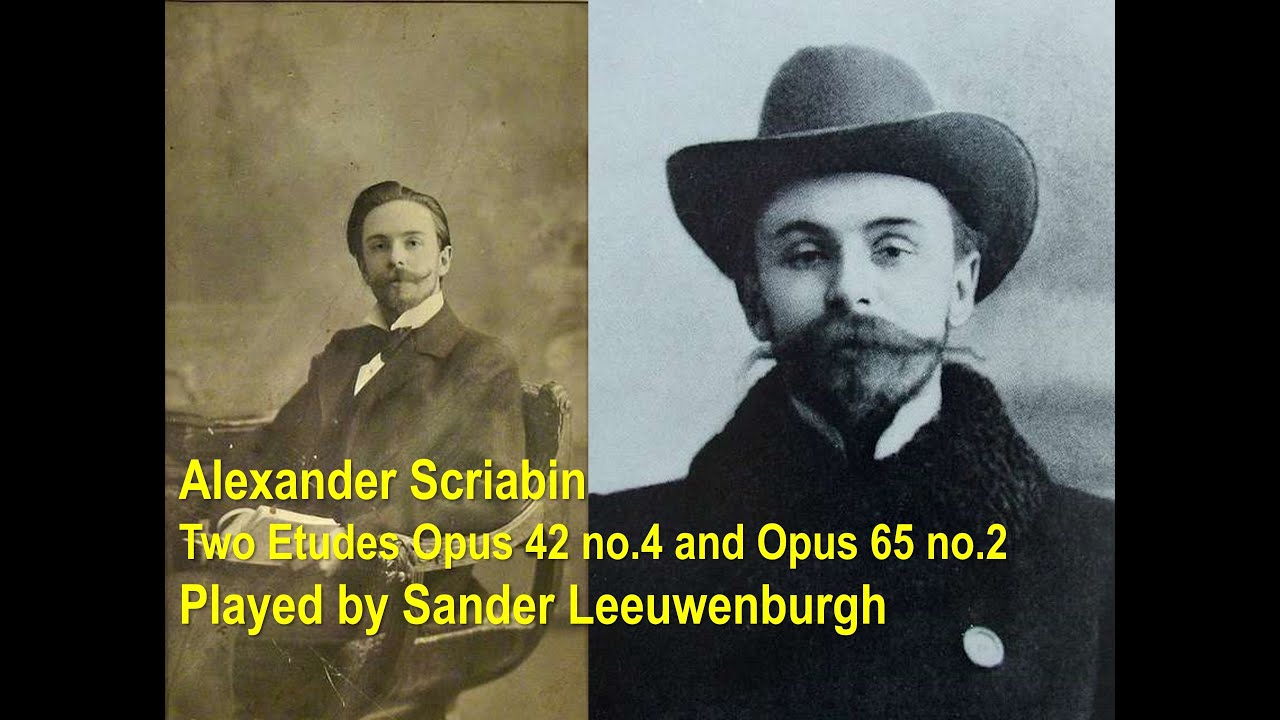
Alexander Scriabin: from romantic to mystic piano music: Studies (“Etudes”) op.42 no.4 & op.65 no2
Автор: Sander Leeuwenburgh
Загружено: 2024-10-26
Просмотров: 109
In 2004 I became deeply intrigued by the dramatic evolution of Russian composer Alexander Scriabin, who moved within less than 10 years from the lush, Romantic tonalities of the early 1900s into an entirely new harmonic language challenging the traditional tonal system by the 1910s. This video illustrates Scriabin’s shift from late-Romantic Etude Op.42 no.4 toward his unique late style characterized by harmonic experimentation, unique intervals, and a deep philosophical commitment to mystical themes in Etude Op. 65 nr2 (composed in 1912).
Composed in 1903, Etude Op. 42 no.4 stands as a beautiful example of Scriabin's middle period, during which he was beginning to move beyond traditional harmony. The piece is set in F-sharp major and opens with a bittersweet melody that weaves through a tapestry of cross-rhythms, creating a wistful yet intensely expressive character. In this phase of his career, Scriabin’s compositions were still rooted in Romanticism heavily influenced by Chopin and Rachmaninov.
On the contrary, Scriabin’s Étude Op. 65 no. 2 showcases the composer in a drastically different light. The Opus 65 collection of Etudes ( ‘studies”) reflects Scriabin’s deepening fascination with mysticism, theosophy, and synesthesia-a technique that he believed linked color and sound. This era of Scriabin’s life was marked by an ambition to create a world of sound so intense it would stimulate a spiritual revolution. This etude marks his departure from traditional harmony into a realm where the dissonant interval of a major seventh forms the harmonic foundation. By exploring dissonance and atypical intervals, Scriabin harnesses tension to capture what he described as "the horrifying…perverse…sacrilegious" nature of these intervals. Etude Op. 65 no.2 is built around a series of major sevenths, the most dissonant interval which was to be avoided in traditional harmony, which Scriabin explores as an expressive harmonic tool. His unique approach results in a shimmering, hypnotic sound that is far removed from the tonally centered F-sharp major of Op. 42 no.4.
0:00 Etude Op. 42 no.4
2:47 Etude Op. 65 no.2
Recording date: June 10th 2004
Recording location: Studio Edgetip Arnhem
Pianist: Sander Leeuwenburgh
Photo credits: all images from public domain (Creative Commons)
Доступные форматы для скачивания:
Скачать видео mp4
-
Информация по загрузке:







![[4K] 마르크-앙드레 아믈랭 (Marc-André Hamelin) :: 슈만 - 숲의 정경, Op.82 :: R. Schumann - Waldszenen, Op.82](https://imager.clipsaver.ru/YvN3XxJM5G4/max.jpg)
