TCP/IP for Automation Engineers | OSI Mapping, IP/ARP/Ping Truth, TCP vs UDP, FTP/TFTP/Telnet
Автор: Engineering Design, Project Management
Загружено: 2026-01-12
Просмотров: 13
Networking feels “local” until it suddenly isn’t.
Up to now, your mental model has been plant-floor scale: bus, ring, star, panels, segments, shared media.
TCP/IP is where networking stops being local and starts being infrastructure. This is the moment automation systems stop thinking like wiring diagrams and start thinking like scalable systems.
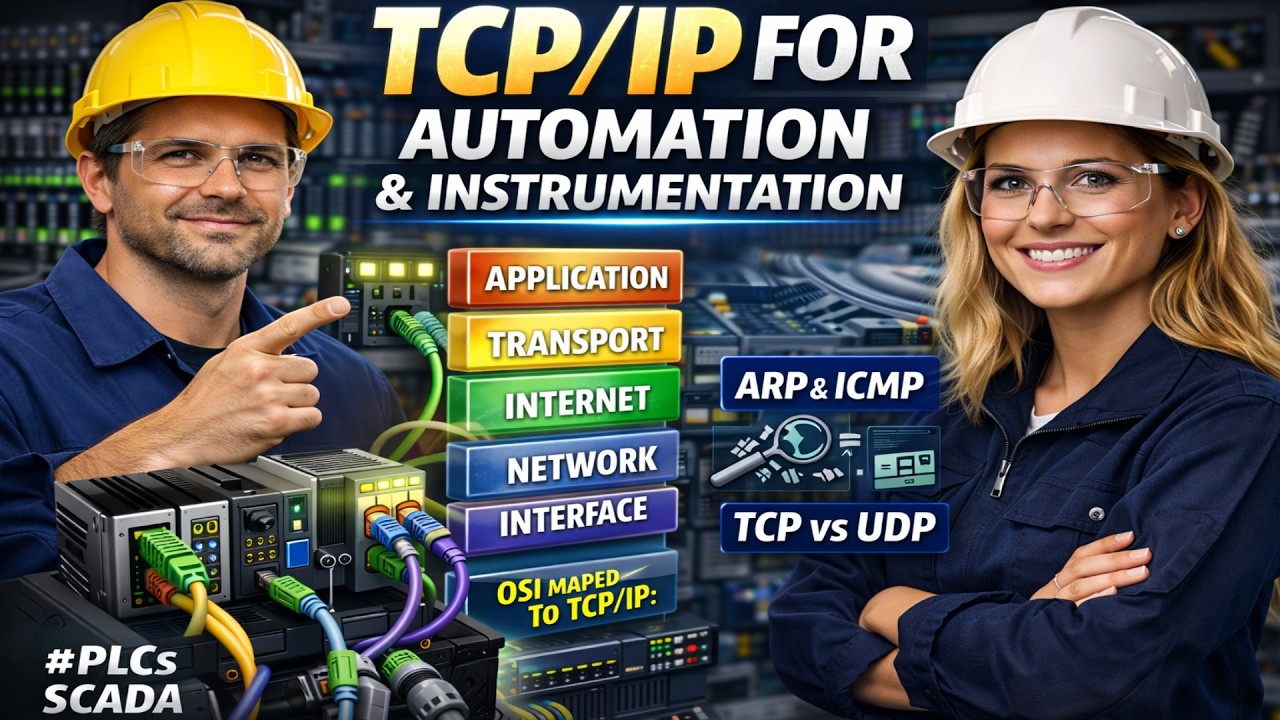
In Module 5: TCP/IP for Automation and Instrumentation, I explain TCP/IP the way an automation engineer needs it—without drowning in IT theory—by mapping it directly to the OSI model you already understand.
What you’ll learn in this module
✅ TCP/IP vs OSI (4 layers, same responsibilities)
TCP/IP compresses OSI’s seven layers into four opinionated layers that actually scale:
Network Interface (OSI Physical + Data Link): Ethernet, MAC, frames, switches
Internet Layer (OSI Network): IP addressing, subnets, routing, gateways
Transport Layer (OSI Transport): TCP vs UDP—reliability vs timeliness
Application Layer (OSI Session/Presentation/Application): where engineering work happens
✅ IP, ARP, ICMP: what Ping proves (and what it doesn’t)
You’ll learn why a device can reply to ping and still fail every automation protocol above it.
Ping proves reachability, not usability—and that distinction saves hours in commissioning and troubleshooting.
✅ TCP vs UDP: reliability vs speed (the control philosophy decision)
TCP protects correctness: acknowledgements, ordering, retransmissions
UDP protects timeliness: low overhead, no retries, “fresh beats perfect”
You’ll learn where each belongs in automation: configuration, diagnostics, historian traffic, cyclic updates, streaming measurements, and real-time behaviors.
✅ Application layer protocols that still run plants
FTP: correctness-first file transfers (programs, configs, firmware packages)
TFTP: lightweight boot/firmware workflows for constrained devices
Telnet: raw visibility for diagnostics when tools fail and you need the truth
The mental model to keep
If you don’t know the layer, you reboot everything.
If you know the layer, you fix the problem.
And once packets can travel anywhere, the next question becomes unavoidable:
How do we keep automation traffic reliable when the network spans plants, sites, and WAN links?
#TCPIP
#AutomationEngineering
#InstrumentationEngineering
#IndustrialNetworking
#OTNetworking
#SCADA
#PLCNetworking
#EthernetNetworking
#OSIModel
#IPSubnetting
#ARP
#ICMP
#TCPvsUDP
#FTP
#TFTP
#Telnet
Доступные форматы для скачивания:
Скачать видео mp4
-
Информация по загрузке: