PyOR: A Versatile Magnetic Resonance Simulator | Dr. Vineeth Francis Thalakottoor | Session 105
Автор: Global NMR Discussion Meetings
Загружено: 2025-09-29
Просмотров: 188
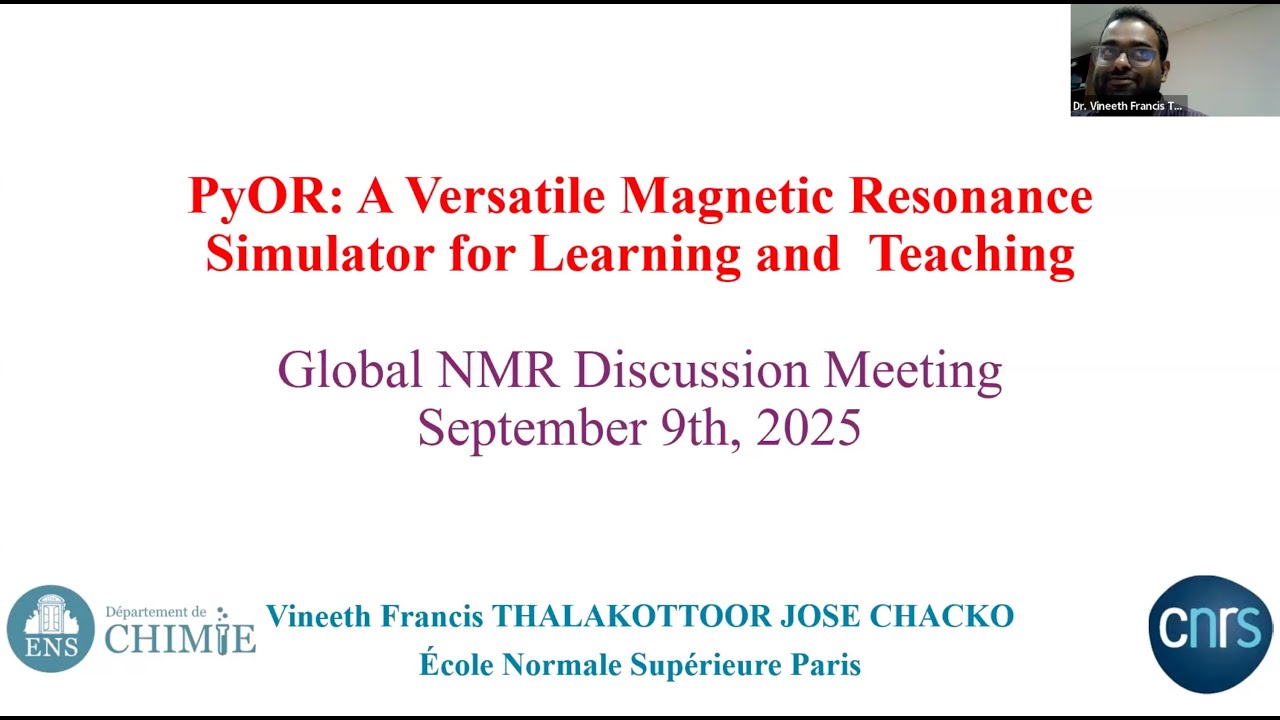
During the 105th session of the Global NMR Discussion Meetings held on September 9th, 2025, via Zoom, Dr. Vineeth Francis Thalakottoor from the ENS Paris, France, gave a talk on the topic " PyOR: A Versatile Magnetic Resonance Simulator for Learning and Teaching". The recording serves as a tutorial.
Find out more about Dr. Vineeth Francis Thalakottoor's research :
https://scholar.google.com/citations?...
Abstract:
Python On Resonance (PyOR) is an open-source, object-oriented simulation package for exploring magnetic resonance phenomena in both liquid- and solid-state systems. Originally developed to model nonlinear NMR effects such as radiation damping and maser dynamics, PyOR has since evolved into a versatile and user-friendly framework. It enables users to learn, simulate, and visualize various NMR experiments, making it accessible to beginners from diverse backgrounds, including physics, chemistry, and biology.
Its modular architecture emphasizes clarity and readability, enabling users to directly link textbook-level formulations of spin dynamics with their computational realization. The package is organized into specialized modules that address key aspects of magnetic resonance theory and practice, including the generation of spin operators and Hamiltonians, the simulation of quantum mechanical time evolution, the modeling of nonlinear effects such as radiation damping and maser dynamics, the incorporation of relaxation mechanisms, and the visualization of results.
PyOR is easy for students to start using, thanks to its clear design and many Jupyter Notebook examples, while still being flexible enough for advanced research.
https://github.com/VThalakottoor/PyOR
Content of this video :
00:00 - 08:05 Introducing PyOR : Purpose and features
08:06 - 28:29 Example : Pulse - Acquisition
28:30 - 36:43 Example : NOE (2 spin system)
36:44 - 49:42 Other features (Radiation Damping, MASER, Shaped Pulse, CSA)
49:43 - 1:00:12 Q&A
Current organizers:
Adrian Draney (Creighton Uni.)
Amrit Venkatesh (University of Virginia)
Asif Equbal (New York Uni., Abu Dhabi)
Blake Wilson (Robert Tycko Lab, NIH)
Charlotte Bocquelet (HMRLab, CRMN Lyon)
Diganta Sarkar (Alberta Uni.)
Julie Buhl (Uni. JKU Linz)
Marcel Levien (Emsley Lab, EPFL)
Mengshan Ye (Miller Institute, UC Berkeley)
Michael Hope (Warwick Uni.)
Mouzhe Xie (Arizona State Uni.)
Nikita Rao (Indian Institute of Science, Bangalore)
Nesreen Elathram (Debelouchina Lab, UCSD)
Tamali Nag (Uni. of Lille/Grenoble)
Доступные форматы для скачивания:
Скачать видео mp4
-
Информация по загрузке: