Day 26 : Random Projection Indexing Explained: Faster Similarity Search for AI
Автор: Cloud and Coffee with Navnit
Загружено: 2026-01-19
Просмотров: 4
In this video, we dive deep into the Principles and Mechanics of Random Projection Indexing, a powerful technique used to handle the "curse of dimensionality" in modern AI and data science.
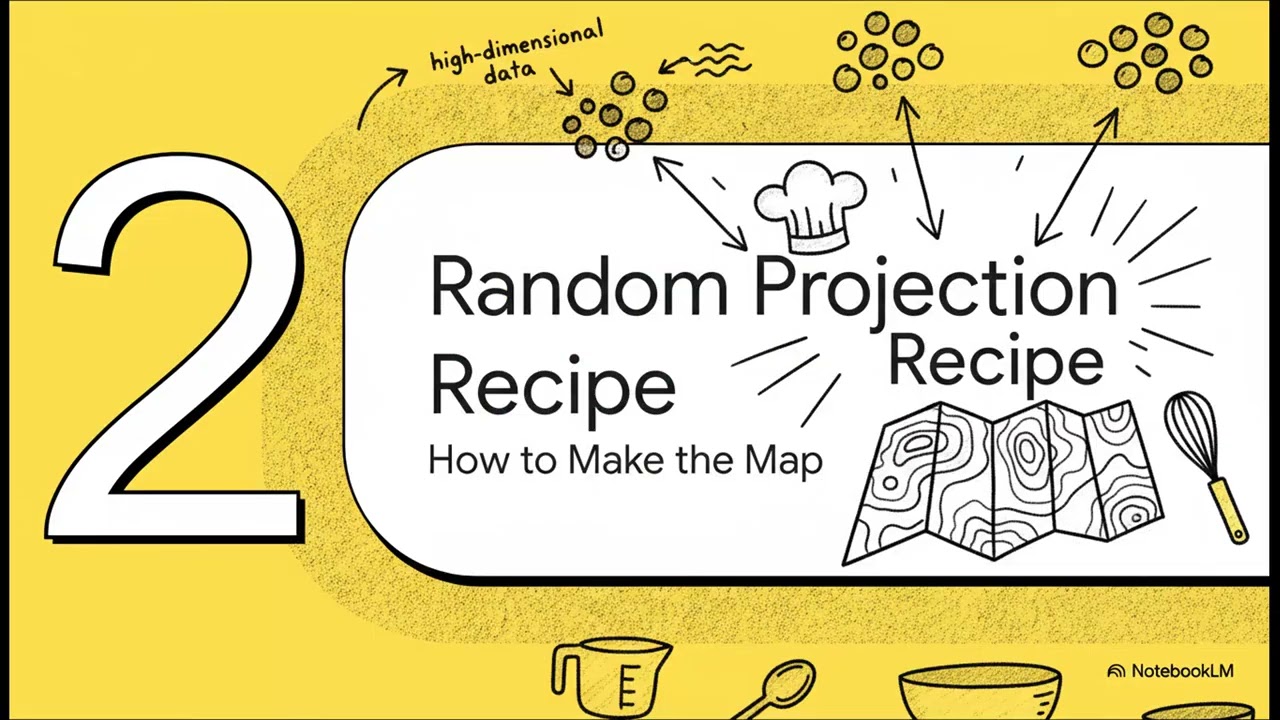
What is a Random Projection Index? A Random Projection Index is a dimensionality reduction technique primarily used in approximate nearest neighbour (ANN) search. Its main goal is to significantly speed up similarity queries within high-dimensional vector spaces by projecting those vectors into a lower-dimensional space while approximately preserving the distances between points.
How it Works (Step-by-Step): We break down the four-stage process of indexing:
1. Generate a Random Matrix: Each row represents a random direction in high-dimensional space.
2. Project Vectors: Multiply the original vector by the random matrix to create a lower-dimensional version.
3. Index the Vectors: Use these smaller vectors for the similarity search.
4. Query-time: New queries are projected using the same matrix for comparison against the index.
The Theory: The Johnson–Lindenstrauss Lemma Why does this work? It is based on the Johnson–Lindenstrauss lemma, which suggests that distances between points are likely to be preserved even when projected into lower dimensions. This helps developers reduce computation costs and manage high-dimensional data efficiently.
Pros and Cons of Random Projection: While this method is simple to implement, fast, and requires less memory than other techniques, it does have its trade-offs.
• Benefits: Excellent for sparse or high-dimensional data.
• Limitations: It is generally less accurate than complex indexes like HNSW or IVF and may require multiple projections to ensure better recall. It is also not ideal for dense or highly clustered data.
(Note: The following section regarding specific software implementation or coding examples is not from the sources and should be independently verified for your specific use case.)
Timestamps: 0:00 - Introduction to Random Projection 1:15 - How Random Projection Indexing Works 2:45 - The Johnson–Lindenstrauss Lemma 4:10 - Dimensionality Reduction & Computation Costs 5:30 - Comparing Random Projection vs. HNSW & IVF 7:00 - Use Cases: Sparse vs. Dense Data
If you found this video helpful, please like, subscribe, and follow my 150-day journey into the world of AI!
#AI #MachineLearning #VectorSearch #DataScience #RandomProjection #ANN #DimensionalityReduction #150DaysOfAI
Доступные форматы для скачивания:
Скачать видео mp4
-
Информация по загрузке: