valence electron | valence shell| inertness of noble gas| cause of chemical combination
Автор: pankaj yadav
Загружено: 2025-12-21
Просмотров: 7
The outermost electron shell of an atom is known as valence shell.
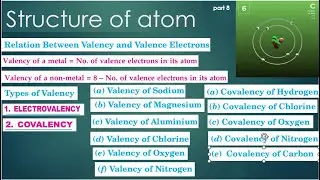
The electrons present in the outermost shell of an atom are known as valence electrons (or valency electrons) because they decide the valency (combining capacity) of the atom.
Only the valence electrons of an atom take part in chemical reactions because they have more energy than all the inner electrons of the atom.
The atomic number of sodium is 11, which means that one sodium atom has 11 electrons in it.
So, the electronic configuration of sodium atom will be K L M .
In the sodium atom, M shell is the outermost shell or valence shell.
There is 1 electron in the outermost shell of sodium atom, therefore, sodium atom has 1 valence electron.
When a sodium atom combines with other atoms, only its one valence electron (in the M shell) takes part in chemical reactions.
The electrons of two inner shells (K shell and L shell) of the sodium atom never take part in chemical reactions.
those electrons of an atom which take part in chemical reactions are called valence electrons.
Valence electrons are located in the outermost shell of an atom.
In a chemical reaction, valence electrons of an atom are either transferred to the valence electrons of another atom, or shared with the valence electrons of another atom
The elements Hydrogen, Lithium, Sodium and Potassium have 1 valence electron each in their atoms.
The elements Helium, Beryllium, Magnesium and Calcium have 2 valence electrons each in their atoms.
The elements Boron and Aluminium have 3 valence electrons each in their atoms.
The elements Carbon and Silicon have 4 valence electrons each in their atoms.
The elements Nitrogen and Phosphorus have 5 valence electrons each in their atoms.
The elements Oxygen and Sulphur have 6 valence electrons each in their atoms.
The elements Fluorine and Chlorine have 7 valence electrons each in their atoms.
The elements Neon and Argon have 8 valence electrons each in their atoms.
In order to find out the number of valence electrons in an atom of the element, we should write down the electronic configuration of the element by using its atomic number.
The outermost shell will be the valence shell and the number of electrons present in it will give us the number of valence electrons.
There are some elements which do not combine with other elements.
These elements are : Helium, Neon, Argon, Krypton, Xenon and Radon.
They are known as noble gases or inert gases because they do not react with other elements to form compounds.
We know that only the outermost electrons of an atom take part in a chemical reaction.
Since the noble gases are chemically unreactive, we must conclude that the electron arrangements in their atoms are very stable which do not allow the outermost electrons to take part in chemical reactions.
we find that only one inert gas helium has 2 electrons in its outermost shell, all other inert gases have 8 electrons in the outermost shells of their atoms.
We know that the outermost shell of an atom can accommodate a maximum of 8 electrons (except when the outermost shell is K shell and it can hold only a maximum of 2 electrons).
This means that all the noble gases have completely filled outermost shells.
Since the atoms of inert gases are very stable and have 8 electrons in their outermost shells, therefore, to have 8 electrons in the outermost shell of an atom is considered to be the most stable arrangement of electrons.
To have ‘8 electrons’ in the outermost shell of an atom is known as ‘octet’ of electrons.
Most of the inert gases have octet of electrons in their valence shells.
From this discussion we conclude that the atoms having 8 electrons (or octet of electrons) in their outermost shell are very stable and hence chemically unreactive.
Please note that 2 electrons in the outermost shell is considered to be a stable arrangement of electrons only when the atom has just one shell, K shell, and there are no other electron shells in the atom.
To have ‘2 electrons’ in the outermost K shell is known as ‘duplet’ of electrons.
Helium is the only inert gas having a duplet of electrons in its outermost shell.
It is very important to note here that though 8 electrons in the outermost shell always impart stability to an atom, but 2 electrons in the outermost shell impart stability only when the outermost shell is the first shell (K shell), and no other shells are present in the atom.
It should be noted that noble gases are unreactive because they have very stable electron arrangements with 8 (or 2) electrons in their outermost shells.
In other words, the noble gas atoms have completely filled outermost shells.
It is not possible to remove electrons from the outermost shell of a noble gas atom or to add electrons to the outermost shell of a noble gas atom.
Due to this the outermost electrons of a noble gas atom cannot take part in chemical reactions.

Доступные форматы для скачивания:
Скачать видео mp4
-
Информация по загрузке:


![What is a Plasma? Is it the 4th State of Matter? - [5]](https://image.4k-video.ru/id-video/WVYJQucn2yU)


![Суть линейной алгебры: #14. Собственные векторы и собственные значения [3Blue1Brown]](https://image.4k-video.ru/id-video/khMBBxLJLcw)

