Y13 A2 CHEMISTRY: WHY DOES IODINE TURN PURPLE IN AN ORGANIC LAYER?
Автор: Knightbus Science
Загружено: 2024-11-13
Просмотров: 459
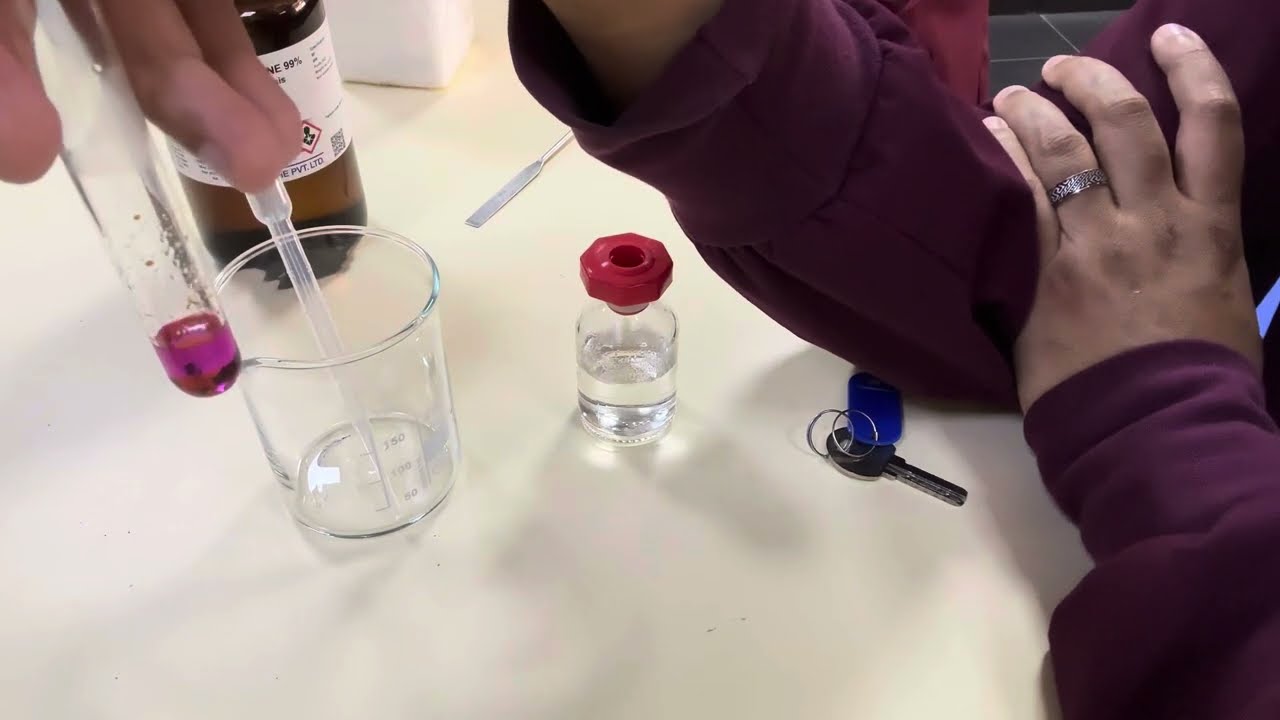
This is a clip from one of my lessons, filmed live with y13 A-Level chemistry students. They had just completed their studies on electrochemistry. I used the opportunity to delve a little deeper into the quantum mechanics of the atoms and how favourable interactions between non-polar molecules could raise the energy gap within molecules and ultimately shift the wavelengths of light as electrons move between specific energy levels within the iodine molecules themselves, causing a change in colour.
When iodine appears brown in water, it’s because it absorbs higher wavelengths (lower energy) than it does in non-polar solvents.
Absorption and Appearance: The colour we see is due to the wavelengths that iodine does not absorb. In other words, we see the complementary colour of the absorbed light.
Effect of Polar Solvents on Absorption: In a polar solvent like water, the interactions with the solvent reduce the energy gap between the HOMO (Highest Occupied Molecular Orbital) and LUMO (Lowest Unoccupied Molecular Orbital). This reduced gap means that iodine absorbs light at lower energy, which corresponds to longer wavelengths (in the yellow or brown part of the spectrum) compared to when it is in a non-polar solvent.
Observed Colour in Polar Solvents: Since iodine in water absorbs longer wavelengths (yellow-brown region), it transmits and reflects the complementary colours, which are toward the blue-purple part of the spectrum. However, because the absorption is broad and not specific to a single wavelength, the result is a brownish colour rather than a pure blue or purple.
Non-Polar Solvent (Organic) Case: In a non-polar solvent, iodine’s energy gap is larger, so it absorbs shorter wavelengths (higher energy), closer to the violet end of the spectrum. This leaves the complementary colour (purple) as the colour we observe.
In summary:
In Non-Polar Solvents (e.g., cyclohexane)
• Colour absorbed: Iodine absorbs light in the yellow-green region of the spectrum.
• Wavelength range absorbed: Approximately 500–570 nm.
• Observed colour: Since the yellow-green wavelengths are absorbed, the complementary colour, purple, is what we see.
In Polar Solvents (e.g., water)
• Colour absorbed: Iodine absorbs light in the yellow-brown region of the spectrum.
• Wavelength range absorbed: Approximately 570–700 nm.
• Observed colour: With yellow-brown wavelengths absorbed, the complementary mix of colours results in a brown appearance.
The change in solvent affects which part of the spectrum is absorbed, and thus the colour we observe.
Доступные форматы для скачивания:
Скачать видео mp4
-
Информация по загрузке: